


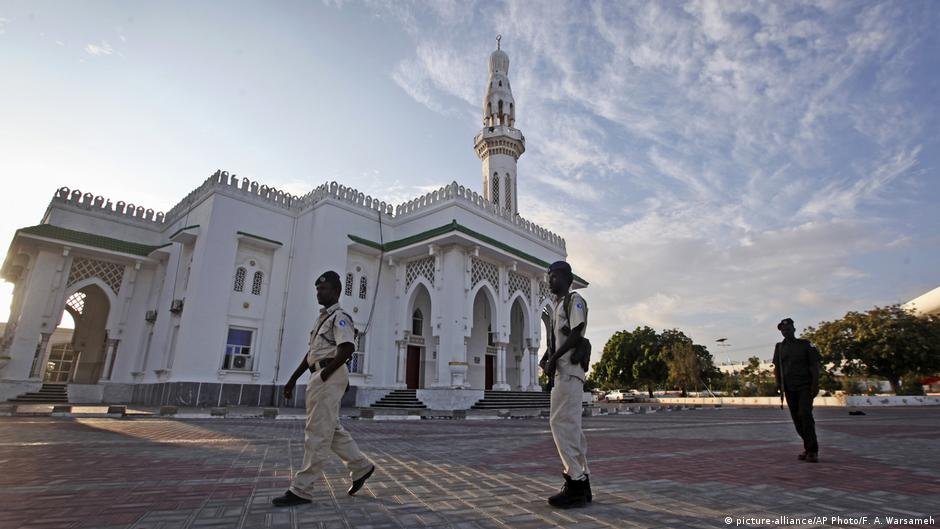
In November, Djibouti’s largest mosque, the Abdul Hamid II Mosque, was inaugurated. This mosque in Djibouti City is huge, measuring 13,000 square meters (140,000 square feet) and seating 6,000 people. The two minarets are 46 meters (152 feet) high. The walls are decorated with classic Ottoman calligraphy. The dome is covered with gilded copper sheets, and the huge chandelier inside is reminiscent of the lighting in Turkish mosques.
Djibouti’s new landmark was funded by the Turkish Religious Directorate. Officials consider the mosque, which they call Diyanet, a sign of strengthening ties between Djibouti and Turkey. Most of the materials were imported from Türkiye, including the cream-colored natural stone in the prayer room. In 2015, Djibouti President Ismail Omar Guelleh told Turkish President Recep Tayyip Erdoğan that he wanted an Ottoman-style mosque. “Turkey wants to establish itself as an Islamic power, just as Saudi Arabia has for decades,” Abdoulaye Sunaie, a Nigerien-born anthropologist at the Center for Contemporary Oriental Research in Berlin, told DW.
Turkey is investing millions of dollars in efforts to increase its influence across Africa. For more than 40 years, Diyanet has financed the construction of more than 100 mosques and educational institutions in 25 countries around the world, including the African countries of Djibouti, Ghana, Burkina Faso, Mali and Chad. Turkey is also involved in the renovation of mosques in South Africa and the construction of the Nizamiye Mosque, the largest in the southern hemisphere. Turkey also cooperated in the renovation of the Islamic Solidarity Mosque in Mogadishu, the capital of Somalia. It is the largest mosque in the Horn of Africa and can accommodate up to 10,000 believers.
“This is how countries build their reputations and show people, ‘You can trust us, we have the resources at your fingertips,'” Sunaye said. Now you can find big, shiny mosques like that even in places where electricity is not even guaranteed.
“Salafist trends”
The Islamic Solidarity Mosque was originally built in 1987 with funds from Saudi Arabia’s Sultan bin Abdulaziz Al Saud Foundation. “Saudi Arabia has been investing in Niger, Nigeria and Mali for 10 to 20 years,” Sunayeh said. “In this way, they create a space for a particular theological interpretation of Islam, especially here the Salafi tendency.” Salafism is a particularly strict interpretation of Islam when some Sunni Muslims practice it. Based on the early ideals of Islam, Salafims do not accept Sufism or other more tolerant faith doctrines that are widespread in Africa.
“All forms of ideology can be spread in mosques,” said Bakary Sambé, director of the Timbuktu Institute think tank in Senegal’s capital Dakar, which studies radicalization and religious conflict in Africa. “Influence and power are gained through religion.”
Like Türkiye and Saudi Arabia, Qatar and Iran recognize the potential for religion to influence African countries. Sambé said Iran has built mosques in Senegal, Ivory Coast, Guinea and other countries. “This is a competition between the great powers of the Middle East,” Sambé said. For example, he added, Saudi Arabia is building more mosques in Nigeria to counter the Shiite Islam that Iran is trying to spread and “to keep the population Salafist.” Shiite Muslims are a minority in Nigeria and say they often feel oppressed.
A site of radicalization?
Sunayeh criticizes the fact that building a mosque often requires only financial investment. “Until recently, anyone with the means could build a mosque in Niger,” he says. “There were no restrictions.” The country in the Sahel region is home to more than 21 million people, 99% of whom are Muslim. “Since 1990, mosques have been the most controversial site in Niger,” Sunayeh said. One of the main reasons is the rise of Salafism, he added. “Saudi Arabia built a mosque in Niger. A Nigerian student was trained as an imam in Saudi Arabia. In recent years, he has played a leading role in a mosque in Niger. This is important in supporting Salafism,” he said.
Religious violence is a serious problem in Africa. “Since the 1990s, Salafism has been increasingly supported by Saudi Arabia, and there have been more and more conflicts,” Sunayeh said. In Nigeria, radicalization is helping the terrorist militia Boko Haram. “Their former leader Mohammed Yusuf used his mosque to spread jihadi ideology. Saudi Arabia’s support led to the emergence of Salafi trends.”
In Mali and Niger, Sufi Muslims – considered to be tolerant, spiritually minded and ascetic – are particularly vulnerable, Sambé said, adding that “Salafis aim to destroy them”. Despite the overwhelming number of Sufis and their strong traditions and deep roots, Salafism has gained the upper hand thanks to Saudi financial support, Sambeh said. The country has long denied official cooperation with the Salafis, which Sambe said was a strategy of “double diplomacy”. “The state says it is not cooperating with these extremist movements,” Sambe said. “But wealthy private organizations continue to fund these mosques.”
Morocco has also become increasingly active in religious diplomacy in Africa, establishing in 2015 the Mohammed VI Institute to train imams to counter extremist ideologies in the Sahel with a moderate version of Islam. The institute primarily trains imams from West African countries such as Burkina Faso, Ivory Coast and Guinea. There were 500 scholarship recipients in Mali alone. Imams say Morocco is supporting them after their studies by building mosques and rebuilding those that were destroyed. It is said that it is done carefully and does not require a grand building.
DW brings you a selection of the day’s news and features. Sign up here.
