


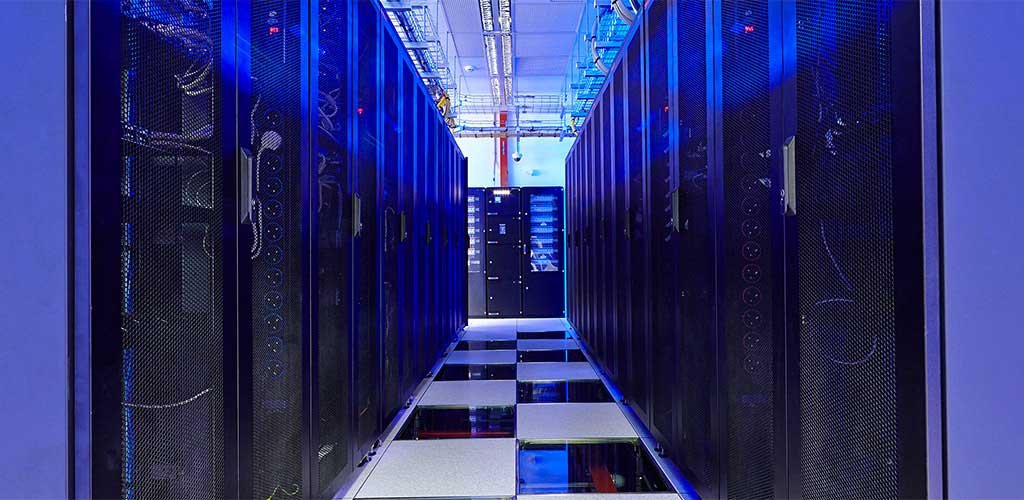
Artificial intelligence often appears in public conversations as software. Chatbots, automation tools, and predictive engines. Visible layer. What gets less attention is the physical reality underneath: a warehouse of machines receiving power, cooling themselves from equatorial heat, and processing vast amounts of data every second. Without that tier, the remaining capacity remains borrowed.
The data center map lists 19 data centers in Kenya. Only two are considered capable of handling the computational demands associated with artificial intelligence workloads. In total, we have 60 data centers in South Africa, 5 of which have comparable functionality. There are 22 facilities in Nigeria, but only one that meets similar requirements. The numbers themselves are modest. It looks even smaller against the backdrop of global infrastructure.
10,793 data centers in 174 countries are listed. Nearly 40 percent live in the United States. There are 498 in the UK and 470 in Germany. These concentrations are no coincidence. These reflect decades of capital accumulation, stable power systems, proximity to chip suppliers, and the presence of cloud companies building at huge scale because the demand already exists.
Africa’s challenges are more structural. The continent is entering the AI era without the dense physical backbone that routinely performs large-scale computations elsewhere.
AI is not software first. It’s electricity, land, and capital.
The popular imagination treats artificial intelligence as something abstract. In reality, it behaves more like heavy industry. Training large language models requires specialized processors, high-speed networks, and uninterruptible power supplies. Running AI applications at scale requires data centers designed for sustained compute loads, rather than traditional hosting.
Most existing facilities in Kenya are light duty environments. Suitable for hosting websites, enterprise systems, or cloud storage. Not designed for sustained GPU-intensive workloads. This distinction is important because AI development is increasingly happening where the infrastructure already exists. Developers build something close to computing. Investment follows availability.
This creates a feedback loop. Regions with advanced infrastructure will have more experiments, research, and commercial deployments. Without it, regions become customers rather than producers.
15 of Kenya’s 19 data centers are located in Nairobi. Concentration makes commercial sense. The fiber routes are concentrated there. The demand for companies is there. But it also reveals a narrow base. The nation’s digital ambitions rest on a small geographic footprint and limited high-performance capabilities.
Risk of becoming a permanent customer
African businesses are already heavily dependent on overseas cloud regions. Data is processed across continents and returned as a completed service. For everyday use, this arrangement works. Delays are acceptable. Costs are manageable even with small workloads.
AI complicates that equation. Training models and performing inference at scale places continuous demand on computing power. When that capability is offshore, value creation tends to follow. Intellectual property is accumulated where infrastructure exists. Talent will move to environments where experimentation can be done cheaper and faster.
The results are mixed. African companies are deploying AI tools, but not necessarily building them. Although governments are digitizing their services, they still rely on external platforms. Over time, dependence becomes structural rather than temporary.
There are also data sovereignty issues. As AI systems become increasingly reliant on locally generated datasets, questions arise about where that data is processed and whose legal jurisdiction it falls under. Infrastructure choices begin to look less technical and more political.
South Africa’s early lead and its limits
South Africa’s advantage reflects history rather than a deliberate AI strategy. The country developed a stronger enterprise hosting market early on, supported by demand for financial services and a relatively mature energy infrastructure. This foundation allows hyperscale cloud providers to establish local regions faster.
However, our five AI-enabled data centers across the country are not large-scale locations. The gap between Africa and established AI economies remains large. The United States and parts of Europe continue to dominate not only in cloud capacity but also in chip supply chains and data center networking technologies.
The race for infrastructure will therefore be less about catching up numerically and more about choosing where to specialize. Replicating a hyperscale ecosystem from scratch requires billions of dollars of capital, stable power generation, and regulatory clarity over long investment horizons.
Currently, there are very few African markets that meet all of these conditions simultaneously.
Connectivity, power, and invisible constraints
Fiber connectivity is often cited as the main bottleneck. That’s just part of the story. AI-grade facilities require a large and reliable power supply, often measured in tens of megawatts. The cooling system must operate continuously. Power outages are more than just an inconvenience. Risk of hardware damage and data loss.
Although renewable energy generation is progressing in Kenya, reliability and transmission constraints still form where large-scale facilities can be built. The availability of land near fiber optic routes and substations further narrows the viable locations.
These constraints explain why many announced data center projects take a long time from announcement to operation. The construction schedule will be extended. Funding structures will be complex. Revenues will depend on future demand in emerging markets, which remains uncertain.
Contradictions at the heart of the African AI debate
Africa generates huge amounts of digital data. Mobile money transactions, logistics platforms, agricultural monitoring, urban mobility systems. Raw materials exist. What’s missing is an infrastructure that can process this data locally and at scale.
There’s an irony here. The continent is often cited as an ideal environment for AI adoption due to unmet service needs and rapid digitization. However, the physical systems needed to support its introduction lag behind the story.
Kenya is caught in the middle of this contradiction. It has a reputation as a regional technology hub, a strong developer community, and a growing digital service. At the same time, its high-performance computing power is still limited. Ambition goes beyond infrastructure.
Where will the next investment come from?
The next stage is unlikely to mirror the American or European path. The African market is likely to lean towards smaller modular facilities built in stages rather than large hyperscale campuses. Partnerships between carriers, energy providers and global cloud companies are already emerging in several countries.
Government policy also influences the outcome. Tax incentives for data infrastructure, energy pricing frameworks, and data governance rules influence where investors place long-term bets. Lack of a clear framework can delay a project just as much as funding constraints.
There is another possibility. AI workloads themselves may evolve to become more efficient and less dependent on large, centralized computing clusters. Small-scale models tailored to local needs could narrow the infrastructure gap. Whether this will be a technical necessity or a strategic choice remains an open question.
An infrastructure story disguised as a technology story
Conversations about artificial intelligence often focus on algorithms and applications. In fact, the decisive question is an old one. Infrastructure owner. Who will provide the funding? Where the physical machine is located.
Kenya’s two AI-enabled data centers will not in and of themselves determine Kenya’s technological future. But they expose structural tensions. The continent is entering an era in which economic competitiveness increasingly relies on computing power, but the hardware foundation remains thin.
Infrastructure rarely makes headlines. It develops slowly in public until its absence can no longer be ignored. Africa’s place in the AI economy may ultimately depend less on software innovation and more on whether these physical infrastructures are built well enough and fast enough to matter.
(Secure your seat at Africa Tech Summit Nairobi 2026 | February 11-12 here) Use code TTRENDS10 at checkout to save 10% on your pass and join the leaders building Africa’s $1 trillion cross-border payments future.
For more technology and business news from the African continent, visit TECHTRENDSKE.co.ke.
Follow us on WhatsApp, Telegram, Twitter, Facebook or subscribe to our weekly newsletter to never miss any future updates. Send your tips to editor@techtrendsmedia.co.ke
