


See all ideas that matter
Communities in Lesotho have complained to the African Development Bank over a controversial plan to transfer water from the continent’s largest country to neighboring South Africa.
The Lesotho Highlands Water Project (LHWP) is currently in its second phase and is partially funded by the African Development Bank (AfDB). In a complaint filed with the bank’s independent relief agency, seen by Mongabay, the plaintiffs accuse the developers of promoting LHWP as a climate mitigation project and ignoring its impacts on local communities and the environment, calling it “greenwashing.”
“Some local residents say they wish the project had never existed, because instead of bringing the expected development, such projects actually bring about poverty,” said Mosa Letshi, a lawyer at Lesotho’s Seinori Law Center (SLC). The center provided legal assistance and advice to marginalized communities and worked with affected communities to file complaints. Letsie said women are being disproportionately affected. It falls short in every way, from inadequate consultation to lack of compensation and benefits.
The LHWP diverts water from the Senku-Orange River system on the Lesotho Plateau via a series of dams to South Africa’s water-scarce Gauteng province, the country’s economic hub, and the greater Johannesburg area. The highlight of Phase 2 is Polihari Dam and Reservoir. The project documents specify the amount of water to be transferred to South Africa, but only promise to supply hydropower to Lesotho.
AfDB’s 2025 assessment report states that the project’s objective is to “ensure water security in South Africa’s Gauteng province and improve socio-economic development in Lesotho through infrastructure improvements and hydropower potential.”
The complaint was lodged by approximately 1,600 people from 18 communities directly affected by the construction, primarily rural, pastoralist and agricultural communities in Lesotho’s Mokotolong district, although the impact of the project is being felt in at least 72 communities in north-eastern Lesotho.
This landlocked country is completely surrounded by South Africa. Water resources are a lifeline for 2.3 million people, but they use less than 10% of the available water. Its much larger and more dominant neighbor, South Africa, with a population of 63 million people and an economy based on mining and agriculture, guzzles water and lives in a state of permanent water scarcity.
The water transfer project was part of an agreement signed in 1986 between South Africa’s ethnic apartheid government and the then-Lesotho military government.
“The terms of the agreement lean heavily towards water supplies to South Africa. Lesotho has no room to interfere with water supplies,” said Clive Binti, an expert in international trade and environmental law at South Africa’s University of the Witwatersrand. He added that this was inconsistent with Lesotho’s domestic law, which requires the government to prioritize the water needs of its own people.

Vinti suggested that if Lesotho were to run out of water, South Africa’s dependence on its smaller neighbour’s water could lead to conflict. He said this is an addiction that is likely to increase further in the coming years.
The main objective of Phase 2 of the LHWP is to increase water transfer from the 780 million cubic meters per year agreed as part of Phase 1 to 1.26 billion cubic meters per year (approximately 27.5 billion cubic feet to 44.5 billion cubic feet per year).
The implementing agencies are the Lesotho Highlands Development Authority (LHDA) in Lesotho and the Trans Caledon Tunnel Authority in South Africa.
“The LHDA has not meaningfully consulted[communities]about the development of projects that will shape their current livelihoods and futures,” Letsie said, adding that affected people are not fully informed about the compensation they will receive, which is often meager and delayed.
According to the complaint, people undergoing resettlement are being sent to areas without access to electricity, water, adequate sanitation, and are cut off from communal grazing lands.
The construction of an entire complex of dams, canals, feeder roads, and bridges in the area is degrading the environment, polluting water streams used by residents, destroying arable land used for growing food crops, encroaching on forests, and reducing access to pastureland, the complaint added.
“Not only are we being denied benefits from the project, we are being harmed by it,” the complaint says.
The second phase of the LHWP will cost approximately R32.6 billion (approximately $1.9 billion). AfDB’s loan amount is R1.3 billion ($75 million), while the New Development Bank (formerly the BRICS Development Bank, set up in 2015 by Brazil, Russia, India, China and South Africa) has approved a R3.2 billion loan, about 10% of the cost. The remaining funds will be raised from other multilateral banks or through bonds issued by the TransCaledon Tunnel Authority.
Project proponents estimate that 85,000 people in Lesotho will benefit from infrastructure and regional development projects. Lesotho will receive an estimated R1.45 billion ($83.8 million) in royalties. The goal is 1.6 billion ($92.5 million).
“The current arrangement is essentially a contractual arrangement: You give me water, I’ll pay you,” Binti said. “This agreement doesn’t really read like an environmental agreement. It ignores fundamental environmental principles such as equity, reasonable use, and sustainable development.”

Despite Lesotho’s abundant water resources, climate change could threaten water security. A World Bank report warned that the country could face water shortages in the future and struggle to meet domestic water needs.
“We need a water-sharing system that focuses on equity and sustainability, not only to respond to emergencies such as water scarcity, but also to address concerns about climate change,” Binti said.
Polihari’s small hydropower plant has a capacity of 4 MW. AfDB officials and LHDA have not disclosed what the electricity will be used for or to whom it will be provided.
“Existing dams generate renewable electricity that generates huge profits for investors, yet the surrounding communities have neither affordable power nor revenue share,” the complaint to the AfDB says.
LHWP Phase 1 included the construction of the Katse and Mohale dams and the Muela hydropower station, which became operational in 2004.
“The community is in no way opposed to the ongoing project. Their rights, livelihoods and safety must be protected before water flows across the border,” Letsie said. “They’re not trying to stop it, they’re demanding a better deal.”
Eskendir Alemseged Demissi, AfDB’s chief water and sanitation engineer, referred Mr Mongabay’s questions to the LHDA. He added: “As the complaint has been submitted to the Bank’s independent redress mechanism, we have no comment at this stage.”
The Lesotho Highlands Development Authority had not responded to Mongabay’s questions by the time this article was published.
“We remain true to our work and purpose: to transform project-affected people into project beneficiaries,” LHDA CEO Tente said at a conference in March, where LHDA provided an update on the project and raised challenges affecting its implementation.
The meeting was attended by government officials, representatives of affected communities, international development partners, and private sector stakeholders.
“There’s a lot of criticism directed at the LHDA when it comes to community issues and land use restoration issues,” Tente said, adding, “We accept our vulnerability, but at the same time there’s a lot of good work that we’re doing.”
The next phase of LHWP is scheduled to be completed by 2030.
But SLC’s Letsy said AfDB’s complaints have a larger purpose than highlighting complaints from a single project. She said this was the first step in re-evaluating Lesotho’s relationship with its much larger neighbor.
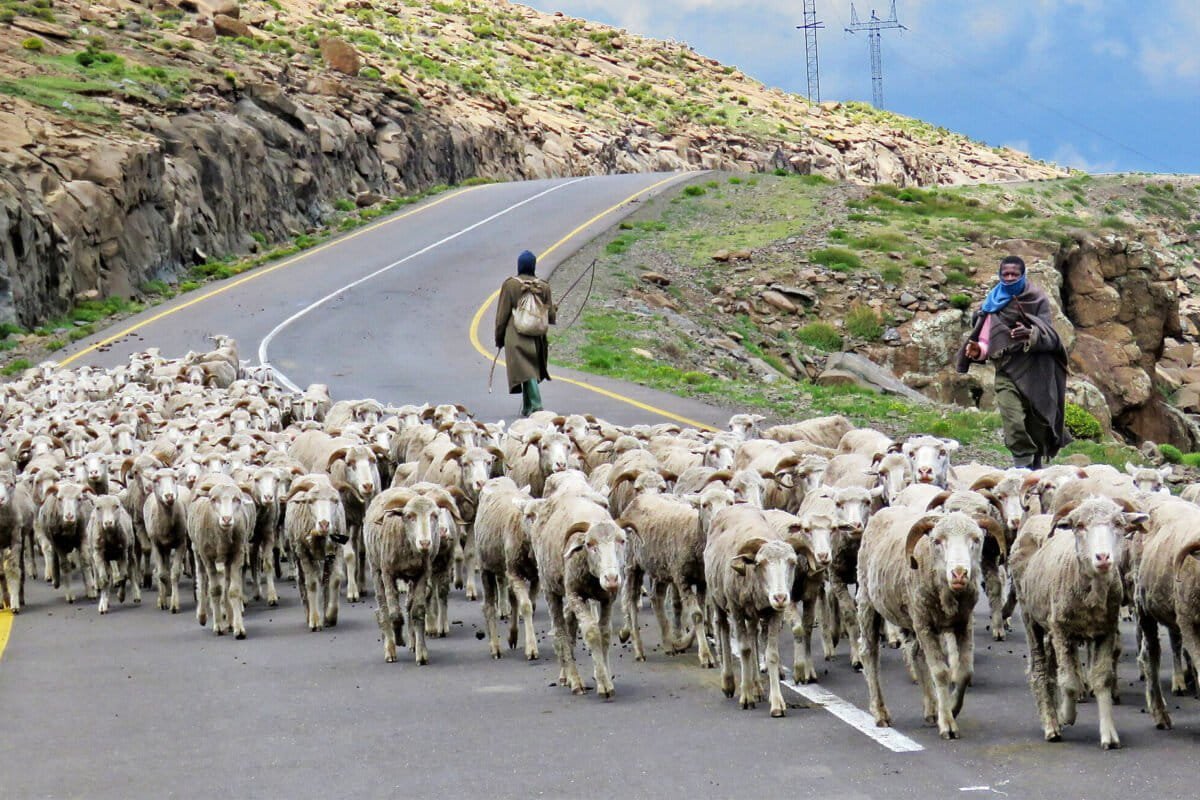
Banner image: Pastoralists in Lesotho. Image by Michalabraham (CC BY-SA 4.0) via Wikimedia Commons.

