


One autumn evening, the university president stood at a podium facing a packed auditorium. Hundreds of students were protesting outside. The faculty was publicly divided. The office was flooded with angry emails from alumni and donors. Cable news trucks lined the street.
There was a sense of tension in the room. The president began with a firm statement defending the agency’s policies. Within minutes a crowd erupted. A scream drowned out the microphone. The clip on social media went viral instantly. The conflict escalated overnight.
A week later, the same leader took a different approach. Instead of another statement, the administration convened a facilitation forum, brought in seasoned facilitators, and began a structured dialogue with students, faculty, and community groups. His tone slowly changed. Although the disagreement remained tense, the conversation became more constructive.
What has changed? It wasn’t a personality. It wasn’t an ideology. That’s how conflicts have been dealt with over time. This change captures the essence of what I call conflict intelligence, the ability to constructively engage in conflict as the situation evolves. And surprisingly, patterns are better understood through mathematics than through personality.
Conflict information is dynamic rather than fixed.
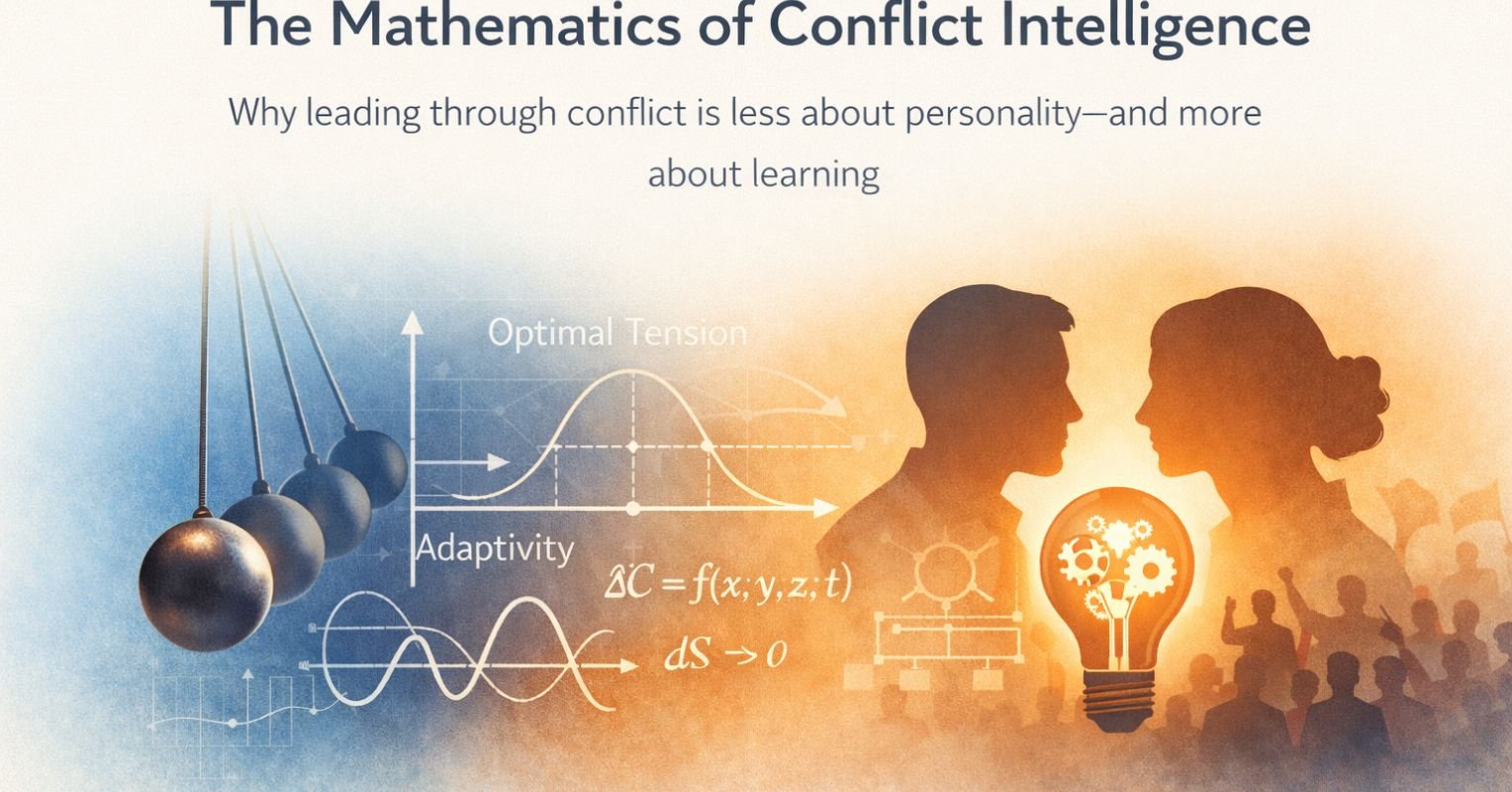
Most people think of conflict skills as a trait. Some leaders are simply “good at conflict,” while others avoid conflict or incite conflict. But research suggests something different. Conflict information behaves more like a dynamic system. Over time, it grows, stabilizes, or declines depending on how leaders respond to pressure, complexity, and feedback.
In this sense, the real question is not, “Is this leader good at conflict?” The question is how this leader’s ability to handle conflict evolves under stress and learning. Its trajectory is primarily determined by four abilities.
At the heart of the model is the following equation:
CIQ = f(A, E, S, O)
This equation describes how a person’s conflict information (CI) changes over time. CI is said to improve if you are good at:
A: Adaptive thinking – the ability to change your approach depending on the type of conflict you are facing. E: Emotional Regulation – Stay calm and think clearly under pressure. S: Systemic Awareness – Understand how deeper social, cultural, or historical forces influence conflict. O: Tension management – knowing how much conflict you can tolerate (too little and nothing changes; too much and things explode).
But R: Resistance to change, which is burdened by one’s own entrenched habits, organizational constraints, and social pressures, also reduces CI. Each of these elements is multiplied by a factor (α, β, γ, δ, etc.) that indicates its importance in a particular situation.
Four engines of conflict information
1. Adaptability
Conflicts are rarely static. What begins as a misunderstanding can quickly become political, emotional, or organizational. Conflict-aware leaders adapt as circumstances change. They change, experiment, and readjust their strategies rather than rigidly applying a single strategy. However, there are limits to adaptation. When conflicts become overwhelmingly complex, leaders often freeze or oversimplify the situation.
2. Emotional control
Conflict creates stress, especially in high-stakes leadership situations. Under continuous pressure, emotional control begins to suffer. Leaders can become reactive, defensive, or stubborn. Their decision-making power is reduced. However, regulations have not been decided. Through training, reflection, and experience, leaders can rebuild their ability to remain stable under attack. This is why experienced crisis leaders often appear calm during intense conflicts. They are learning how to stabilize themselves before attempting to stabilize conflict.
Leadership essentials
3. Understanding the system
Many conflicts that appear personal on the surface are actually systemic. Conflict in the workplace can reflect deeper power and social dynamics. Campus protests may reflect domestic political tensions. Neighborhood disagreements may involve historical grievances.
Leaders with high conflict intelligence look beyond the immediate discussion to the structures surrounding conflict, including the incentives, identities, and feedback loops that shape the conflict. As leaders gain experience, this systemic awareness increases. However, due to the limits of human attention and cognitive capacity, this eventually reaches a plateau.
4. Optimal tension management
Perhaps the most overlooked skill in conflict leadership is managing tension. A healthy system requires tension. Without it, hard truths remain unspoken and innovation stagnates. However, if tensions become too strong, relationships and institutions can break down. The challenge is to learn how to keep conflict within productive bounds—not to eliminate it, but to prevent its destructive escalation.
goldilocks war zone
One surprising insight from this model is that adaptability peaks in the “Goldilocks zone” of complexity. If a conflict is too simple, leaders may overreact. They intervene violently over manageable disagreements. When conflict becomes overwhelmingly disruptive, adaptive capacity collapses. Leaders become cognitively overloaded and revert to rigid thinking. But when complexity is moderate—difficult but understandable—leaders are at their best at creative problem solving. This is where conflict information comes into play.
Why leaders often overcorrect
When we examine how leaders manage tension over time, another pattern emerges. Many leaders are stuck in a cycle of overcorrection. So we’re stuck in a cycle of violently escalating, then retreating, then cracking down, then adapting, then pushing too hard, then backing down. The result resembles a pendulum swinging back and forth.
Conflict-aware leaders learn how to gradually reduce these fluctuations and stabilize tensions at productive levels. Conflict does not disappear, but it becomes functional rather than destructive. Think of it like learning to steer a car on a winding road. New drivers jerk the steering wheel back and forth. Experienced drivers will make smaller, smoother adjustments.
What this means for leadership
Understanding conflict information as a dynamic system changes the way we think about leadership. This suggests that leadership effectiveness in conflict environments is constantly evolving. Leaders grow when they:
Adapt strategies as conflicts change Manage emotions under pressure Understand the deep systems driving conflict Manage tensions without suppressing them
And when stress, defenses, or institutional inertia overwhelm those capacities, they decline. Conflict information behaves less like a personality trait and more like a living system formed by feedback loops between people, organizations, and events.
conflict is energy
We often talk about conflict as if it is something to be eliminated. However, conflict is better understood as a form of social energy. Left unmanaged, it can lead to polarization and institutional collapse. When fully suppressed, it goes underground and trust is undermined. But conflict can generate clarity, innovation, and resilience if leaders learn to regulate it wisely. Leaders who succeed in times of polarization are not leaders who eliminate conflict. That’s not possible. They will be the ones who understand its deeper dynamics and learn how to channel that energy productively. After all, that’s the mathematics of conflict information.
