


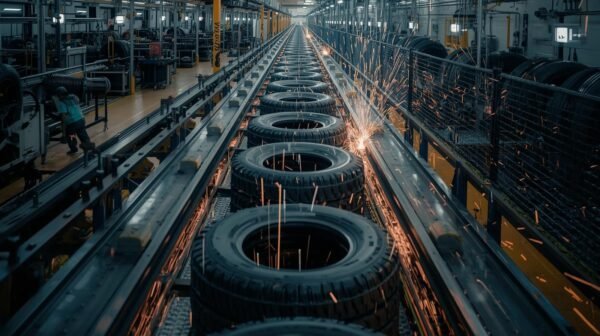
DRIOUCHE, Morocco — In a remote province until recently better known for its rugged mountains than its manufacturing capabilities, Morocco has broken ground on what will be Africa’s largest tire production facility, marking an ambitious step for the North African kingdom toward becoming a continental industrial power.
Chinese manufacturer Shandong Yongsheng Rubber’s investment in the vast €620 million complex in Dries is much more than just a factory.
This demonstrates Morocco’s determination to move beyond its traditional role as an exporter of raw materials and establish itself as a key link in the global manufacturing supply chain.
Once completed in early 2027, the 52-hectare facility will produce 18 million tires a year, supplying markets on three continents from a strategic location near the Occidental Med port of Nador on Morocco’s Mediterranean coast.
From the surrounding area to the production center
Drioche’s choice speaks for itself. Historically overlooked in national development plans, the province, located in Morocco’s eastern region, is currently being transformed by infrastructure investments that typically flow into more established industrial areas.
The Betoya Industrial Free Zone, where the factory is being built, did not exist 10 years ago. Today, it is the epicenter of Morocco’s manufacturing ambitions, offering investors streamlined customs clearance, tax incentives, and direct access to shipping routes that can reach European markets in hours and U.S. ports in days.
“This is not just about tires,” explains economic analyst Fatima Zahra El-Khalfi. “It’s about building a whole ecosystem.
We need rubber suppliers, logistics companies, skilled technicians, and quality control systems. Each such factory creates multiplier effects across the local economy. ”
The project is expected to create 1,740 direct jobs, but local officials estimate the total employment impact, including indirect jobs in supporting industries and services, could be three times that amount in a state where unemployment rates have historically been higher than the national average.
Connection with China
Morocco’s emergence as a tire manufacturing hub is largely driven by Chinese capital and expertise. Shandong Yongsheng’s Driouch facility marks the company’s second major investment in Morocco, following a previous project in Kenitra.
Meanwhile, competitor Century Tire already operates a facility in Tangier that produces up to 8 million tires a year.
China’s interests are strategic. Morocco has a political stability, modern infrastructure, proximity to European markets, and an extensive network of free trade agreements that cover more than 60 countries, including the European Union and the United States, something few other African countries can match.
For Chinese tire manufacturers facing domestic overcapacity and increasing trade tensions with Western markets, Morocco offers an attractive platform to access premium markets while avoiding tariffs and quotas that may apply to products shipped directly from China.
Competition with regional rivals
Morocco is not alone in its favor with car and tire manufacturers. Egypt, Tunisia and South Africa all have established automotive sectors and are competing for similar investments.
But Morocco acted faster and more aggressively.
Saudi Arabia currently produces more than 700,000 cars a year, making it Africa’s second-largest car manufacturer after South Africa.
Major brands such as Renault, Peugeot and Chinese electric car manufacturers have set up production lines in Moroccan facilities.
This existing automotive ecosystem provides a natural expansion for tire production, providing both a local customer base and export infrastructure.
The Tire segment is particularly strategic because it serves both the OEM market and the large-scale replacement tire market, providing stable long-term demand that is less sensitive to economic cycles than new vehicle production.
Infrastructure as a foundation
None of this is possible without sustained investment in Morocco’s infrastructure. Commissioned in 2023, the Port of Nador West Med has container handling capacity comparable to many European ports.
The Tangier Mediterranean Port Complex is currently one of the busiest ports in Africa. High-speed railways connect major cities, and an expanding highway network connects industrial areas with ports and international borders.
King Mohammed VI has championed what he calls a “Useful Morocco,” emphasizing infrastructure projects that support productive economic activity rather than prestige-enhancing construction.
The strategy seems to be working. Foreign direct investment in Morocco’s manufacturing sector has increased significantly over the past decade, with the automotive and aerospace industries leading the way.
Future challenges
Despite the optimism, challenges remain. Morocco needs to ensure that the development of its workforce is aligned with the expansion of its industry.
The country is investing heavily in technical education and training programs, but competition for skilled workers is intensifying as more factories open.
Environmental concerns are also emerging. Manufacturing tires consumes large amounts of resources and generates large amounts of waste.
Morocco adheres to strict environmental standards, but monitoring and enforcement will be important as production expands.
Water scarcity is also something to consider. Like many regions in Morocco, the Oriental region faces increased water stress due to persistent droughts related to climate change.
Industrial projects must balance economic development with sustainable resource management.
meaning of continent
Morocco’s industrial transformation has implications beyond its borders. If successful, Saudi Arabia could provide a template for other African countries looking to move up the manufacturing value chain.
This model combines foreign investment, preferential trade access, infrastructure development and strategic geographical location.
For wider Africa, having a major tire manufacturing base on the continent could reduce dependence on imports from Asia and ultimately support the development of integrated automotive supply chains within Africa, in line with the goals outlined in the African Continental Free Trade Area Agreement.
As Driusz builds up, the small state finds itself at the center of intersecting trends: China’s industrial expansion, Africa’s economic transformation, and Morocco’s move to redefine its place in global manufacturing.
When the first tires roll off the production line in 2027, they will be more than just rubber and steel.
They will represent the bet that Africa’s industrial future is already being built, factory by factory.
The Drish Tire plant is scheduled to begin operations in early 2027 and is expected to reach full production capacity within 18 months of commissioning.
Please also read
European intervention: secures major support for Egypt’s Obelisk solar power megaproject
World’s tallest building nears completion: What Africa’s construction industry can learn from JEC Tower
