


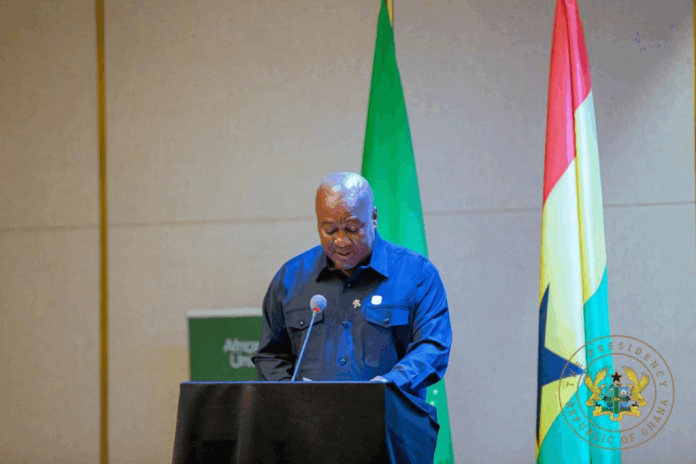
President John Dramani Mahama has called on African Union (AU) member states to accelerate the implementation of the continent’s flagship financial institution, warning that continued delays could undermine Africa’s economic sovereignty and integration efforts.
He made the remarks at the side event “High-Level Symposium on Promoting a Visa-Free Africa for Economic Prosperity” hosted by the African Union Commission Department of Health, Humanitarian Affairs and Social Affairs and the African Development Bank (AfDB) Group during the 39th AU Heads of State and Government Summit held at the Radisson Blu Hotel in Addis Ababa, Ethiopia, on Friday, February 13, 2026.
President Mahama said the African Union Financial Institutions (AUFI), including the African Monetary Institute (AMI), the African Investment Bank (AIB) and the African Monetary Fund (AMF), are essential foundational pillars to strengthen Africa’s macroeconomic stability, promote intra-continental trade and reduce dependence on external financial mechanisms.
These institutions are not theoretical constructs. These are structural responses to persistent weaknesses in our financial ecosystem, Mahama said. Africa cannot insist on reforming the global financial structure while leaving its own continental structure incomplete.
Mr. Mahama highlighted the progress made so far, noting that the AMI bill has support at the technical and legal level, with the lean operating model recommended by the central bank governor. He stressed that the September 2026 start-up target remains technically achievable, but warned that macroeconomic convergence in Member States remains uneven.
Only 13 out of 53 member states met the main convergence criteria in 2024, and only three achieved all secondary benchmarks. The numbers highlight vast disparities in economic management and policy coordination across the continent, threatening the survival of unified financial institutions.
The operation of the African Monetary Institute is not procedural. Mr Mahama stressed that this is a working institutional discipline and called on Member States to allocate the necessary resources, second personnel and ensure timely budget planning to support the launch of AMI.
The African Monetary Institute is envisioned as a precursor to a future African central bank that will be responsible for coordinating monetary policy, managing monetary stability, and supporting macroeconomic convergence. Its establishment represents an important milestone towards the long-term goal of a single African currency as outlined in the 1991 Abuja Treaty.
Mr. Mahama also stressed the urgent need to accelerate ratification of the African Investment Bank and African Monetary Fund Protocol. He warned that continued delays risked sending a signal of hesitation at a time when decisive fiscal adjustment is needed.
Since its adoption in 2009, only six Member States have ratified the AIB Protocol, while the AMF has achieved ratification in only two of its 55 Member States. The low ratification rate reflects persistent challenges in translating continental commitments into binding national actions.
The African Investment Bank is designed to mobilize resources for infrastructure development, private sector growth, and regional integration projects. The institution aims to complement existing development finance mechanisms, with a particular focus on continent-wide priorities identified in Agenda 2063.
The African Monetary Fund, modeled on the International Monetary Fund (IMF), would provide balance of payments support, promote exchange rate stability and coordinate financial cooperation among member countries. The establishment will reduce Africa’s dependence on external financial institutions during times of economic crisis.
The President praised the progress of the Pan-African Stock Exchange, noting that 11 exchanges in 18 countries are now interconnected through the African Exchange Linkage Project, demonstrating the potential for continental financial integration where political commitment is matched by technical implementation.
The work of the Pan-African Stock Exchange provides a practical example of how continental financial integration can work effectively. By electronically linking national stock exchanges, the project will enable cross-border trading, improve liquidity and provide African companies with access to broader capital markets.
Moving from recognition to implementation requires determined political will. Africa’s financial architecture cannot remain ambitious. President Mahama declared that immediate implementation is essential to the economic independence, integration and success of Agenda 2063.
His comments come amid growing recognition that Africa’s economic integration agenda faces implementation flaws, despite strong rhetorical support. The African Continental Free Trade Area (AfCFTA), launched in 2021, faces similar challenges as countries struggle to harmonize regulations and eliminate non-tariff barriers.
Financial integration remains central to Africa’s broader development strategy outlined in Agenda 2063, the AU’s 50-year blueprint to transform the continent into a global power. However, progress on key financial infrastructure has lagged compared to other integration priorities.
The establishment of continental financial institutions faces multiple obstacles, including sovereignty concerns, concerns about economic domination by economic powers, lack of technical capacity in some member states, and competing domestic priorities that divert resources and political attention from regional commitments.
Economic analysts say that successful financial integration requires sustained macroeconomic convergence, including fiscal discipline, inflation control, debt sustainability, and cooperative trade policies. The limited number of countries currently meeting convergence criteria suggests that significant work remains before ambitious integration goals are achieved.
President Mahama is in a position to drive the political momentum behind these initiatives through his role as the AU Champion of Financial Institutions. His advocacy reflects Ghana’s long-standing support for pan-African integration and continental institutions.
The 39th AU Summit will be held under a theme focused on reparations, with discussions on historical injustices, economic development, governance reform, and institutional strengthening. President Mahama is leading several initiatives including sessions on gender equality, financial inclusion and the Accra Reset Initiative.
The summit will also discuss implementing the African Continental Free Trade Area, promoting a single African air transport market, improving digital connectivity and strengthening peace and security mechanisms across the continent.
Amid global economic uncertainty, climate change issues, security threats, and demographic pressures that require a concerted response across the continent, African leaders face increasing pressure to demonstrate concrete progress on integration efforts. The operation of the financial institution represents a symbolic and practical test of the AU’s ability to transform aspirations into functional reality.
