


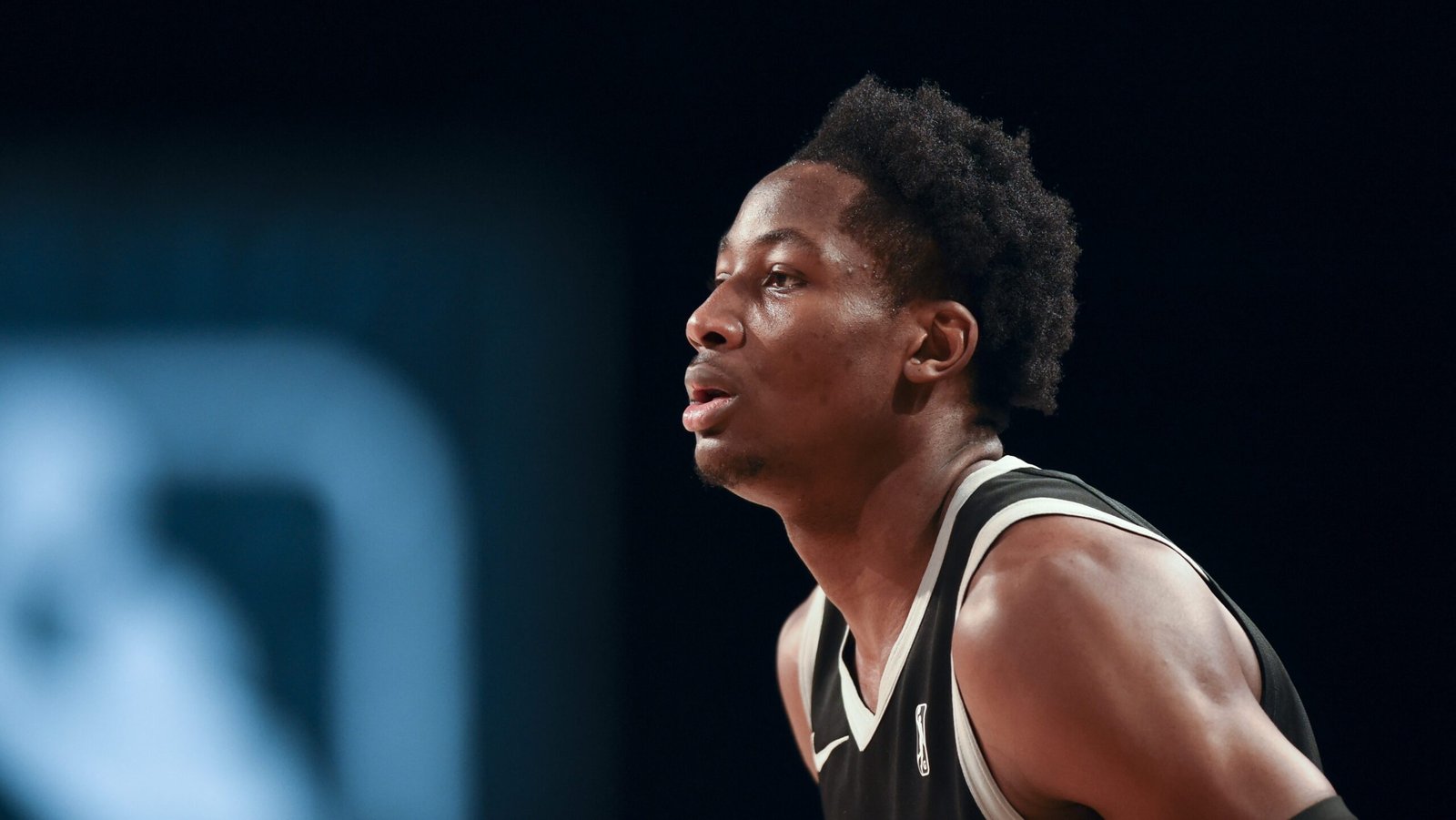
Jonathan Kuminga grew up in Congo, so the 2021 NBA Draft prospect had little access to American basketball, other than a 30-minute (or an hour, if he was lucky that day) session at a local internet cafe, where he could load up highlights of Kobe Bryant and LeBron James on YouTube.
When the combo forward, who averaged 15.8 points and 7.2 rebounds this season in the NBA’s developmental league, wanted to play basketball in his home country, the sport that took him from civil war-torn Congo, where conflict has been going on in some form for nearly 30 years, to the precipice of NBA stardom, there was little access to indoor courts or basketball shoes suitable for playing. Not to mention the level of training required for an elite basketball talent like him.
Those years in Congo, and then the last five years spent playing high school and professional basketball in the United States (Kuminga immigrated to the United States in 2016), have left the 18-year-old grateful for the opportunity he’s had by going top-10 in this Thursday’s NBA draft, and focused on making sure he’s not the last Congolese player to make it to the league.
Thomas Urbain/AFP via Getty Images
“I want to do great things. I want to be great,” Kuminga told The Undefeated last week. “If I succeed. I want Africans to think, ‘If he succeeded, we can too.'”
Until recently, Africa has not been a hotbed of basketball talent. The sport is second only to football on the continent, and one of the reasons for this is the accessibility of the latter. To play soccer, all you need is a ball and almost any playing surface. Basketball requires not only a ball, but also a court and basket to play on, as well as suitable sneakers.
But the selection of Nigerian center Hakeem Olajuwon (1984), South Sudanese big man Manute Bol (1985) and Congolese center Dikembe Mutombo (1991), as well as the NBA’s investment in the continent at the beginning of this century, opened the floodgates to African talent over the past two decades, as evidenced by Cameroonian Joel Embiid’s MVP candidacy last season.
Kuminga’s parents previously played basketball, and Kuminga’s older brother, Joel Ntambwe, appeared in three games at Texas Tech last season before leaving the program for personal reasons. Emmanuel Mudiay, who last played in the NBA with the Utah Jazz in 2019-20, is Kuminga’s cousin.
“My parents were basketball players their whole lives,” Kuminga said. “Basically, I had the opportunity to play basketball, but I can’t really remember the first time I played basketball.”
 Powerful African Union appears in NBA FinalsRead now
Congo lags behind other African countries, especially Nigeria, when it comes to finding talent capable of playing in the NBA. Four Congolese-born players have been drafted: Mutombo, Christian Ayenga (2009), Bismack Biyombo (2011), and Mudiay (2015), and seven more players have been selected, most notably Atlanta Hawks center Clint Capela (2014), with at least one parent of Congolese descent. By comparison, nine Nigerian players were selected in the 2020 draft alone.
Nine players from Nigeria played in the first round of the playoff series between the Milwaukee Bucks and the Miami Heat, and players with ties to Nigeria, Guinea, Senegal and Egypt played in the NBA Finals matchup between the Bucks and Phoenix Suns, but a Congolese-born player has appeared in only one playoff series in the past four years, Mudiay said. And internationally, the Congolese men’s national team has never qualified for the Olympics or the FIBA World Championship, but they have participated in FIBA AfroBasket multiple times, including this summer.
Kuminga, who was born in Goma in western Congo near the Rwandan border, said his country was lagging behind due to a lack of basketball infrastructure.
“People are playing basketball, but it’s not that big of a deal because you don’t have certain people going out there and helping the organization,” he said. “That’s why a lot of people can’t keep up.”
Something as simple as getting basketball shoes can be difficult for young people. Kuminga has said in the past that as a child he had to play in beat-up sneakers, which often caused him to slip and fall on outdoor courts.
“In two weeks I’ll be playing and my toes will stick out of my shoes,” said Kuminga, whose first language is French.
“I’m going to keep playing, but I don’t have any other shoes. It’s going to take me longer to buy another one, because that’s the only shoe I’m going to use for basketball, and the other shoes I’m going to use to go to games and go to school.”
“I think if we had a better organization, if we had people who were really willing to help, we would have a lot of players. And that’s what we’re really focused on…If we’re successful, we’re going to go home and give people gear, shoes, things like that.”

Juan Ocampo/NBAE via Getty Images
However, if Kuminga is selected in the top six of Thursday’s draft (he was projected to be No. 8 overall in ESPN NBA Draft Analyst Jonathan Givony’s latest mock draft), he would become the highest Congolese-born player in the league since Mutombo was selected No. 4 overall by the Denver Nuggets in the 1991 draft, surpassing Mudiay (seventh overall in 2015), and the second active Congolese player in the league. Biyombo of the Charlotte Hornets. (Patrick Mutombo, who played in the NBA’s Developmental League during the 2009-10 season, is the head coach of the Toronto Raptors’ G League affiliate.)
In addition to contributing to the development of basketball in his home country, Kuminga also hopes to use his elevated status as an NBA draft candidate to speak out against human rights violations in Congo and the United States.
Kuminga was born in a country still affected by the genocide in neighboring Rwanda and the First Congo War. The Second Congo War, which claimed the lives of more than five million people, ended just one year after Kuminga was born in 2002. Civil war has ravaged the country ever since.
Although Kuminga has not elaborated on what he witnessed as a boy growing up in Congo during this time, he compared the protests after the police killing of George Floyd to the “atrocities” he witnessed in Congo last spring, and inspired people to “stand up against bigotry, discrimination and racism of all kinds that are still being experienced in every corner of the world.”
By then, Kuminga was well aware of which coaches at the schools that had recruited him, including Duke and Kentucky, were speaking out about anti-Black racism in America. (Kuminga eventually dropped out of college altogether and played last season with the G League Ignite, a developmental team exclusively for NBA draft candidates).
“Growing up, I faced certain situations. My parents really helped me, provided for me and tried to keep me away from things like that,” Kuminga said. “We’re not really talking about it, but it just makes people feel bad because what used to happen is not right. And especially when Africans, not just Congolese, but African children and all come to the United States, it feels like a dream come true.
“Whenever I walk away from something like that, I say thank you, Lord, that I was successful. So we keep working hard. We are trying to change the situation in Africa. We are trying to make Africa great.”
Kuminga hopes his selection Thursday will lead to further investment and commitment to Congo and one day see more Mutombo, Biyombo, Mudiay and Kuminga playing in the NBA.
“I want to achieve so many goals in basketball that one day people will talk about that kid from Congo,” he said. “And when they talk about that kid from Congo, it reminds Congo a lot and they want to know who’s going to take over. What does Congo need? What kind of support does it need to produce more kids like that? That’s the question.”
