


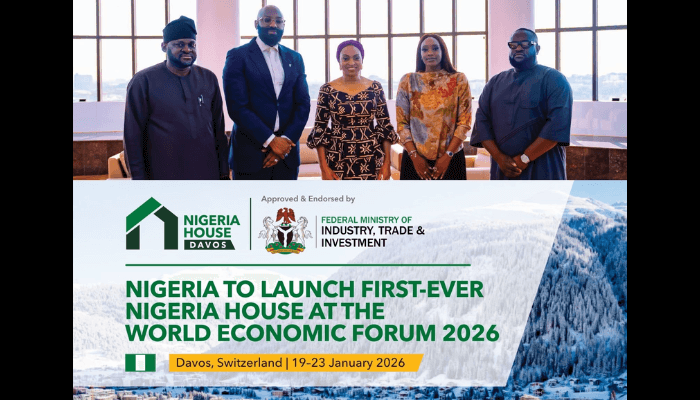
Nigeria is set to debut its first national pavilion at the World Economic Forum in Davos next January, using the global gathering to strengthen its pitch to foreign investors and rebuild a foreign direct investment pipeline strained by years of policy uncertainty and capital flight.
The country will launch Nigeria House at the 56th World Economic Forum Annual Meeting to be held from January 19 to 23, 2026, marking the first time in more than 50 years that Nigeria House will participate in the event. The invite-only hub, located along the Davos Promenade, aims to move Nigeria’s engagement beyond symbolism to structured deal-making and post-forum capital commitments.
Officials said the platform focuses on converting investor interest into bankable deals by combining policy clarity with investment-ready projects and trusted private sector partners, an approach aimed at shortening deal cycles and accelerating capital flows into one of Africa’s largest economies.
“Nigeria is focused on deepening reforms, strengthening the foreign direct investment pipeline and translating global attention into real economic results,” Minister of Industry, Trade and Investment Jumoke Oduwole said in a statement. “The World Economic Forum’s Nigeria House reflects our commitment to policy clarity, trusted partnerships and sustainable value creation.”
FDI inflows to Nigeria have lagged behind other regional countries in recent years, weighed down by foreign exchange shortages, high inflation and changing regulatory signals, even though recent reforms such as currency liberalization and the elimination of subsidies aim to restore investor confidence.
Nigeria House aims to serve as a permanent interface between policymakers and global capital as investment competition intensifies across emerging markets.
The five-day program is structured around four priority areas in line with the government’s reform agenda. solid minerals, mining value chain, trade infrastructure, agriculture. Investing in climate change, energy and environmental sustainability. Digital trade and technology. and creative economy and cultural export.
Each day will feature sector-focused investor roundtables, bilateral meetings and policy dialogues, culminating in a cross-sector session aimed at defining post-Davos investment paths.
Also read: 8 important things we learned from this year’s Davos trade
Organizers said there will be a focus on institutional investors, development finance institutions and multinational executives, with discussions ranging from gas power projects, renewable energy, mining value chains, digital infrastructure, artificial intelligence and cultural exports such as film and music.
Organizers say Nigeria House represents a transition from a temporary presence at Davos to a coordinated national presence based on measurable results. The program will include high-level panel discussions, closed-door meetings, cultural showcases, and follow-through mechanisms designed to maintain engagement after the forum ends.
The initiative was approved by the Federal Ministry of Industry, Trade and Investment and is being implemented by Eviola & Co Integrated Services LTD, Lex – Con Advisory Services LTD and UFAM Services Nigeria LTD in collaboration with local and international partners. Sponsors of the event include Agricultural Bank, African Finance Corporation (AFC), Nepal Energies, UFAM Services Nigeria LTD, Coronation Group and Sambes Global Concepts.
Others include Redwire Group, Aruwa Capital, Pipeline Infrastructure Nigeria Limited (PINL), The Osa Okunbo Foundation, Wigwe & Partners, ABinBev Africa and Roxettes Group.
Organizers describe it as a pan-Nigerian public-private platform aimed at aligning policy, capital and business during global economic restructuring.
For Nigeria, the Davos debut is less about name recognition and more about showing that reforms are turning into investable opportunities, an argument policymakers plan to take directly to global capital in January.

