


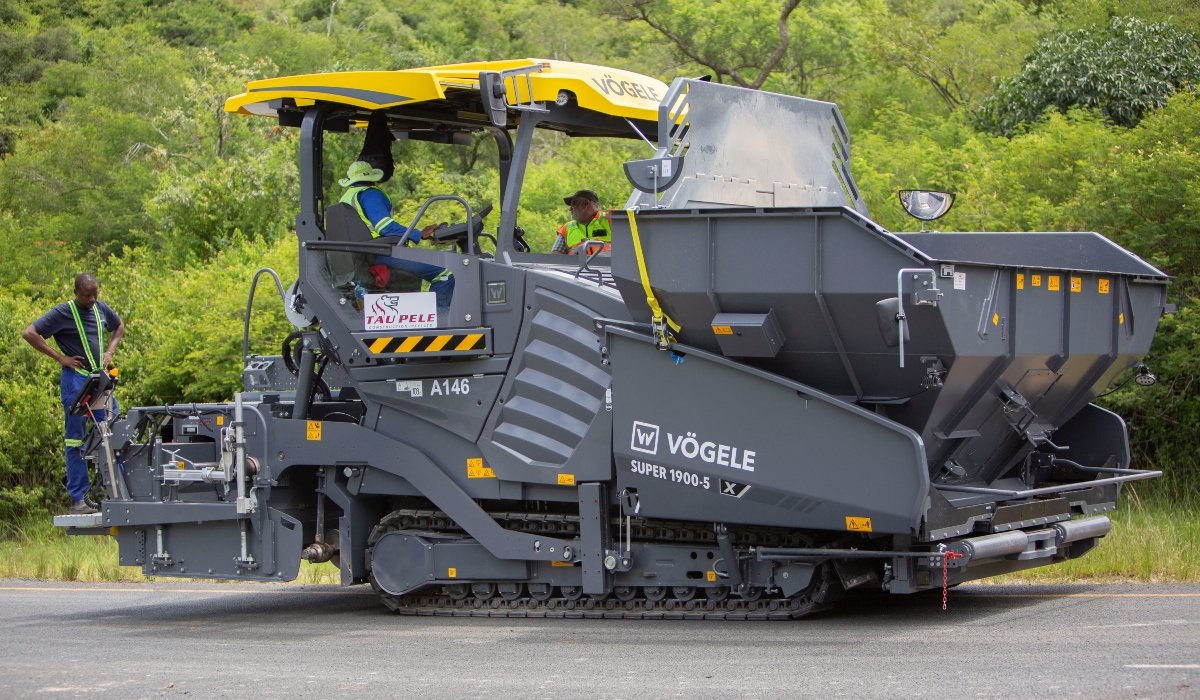
In a pioneering move, leading South African contractor Tau Pele Construction has delivered a cold recycling train from South Africa’s Wirtgen. This is the first attempt in Africa. The arrival of the cold field recycling train deployed on the Schoemanskloof section of the N4 road rehabilitation project is the culmination of a collaborative effort between the contractor and other key stakeholders on the project (client TransAfrican Concessions (TRAC) and engineer KBK Engineers) and heralds a new era in road rehabilitation in South Africa.
The construction industry must rapidly adopt new technologies to overcome chronic productivity, safety, and efficiency challenges, with the aim of reducing project delays, material waste, and cost overruns. This is the view of Wimpy Janse van Rensburg, Executive Manager, Engineering and Technology at TRAC, which manages one of South Africa’s most important motorways, the 580km N4 toll road from the Solomon Mahlangu entrance in Tshwane, Gauteng, to the port of Maputo in Mozambique.
Based on this understanding, TRAC, in collaboration with Tau Pelle Construction, the main contractor for the Schoemanskloof road renovation, and associated engineer, KBK Engineers, deployed South Africa’s first Wirtgen cryogenic in-situ recycling train for this important project. The three parties, who first saw the technology at Bauma 2025 in Germany, were immediately impressed by its value proposition, prompting talks with South Africa’s Wirtgen to bring the technology to South Africa.
Fast forward a year and the first train is now hard at work on an important project in Mpumalanga. There, Tau Pere Construction has been contracted to improve a 68km Schoemanskloof section of the N4 motorway. According to Tau Pele’s Dr Fran Bower, the scope of the project includes 50km of additional lanes in addition to existing road rehabilitation and overlapping throughout the project.
train in detail
The new Wirtgen cold field recycling train consists of a W 380 CR cold recycler, a VÖGELE SUPER 1900-5X paver, a 12 ton
Waylon Kukard, sales manager at Wirtgen South Africa, explains that in-situ (on-site) road rehabilitation systems mill, mix and pave old asphalt in one pass. Offering a working width of up to 3.8 m, the W 380 CR cold recycler (the backbone of the train) granulates the material and converts it into a homogeneous material mixture by adding a binder (in this particular example, foamed asphalt).
“With a mixing capacity of up to 800 tons/hour, the W 380 CR cold recycler feeds the recycled material to the VÖGELE SUPER 1900-5 “The pavers then pave the material to match the slope, thickness and terrain.
required width. Two Hamm tandem rollers are then positioned to optimally compact the material before two pneumatic rollers seal the layers. ”
time factor
Although the technology is new to South Africa, Dr. Heinrich Schulenburg of Wirtgen South Africa says it has already been proven in other parts of the world. He says cold recycling of foamed asphalt in particular is popular with road management and construction companies in regions such as Europe and Southeast Asia.
One of the main benefits of this technology is time savings. “Given this technology, which is not just a train but a process plant in itself, the repair process is accelerated by combining crushing, mixing, and paving in one pass. The foamed asphalt is processed in-situ with existing materials and aggregated The newly laid asphalt-stabilized material provides a solid foundation and can be road-ready immediately after compaction, reducing traffic disruption,” said Schulenburg.
In fact, this was one of the main factors behind the decision to implement this technology in the Schoemanskloof project. TRAC’s Van Rensburg points out that the N4 is generally busy with traffic, with more than 2,000 large vehicles traveling on the road every day. The road will serve as an important artery between South Africa’s industrial heartland (Gauteng Province) and Mozambique’s deep sea port of Maputo, allowing efficient and cost-effective transportation of goods such as agricultural products and minerals.
“Given that the N4 is one of the most important trade routes in the region, reducing traffic disruption is of paramount importance. ‘Stop-and-go’ traffic control systems associated with traditional road rehabilitation techniques typically halve the normal capacity of the road for long periods of time and “By milling, mixing and paving in one pass, the cold on-site recycling system allows roads to be reopened almost immediately, reducing traffic congestion and delays.”
There are many more benefits
Apart from time savings, Tau Pele Director Joe Deetlefs highlights the technology’s cost efficiency as another key factor in the purchasing decision. Wirtgen’s cryogenic on-site recycling trains save project costs by reducing the need for new materials, reducing transportation costs and enabling faster, more efficient construction.
Depending on the project, material costs can be reduced by up to 50%, says Wirtgen South Africa’s sales manager Kukard. Additionally, 100% reuse of existing asphalt eliminates landfill waste and reduces the need for new raw materials by up to 90%, maximizing environmental sustainability. The system reduces trucking for material removal and delivery by up to 90%, significantly reducing CO₂ emissions associated with construction projects.
Jaco Markam, a contract engineer with KBK Engineers, says reusing existing materials is the “next big thing” in road rehabilitation. With a global shortage of natural materials, using recycled asphalt pavement (RAP) in the field enables faster, cheaper and more environmentally friendly road repairs.
“All project stakeholders in the construction value chain need to work together to leverage what we have. Reusing in-situ materials eliminates the need to purchase virgin materials and pay for transport to site. This technology is already available and we are pleased to have taken the pioneering decision to work with TRAC and Tau Pele to introduce Africa’s first Wirtgen cryogenic in-situ recycling train,” Markham concluded.
