


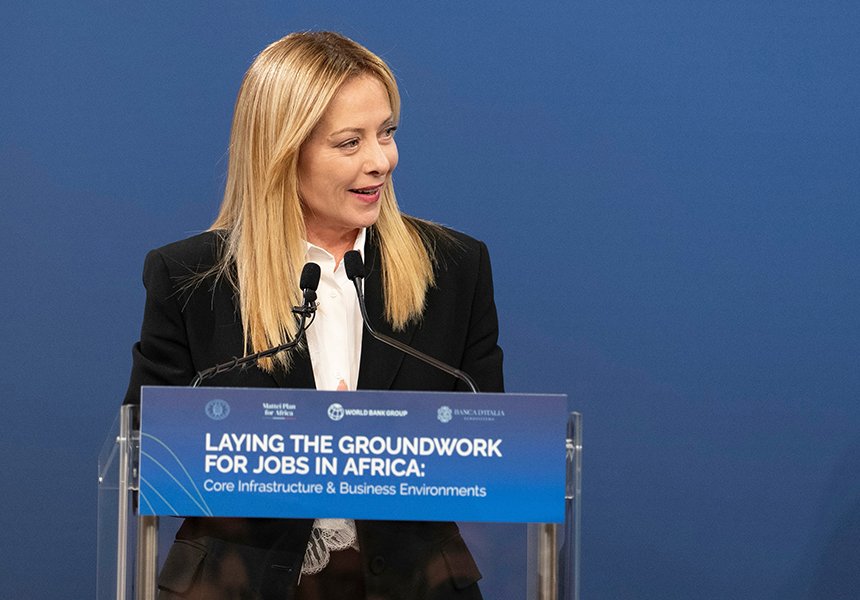
Good evening.
Governor Panetta, President Banga, President Shanmugaratnam, authorities,
Well, despite the difficult days that we are facing, I did not want to miss the opportunity to conclude this debate dedicated to a theme that I think is important not only for the future of Africa, but also for the future of Europe as a whole: building the physical and intangible infrastructure that enables growth, enterprise and employment.
The title of this event, “Laying the Foundation for Employment,” is a reminder of a simple but incredibly often forgotten truth. That is, jobs are not created by simple legislation, for example. They are created where favorable conditions exist. A place with physical and digital infrastructure, reliable energy, trained human capital, strong institutions, clear rules, and access to finance.
This simple premise is the driving force behind Italy’s actions not only domestically, but also clearly internationally, especially with regard to the African continent. We have done this through the Mattei Plan, our investment program in African countries. The Plan outlines a cooperation strategy, a collaboration between equals built on a clear vision: to support the development of production chains, strong local enterprises and the creation of structural conditions for stable and dignified employment in African countries. So that Africa can grow and prosper by processing its resources, cultivating its land and making the most of its human capital.
Cooperation with the World Bank has become, and will continue to be, increasingly central to this process. We have had an intense and concrete dialogue with President Banga from the beginning, and I would like to sincerely thank him for his clarity and willingness to cooperate. We share a fundamental approach to this common goal: to put the private sector at the center of development, mobilize capital, reduce investment risks, and strengthen the institutional capacity of partner countries. The World Bank plays an important role in creating a business-friendly environment, regulatory reform, and strengthening economic institutions. The Italian Government, through the Mattei Plan, is a partner in this mission and wants to be a partner in this mission.
One of the most tangible signs of this cooperation in recent months has been the opening of an International Finance Corporation office in Rome. The presence of the International Finance Corporation in our capital is more than just symbolic. It’s a strategic choice. It means building operational bridges between the Italian production system, African markets and the World Bank Group’s financial products. It means facilitating encounters between companies, investors and profitable projects. That means strengthening our ability to mobilize private capital for initiatives that have a big impact on jobs.
We want Rome to become a hub for European investment in Africa, a place where public and private sectors can work together to turn good ideas into jobs. Because for us, work is still key. Decent, stable, quality work. Jobs that allow young Africans to build a future in their homeland.
Africa is the world’s youngest continent, with 60% of its population under the age of 25. Millions of young people enter the labor market every year. Without creating the right opportunities, there is a clear risk of exclusion, destabilization and forced displacement. But with serious investment in energy, infrastructure, agriculture, and technical and vocational training, we can turn demographic dynamics into an extraordinary vehicle for development.
The Matei Plan focuses on exactly these strategic areas.
First of all, energy. Enrico Mattei said, “There is no work without business, and there is no business without energy.” Investing in networks, production capacity and renewable resources means instantly creating jobs while enabling growth across the supply chain. We are at the forefront of this effort with the World Bank through our Mission 300 project, which aims to provide new power infrastructure to more than 300 million Africans by 2030.
Second: Agriculture. Although Africa accounts for a very large proportion of the earth’s arable land, it still imports a significant portion of its food. Increasing agricultural productivity, developing locally processed products and strengthening value chains means creating millions of jobs, especially for young people and women.
Thirdly, training and skills. Physical infrastructure must be aligned with human capital infrastructure. To achieve this objective, the Italian government is working on technical and vocational training programs in cooperation with local companies and institutions, in order to align the skills of young people with the real needs of the market. One example is the initiative to establish Pan-African training centers for agriculture and water utilization in Algeria and Tunisia, and to provide training in renewable energy to Morocco.
Fourth: Regulatory environment and access to finance. Here too, cooperation with the World Bank is essential. Reforms that simplify procedures, strengthen legal certainty, fight corruption and improve credit access for small and medium-sized enterprises are prerequisites for attracting large-scale investment.
Fundamentally, we believe that the effectiveness of cooperation is measured not by good intentions, but by the concrete results achieved in terms of job creation, business support and investment mobilization. This is our approach, and we believe it should be the approach that Europe and the West should also take towards Africa. Reduce fragmentation and increase coordination. Less rhetoric, more construction sites. Less promises, more innovative and tangible financial products. Less charity, more development.
The collaboration between the World Bank and IFC shows that it is possible to build a system. Pool public resources, technical expertise, and private capital to reduce perceived risks and increase real impact.
And our method is not based on the arrogance of those who impose pre-established models from above, regardless of the demands of African people, but rather on sharing solutions and ways to implement those solutions.
This is the model we follow and this is the path we are on. Build partnerships based on mutual respect, transparency and shared responsibility with a win-win approach. Because when young Africans find work and choose to contribute to the land of their birth, we not only help our countries develop. We are strengthening stability, combating the causes of forced migration, imagining a more balanced relationship between Africa and Europe, and investing in the common future of our societies.
And as the recent success of the Italy-Africa Summit in Addis Ababa demonstrated, this model is gaining interest and engagement. But our work has only just begun. We will continue to plan more effectively, involving more countries, accelerating project implementation, and further strengthening multilateral financial leverage.
Currently, 14 African countries are directly involved in the Mattei Plan, with plans to expand the strategy to four more countries in 2026: Democratic Republic of the Congo, Rwanda, Gabon and Zambia.
I know it’s a tough challenge, but it doesn’t mean I lack determination. Above all, we know that we can always count on the World Bank’s concrete cooperation on this ambitious journey. The World Bank embraced our vision from the beginning and made invaluable contributions.
So, President Banga, I would like to thank you again for the work you have done so far, and thank you even more for the work we will do together in the future.
Thank you everyone.
