


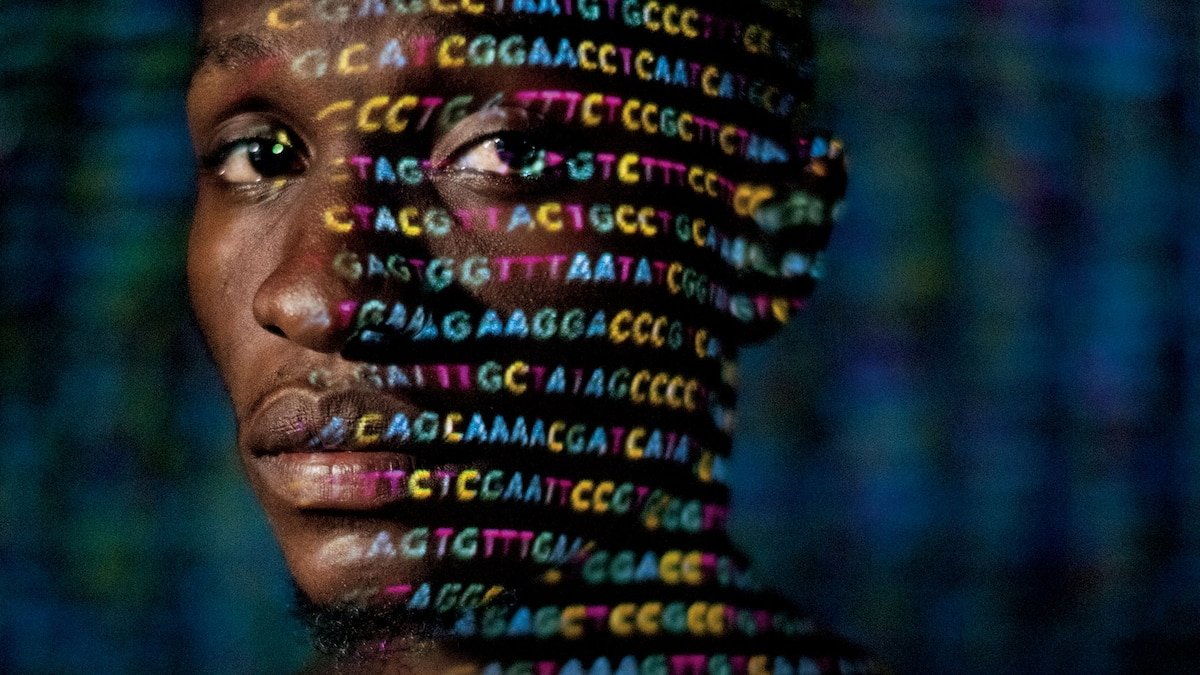
DNA is often compared to text. Letters represent chemical bases. A stands for adenine, C stands for cytosine, G stands for guanine, and T stands for thymine. The human genome consists of 3 billion base pairs (pages of A, C, G, and T) divided into approximately 20,000 genes. The tweak that makes East Asian hair thicker is a single base change in a single gene: T to C.
Similarly, the mutation most responsible for lighter skin in Europeans is a single tweak in a gene known as SLC24A5, which consists of about 20,000 base pairs. In some positions, most sub-Saharan Africans have a G, while Europeans have an A. About 10 years ago, Keith Chen, a pathologist and geneticist at Penn State College of Medicine, discovered this mutation by studying zebrafish that had been bred to have lighter stripes. The fish was found to have a pigment gene mutation similar to that found in Europeans.
Paleogeneticists studied DNA extracted from ancient bones and discovered that the G-for-A substitution was introduced to Western Europe relatively recently, about 8,000 years ago, by people migrating from the Middle East. They also brought with them a new technology: agriculture. That means the people already in Europe, such as the hunter-gatherers who painted Lascaux’s stunning cave paintings, were probably brown, not white. Ancient DNA suggests that many of these dark-skinned Europeans had blue eyes, but this combination is rarely seen today.
“Genetics shows us that admixture and migration occur again and again, and that our images of past ‘racial structures’ are almost always wrong,” says David Reich, a paleogeneticist at Harvard University and author of a new book on the subject, Who We Are and How We Got Here. According to Reich, there are no fixed characteristics associated with specific geographic locations, and isolation often creates differences between populations, which can be obscured or erased by migration and admixture.
Today, skin color is very diverse all over the world. Many of the differences are correlated with latitude. Near the equator, there is a lot of sunlight, so dark skin helps protect you from UV rays. As you head to the polar regions, too little sun becomes a problem, and your skin becomes fairer, which increases the production of vitamin D. Several genes work together to determine skin tone, and different groups can have any number of different combinations of adjustments. Some Africans, like the Mursi people of Ethiopia, have skin that is close to ebony, while others, like the Kosan people, have copper-colored skin. Researchers were surprised to learn that many dark-skinned East Africans carry the fair-skinned variant of SLC24A5. (It appears to have been brought to Africa from the Middle East, just as it came to Europe.) East Asians generally have lighter skin, but carry a darker-skinned version of the gene. Chen is trying to find out why using zebrafish. “It’s not simple,” he says.
