


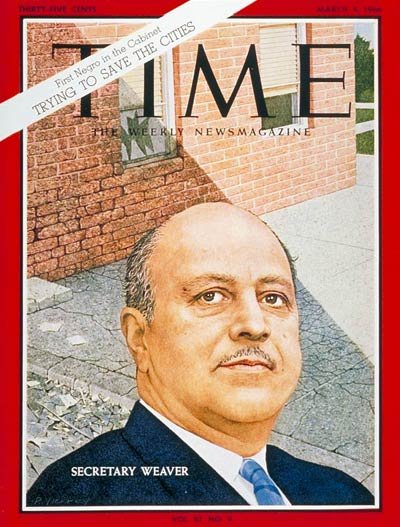
Exactly 50 years ago, on January 13, 1966, President Lyndon B. Johnson appointed Robert C. Weaver to head the newly created Department of Housing and Urban Development, making him the first African American member of the U.S. federal cabinet.
Since the appointment was historic and the result of years of political infighting, why did Time’s cover story declare that Weaver’s choice “unexpectedly selected the most predictable candidate for the job”?
Weaver certainly qualified. Born in 1907 and raised in racially segregated Washington, D.C., he earned three degrees from Harvard University, including a doctorate in economics, even though he considered his older brother a “brilliant person.” After completing his education, Weaver joined Florida’s New Deal administration as a race relations officer under Secretary of the Interior Harold Ickes. Over the next few years, he held a variety of positions related to employment and housing discrimination, and was a prominent leader of an informal brain trust commonly known as the “Black Cabinet,” described by Time as “an influential and stubborn group of young blacks in the FDR administration” that “made significant contributions to its full integration into government institutions.”
In 1960, Weaver was president of the NAACP when John F. Kennedy, then running for president, asked for advice on civil rights. Once elected, President Kennedy appointed Weaver as Commissioner of the Housing and Housing Finance Agency, at the time the highest position ever held in the U.S. government by an African American.
But when Kennedy first proposed creating a Department of Urban Affairs in the spring of 1961, Congress resisted. Then, when Mr. Weaver revealed he would lead the agency, that resistance grew even louder. In the process, Kennedy and Weaver knew that, as Weaver put it, a large portion of the nation viewed “a vote against this plan as a vote against the concept of having a Negro in the Cabinet.” To circumvent the obstacles in Congress, Kennedy attempted to order the creation of the department through his reorganization powers, which could only be blocked by a veto.
Despite Kennedy’s political maneuvering, “for the first time in 20 years, all senators were present for a vote,” and both the Senate and House rejected Kennedy’s new division, which Time called “a humiliating administration setback.”
It wasn’t until 1965, after Kennedy’s death, that President Johnson succeeded in creating a new Department of Housing and Urban Development, and was privately tossing over who would lead the department. The intervening years, and perhaps Weaver’s work at HHFA and advances in the civil rights movement, changed the minds of some in Congress. Democrats who “previously accused Mr. Weaver of using his office primarily to promote racial integration in housing” said they were no longer concerned. “They thought he would be biased,” one Virginia senator said. “But we found no evidence of bias.” Mr. Weaver was quickly confirmed and became the first African American appointed to a presidential cabinet.
As HUD Secretary, Mr. Weaver defended the Fair Housing Act of 1968, which prohibits housing discrimination on the basis of race, color, religion, or national origin. He is known to have said, “Without human regeneration, there can be no physical regeneration.”
For more information about Robert Weaver and the creation of the Department of Housing and Urban Development, see TIME Vault: Hope for the Heart.
