


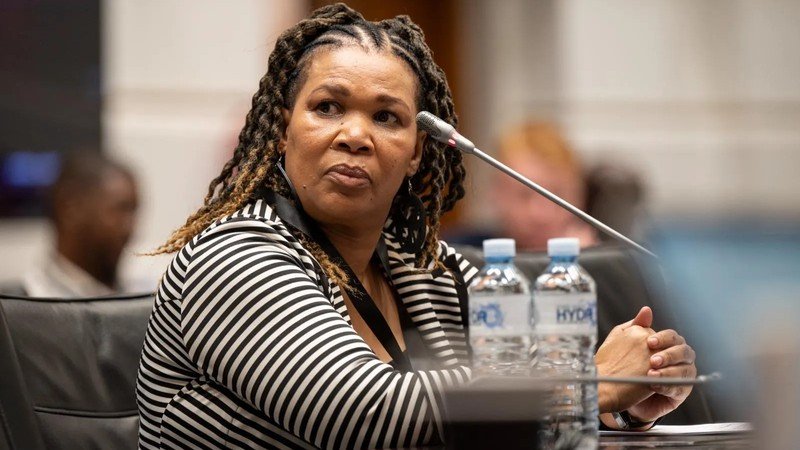
The select committee investigating corruption within South Africa’s law enforcement agencies concluded its public engagement phase this week, hearing alarming evidence from whistleblowers, former crime intelligence officers, police officials and members of parliament.
Controversy surrounding Chairman Thoko Didisa’s decision not to grant forensic subpoenas Investigator Paul O’Sullivan and North West businessman Brown Mogosi cited safety concerns as the reason.
Didisa’s refusal prompted criticism from the EFF, which likened her actions to a dangerous capitulation to intimidation and criticized individuals who openly show contempt for parliament as being shielded from responsibility by unverified claims that they are a security threat.
Spokesperson Moloto Motapo said the claim was inaccurate and mischaracterized both Mr Didiza’s role and the legal basis on which the decision in question was made.
“The chairperson’s decisions regarding both witnesses were taken after careful consideration of the committee’s requests. These are not decisions that can be taken arbitrarily,” Motapo said.
He said it was a well-established principle that Parliament must act lawfully and reasonably to avoid exposing its processes to unnecessary judicial review.
Mr Motapo also said Mr Didisa’s previous record showed that the committee had not considered the reasons why Mr O’Sullivan declined his request to appear virtually, and that he had not materially addressed personal safety concerns about Mr Mogotsi’s appearance before the committee.
In her testimony before the committee on Tuesday, whistleblower and former SAPS employee Patricia Machar told MPs that she had not influenced Police Minister Senzo Mchunu’s decision to disband the political killings task team and that she had only exposed corruption dating back to 2008.
Mr Mashale also supported KwaZulu-Natal police chief Nhlanhla Mkhwanazi’s claims about the infiltration of the criminal justice system by criminal organizations.
“Mr Mkhwanazi was right to say that there is corruption in the NPA and the judiciary. There is evidence of that, especially in the Free State,” she said.
Former criminal intelligence officer Pirasande Dottieni has claimed that senior leaders were involved in the assassination of the late Deputy Director-General of National Crime Investigation Sindile Mufazi, who he claimed died in 2021 by faking Covid-19 infection.
Dotcheni said Mfazi died while investigating Secret Service accounts in connection with the R1.6-billion COVID-19 personal protective equipment package.
“Some of you know. I’m going to lead this committee in the right direction.”
“I want to reveal this information in the appropriate forum. It’s important because it’s a responsible investigation. We shouldn’t be speaking as if we don’t recognize the threat that’s out there,” he said.
On Wednesday, three police officers claimed they were ignored by SAPS higher-ups when they reported apparent criminal activity within the SAPS Forensic Science Laboratory.
Suspended National Deputy Director-General Shadrack Sibiya is accused of asking three staff members to apologize to the SAPS Forensic Sciences Laboratory when he reported criminal activities at the department during his time with Homotso Phahlane, the former head of the department.
Colonel Darius Ramarobe, Captain Edwin Malatsie and Colonel Samuel Ramalepe claimed that they had asked Sibiya to apologize to Phalane if he wanted a possible career within the SAPS.
“During the meeting, General Sibiya suggested that we approach Lt. Gen. (Phalane) and apologize in order to jumpstart our careers. The proposal was contemptuously rejected and the meeting was called off,” Ramalepe said.
Testifying before the committee Thursday, Democratic Rep. Diane Kohler Barnard denied Mkhwanazi’s claims that he had leaked classified information.
Ms Kohler-Bernard said Ms Mkhwanazi’s allegations against her arose from the mistaken understanding that she had disclosed confidential information, and that some of the information Ms Mkhwanazi referred to was already in the public domain before the Standing Committee on Information Integration was established.
Ms. Kohler-Bernard felt that Ms. Mkhwanazi owed her an apology, as she could not have been left out of a non-existent committee.
“I wasn’t happy about being basically labeled a criminal when I actually believed I was doing my job, which is the oversight role that every member of Congress has to do,” she said.
The special committee will hold a housekeeping meeting on Monday and public hearings on Tuesday and Wednesday.
There are no confirmed witnesses yet for next week’s hearing, but committee chair Soviet Lekganyane said Lieutenant General Francina Vuma had submitted a draft affidavit.
“I guarantee you that we will use the two days Tuesday and Wednesday to our advantage. There is no way the defense team can come here empty-handed and say we don’t have witnesses,” Lekganyane said.
(email protected)
