


This article is part of a special report in collaboration with Brand South Africa.
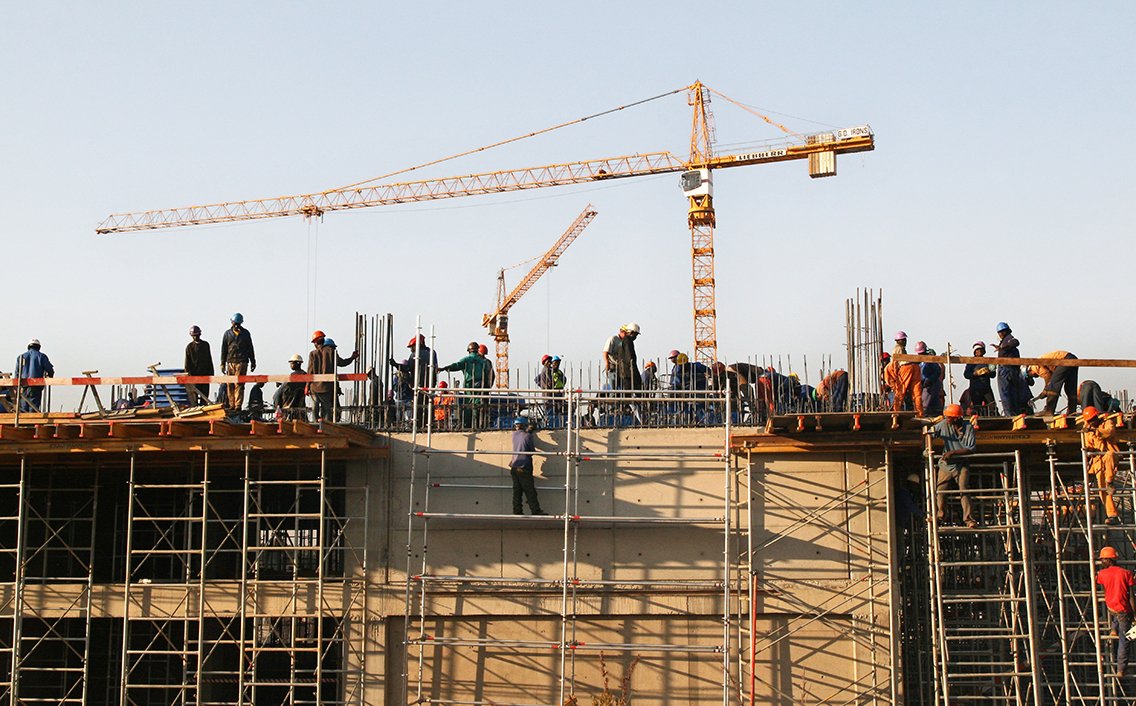
“My message is simple,” Dean McPherson, South Africa’s newly appointed Minister of Public Works and Infrastructure, tweeted shortly after taking up his post in July. “I want to turn this country into a massive construction site that will create jobs and spur growth. I want to put construction cranes in every town and city.”
Mr Macpherson’s enthusiasm for a country resembling a giant Lego set may not be to everyone’s taste, but there is little doubt that South Africa is poised to indulge the minister’s construction fetish.
From transport and logistics to ICT and water, the country has for decades endured infrastructure that fails to meet the aspirations and often basic needs of its people.
While the post-apartheid era initially made great strides in addressing racial imbalances through ambitious construction projects, progress has slowed in recent years as economic growth has stagnated and political crises have undermined the achievements of successive ANC governments.
Gross value added in the construction sector fell from R150 billion ($8.5 billion) in 2017 to just over R110 billion ($6.2 billion) in 2023. Government agency Infrastructure South Africa said this was due to “external shocks and internal challenges within the country” including “policy uncertainty, governance challenges and structural challenges within the industry”. The construction industry, which accounted for 4% of GDP in 2016, will only account for 2.6% in 2023.
Even before the Coalition government was formed and Mr McPherson of the Democratic Alliance took office, investors say there was a realization that things had to change.
“The government has recently turned to the private sector to support pressing infrastructure-related issues,” an ESG expert at South Africa’s infrastructure fund told African Business ahead of the election.
“Most of South Africa’s infrastructure is very old and has been aging for many years. The government recognizes that it cannot solve these problems on its own and is now coming up with policies that are attractive to investors. Asset owners are starting to realize that infrastructure is a good area to invest in.”
turn the page
The need for funds is huge. South Africa needs to spend between R4.8 trillion and R6.2 trillion ($272 billion to $352 billion) on transport, water and sanitation, basic education, and technical and vocational education and training between 2022 and 2030 to meet the United Nations Sustainable Development Goals, according to a World Bank study in January. The infrastructure spending figures correspond to an average annual expenditure of 8.7% to 11.2% of GDP.
To its credit, the previous ANC-only government had already begun efforts to improve this figure.
In March, the South African Government and Infrastructure Agency published the Construction Book 24/25, which profiles infrastructure projects by the government and state-owned enterprises during the financial year. The document promises “significant opportunities” for private sector actors through 153 projects with a total capital expenditure of R158.54 billion.
The projects cover everything from providing sustainable water supplies to communities in remote Limpopo to expanding the arrival and departure area of the airport in the wealthy coastal town of George. Investors say the book is an open invitation from the government to participate.
“They (the government) said they can’t do it themselves, so they need the private sector. When you have a lot of these pressing issues, it creates an environment between the government and the private sector,” says an infrastructure transaction lawyer at an asset management company.
“The past 18 months have only built up the urgency, need and requirement to deploy capital into the South African market,” he says.
He says such advanced infrastructure plans give pension funds and institutional investors the long-term perspective they need to invest.
Transportation and water are the biggest needs
Nowhere is the need for new capital more pressing than in transportation infrastructure. Road projects amounting to R60.4 billion account for 123 of the 153 projects on the construction book, while railways (2 projects, R10.1 billion), ports (3 projects, R9.82 billion) and airports (4 projects, R7.8 billion) also have significant investment needs. Transnet, which runs the freight rail network and manages the country’s ports, is a largely mismanaged state-owned company that has long been dismissed as unequal to the task of running an efficient national logistics network.
The World Bank’s January report said that while some areas of the transport system are operating well, “other areas are in serious decline or complete collapse.”
The worst performing area is access in both rural and urban areas. According to 2020-21 data, only 57.5% of the rural population lives within two kilometers of an all-weather road. Less than 10% of unpaved country roads are in good or very good condition.
In urban areas, transport systems are similarly neglected and “fall short of mass rapid transit,” the World Bank says, given “poor interconnections between rail, bus rapid transit, and minibus taxis.” The minimum spending scenario to remedy the problem would cost R10,000 billion over 2022-30, or about 1.68% of GDP.
“With 132 projects in the transportation sector, including ports, roads, airports and logistics, there is a huge push towards solving transportation problems,” the transaction lawyer said, arguing that improvements will be felt far beyond borders.
“South Africa plays a very important role for the rest of the continent as a gateway to many landlocked countries…prioritizing that sector is key for the continent,” the ESG expert added.
Water similarly requires investment. To meet the World Bank’s minimum spending scenario, the country would need to spend R1,125 billion, equivalent to 1.97% of GDP, between 2022 and 2030. This provides universal access to basic service levels and enables investment in alternative technologies and conservation measures. Maintaining and updating existing water systems, rather than building new ones, must be a priority, says the World Bank.
“It is clear that water is a big issue, given the water scarcity in parts of the country, including Johannesburg,” says the ESG expert.
“There are a lot of projects like the Lesotho Plateau that are important for Gauteng. The opportunities are there.”
The first phase of the Highlands project dates back to the late 1990s and involves the construction of a complex network of tunnels and dams to divert water from the mountains of Lesotho to South Africa.
In August 2023, the New Development Bank, commonly known as BRICS Bank, loaned R3.2 billion to the state-owned Trans-Caledon Tunnel Authority for the second phase of the Highlands Project, which will be used to build a dam and reservoir, a 38-kilometre-long water tunnel, roads and bridges, and other infrastructure. Three other plans highlighted in the construction book envision more substantial private sector involvement.
role of the country
Indeed, one of the main concerns that infrastructure investors still have about large-scale projects is their discomfort with the state and its often dysfunctional role. Construction Book projects primarily envisage close cooperation with governments or their state-owned enterprises. These partners may also be unwilling to do business with private sector investors.
“I don’t think we’ll see a complete exit from the government on some of these assets. We’ll see partnerships with private companies,” the transaction lawyer says.
“There needs to be an element of balancing government commitments with private debt, and it gives us reassurance, especially from our perspective, that although these are state-owned enterprises, the way they operate needs to be balanced with the private sector. That’s where the need is. Transnet won’t be privatized, but there will be a separation like Eskom. You’ll see a lot of those things happen. But I don’t think full privatization will happen.”
As a result, the most attractive sectors for investors include those that have historically had weak government influence. Investors argue that renewable energy, long ignored by the government and flawed power company Eskom in favor of fossil fuels, offers huge opportunities for private investors. Recent government legislation has made it much easier for private companies to generate and sell their own electricity, reducing the country’s dependence on Eskom, which has a recent history of frequent power outages.
Investment in energy infrastructure has increased from R30 billion in 2021 to about R38 billion last year, according to Infrastructure SA, while the Renewable Energy Independent Power Producer Procurement Program is reinvigorating private sector involvement in solar, wind and other renewable energy.
“The South African government has made a commitment to generate approximately 49% of its energy from renewable sources by 2030. This is clearly a difficult commitment given offloading, but as part of the building plan an Independent Power Producer (IPP) structure has been introduced for the renewable energy sector, which clearly shows this is a priority area for the government. This is an opportunity for investors and a priority for the government,” said the ESG expert.
Similarly, digital technology is an area where infrastructure players may find a relatively open field of business.
“From an economic infrastructure perspective, we are seeing a lot of traffic in information and communications technology, especially digitalization and the deployment of fiber optics,” says Fund Principles, another large investment firm.
“We’re seeing a lot of traffic around fiber that’s being deployed in suburban and urban areas. We’re also seeing a lot of conversations around data centers. With the advent of AI, we’re getting a lot of funding offers as we rush to support that kind of network demand.”
influence
Private equity experts at companies active in the South African market argue that such projects not only benefit shareholders, but also have the potential to have a significant social impact.
“We look at economic infrastructure as a catalyst, not only from an economic but also a development perspective. Generally, when capital is put into developing or building roads or airports, the social benefits are increased employment, increased economic activity, and small and medium-sized enterprises (SMEs) benefit from the contracts. We look at economic infrastructure not only from a commercial perspective, but also focus on the social and economic benefits that capital can bring in those areas.”
Such positivity is welcome to the new Infrastructure Minister and his plans to install cranes across the country. During a visit to South Africa’s Infrastructure Department in Johannesburg, Mr Macpherson-Dean reiterated that the coalition government was ready for a new era and insisted he would be the industry’s “biggest political champion”.
“I really want infrastructure to be the pride and place of economic growth in South Africa…We cannot grow our economy without an infrastructure boom in this country.”
