


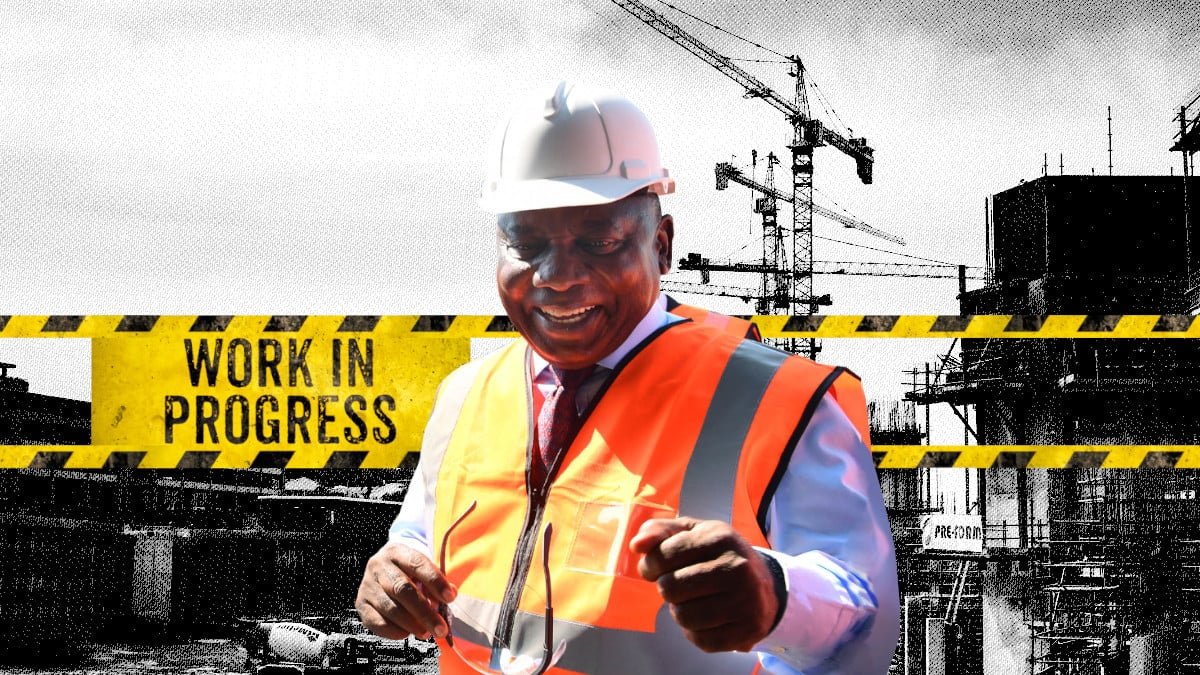
South African President Cyril Ramaphosa’s plans to turn the country into a giant construction site are accelerating, with the government increasing spending on roads, power plants, dams and ports.
The annual budget, announced in Cape Town on Wednesday, allocates R1.07 trillion for construction over the next three financial years.
According to the budget review, state-owned enterprises are expected to spend R445.5 billion, provincial governments R217.8 billion and local authorities R205.7 billion.
Inadequate infrastructure remains a binding constraint to growth in Africa’s largest economy.
The country endured rolling blackouts for more than a decade before they were eased last year, as the state-owned power company was unable to keep up with demand and exports were sluggish due to port and rail congestion.
Meanwhile, Johannesburg and other cities are suffering from water shortages because local authorities have failed to maintain reservoirs, pipelines and pumping stations, or to build enough new pumping stations.
These are some of the developments planned to transform South Africa’s landscape and repair its worn-out infrastructure.
transportation and logistics

Budget allocation for three years: R417.6 billion
The focus is on improving road infrastructure and restoring the country’s passenger and freight rail networks.
National ports and rail operator Transnet SOC Ltd. will spend R76.6 billion to improve the reliability and efficiency of its logistics system, an investment expected to attract private capital and boost the iron ore, manganese, coal, chrome and automotive industries.
The South African Passenger Rail Authority will prioritize improvements to rail signaling and communications infrastructure and will invest in new trains to improve services.
The South African National Highways Agency will invest in new roads and improve existing roads, and provincial authorities have been allocated funding to repair and reseal roads.
energy

Budget allocation for three years: R213.6 billion
According to the National Treasury, power generation capacity is being expanded, batteries added and the power grid strengthened to improve security of supply and attract private investment.
Contracts have been signed with independent power producers to provide approximately 10 gigawatts of renewable energy generation and battery energy storage capacity, as well as an additional 1 gigawatt of peak power capacity.
Most of these projects are already in production, and others are under construction.
The procurement of 2 gigawatts of new gas-fired power generation capacity is underway, with bid submissions expected to close in late May.
The government has also begun the process of appointing a contractor to install approximately 1,164 kilometers of new transmission lines.
water and sanitation

Budget allocation for three years: R185.2 billion
Investments will focus on increasing bulk water supplies and improving services.
The second phase of the Lesotho Highlands Water Project, which will bring water from the mountainous kingdom of Lesotho to Johannesburg and the surrounding Gauteng province, is underway and is expected to be completed between September 2029 and June 2031.
Two supply projects in northern Limpopo province are scheduled to be completed in 2030, and another in KwaZulu-Natal is due to be completed two years later.
education

Budget allocation for three years: R58.5 billion
Treasury has allocated R50.4 billion for the improvement and construction of schools and the provision of electricity and adequate sanitation.
Funding was also set aside for the maintenance and modernization of facilities in 50 technical and vocational education colleges and for university infrastructure projects.
health

Budget allocation for three years: R43.5 billion
Funds will be used to repair and renovate existing hospitals and clinics, as well as build new hospitals.
A 488-bed hospital in Polokwane is expected to be completed in 2028 and will provide specialized medical services to the province.
A 224-bed hospital is being replaced in Limpopo, and two hospitals are under construction in the Western Cape.
