


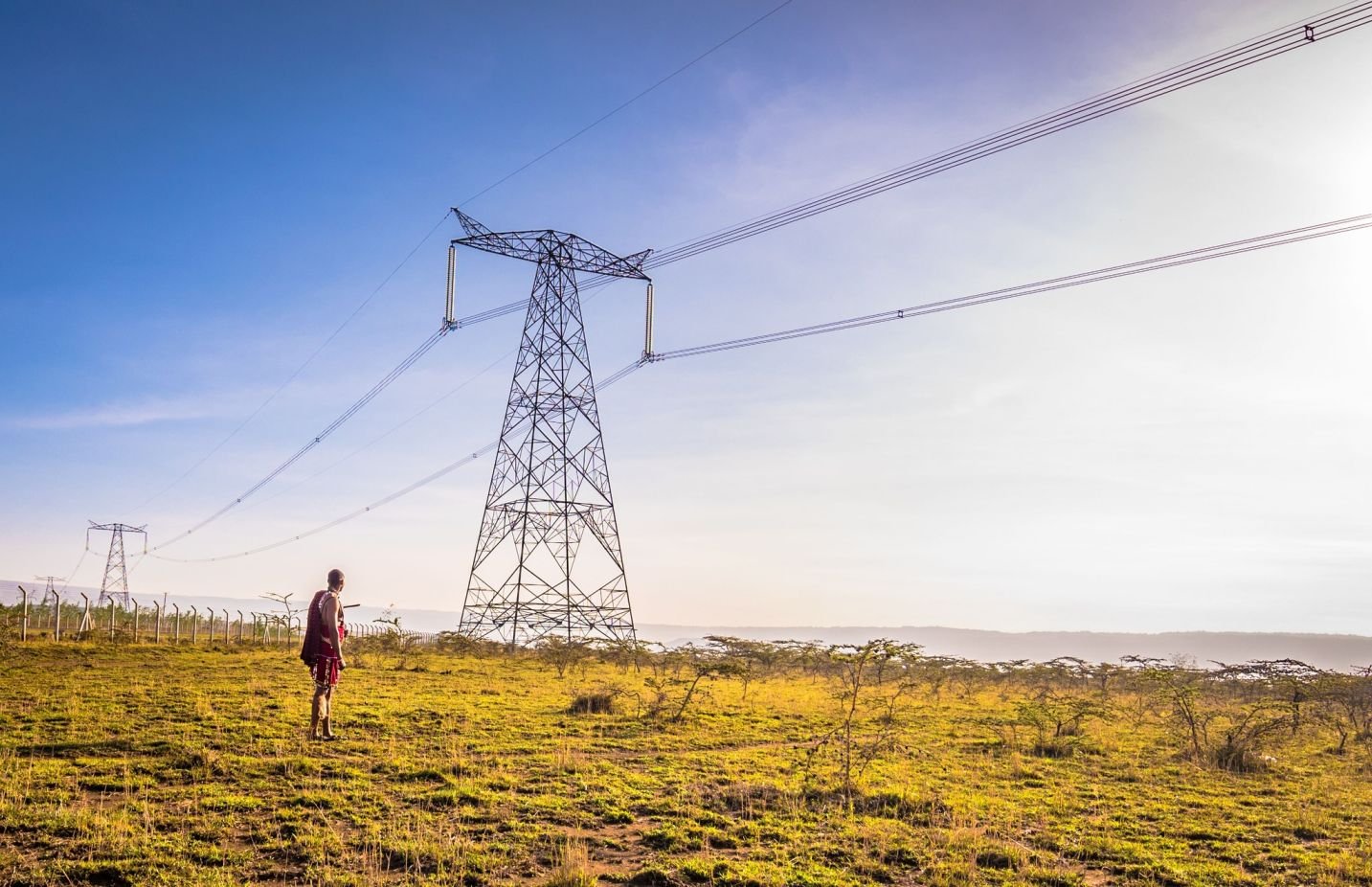
The governments of Tanzania and Kenya have completed and energized a 510km long 400kV transmission line between the two countries, which will allow the two countries to exchange power and import energy from other countries connected to the grid.
The transmission line will have a transmission capacity of 2GW and will be connected to the existing Ethiopia-Kenya interconnector via the 400kV Isinya-Suswa line and will form part of the East African Power Highway. As such, it is a key link for power transfer between the East African Power Pool (EAPP) and North African countries such as Sudan and Egypt.
We have successfully energized the 400kV Kenya-Tanzania interconnection line. The synchronization of the two power grids was completed today, marking an important step towards power integration.
Funded by @AfDB_Group and Gok. #EAPPPowerTrade2024 #Regional Integration pic.twitter.com/iEiwfv0IES
— Ketraco (@KETRACO1) December 13, 2024
In Tanzania, construction included the construction of a 414km double-circuit line from Singida in the central region via Babati and Arusha to the border town of Namanga, as well as the construction of a 400kV substation in Arusha and the expansion of the 220/33kV Singida substation.
The work was carried out in lots and the contractors were a team from France’s Bouygues Energy and Services, India’s Kalpataru Power Transmission, Bosnia and Herzegovina’s Energoinvest and India’s EMC.
In addition, four 400kV substations were constructed in the towns of Iringa, Dodoma, Singida and Shinyanga for rural electrification, under which approximately 80km of 33kV transmission lines and low voltage systems including consumer connections were constructed.
Source: Project Evaluation Report, 2015
In Kenya, North China Electric Power Engineering Company built a 96km double-circuit line from Isinya substation to the Namanga border. The project included rural electrification works consisting of 147km of 33kV lines, 34 transformers and consumer connections.
The total project cost is estimated at US$309.3 million, with funding provided by the African Development Bank, the Japan International Cooperation Agency (JICA), and the governments of both countries.
The Kenya-Tanzania interconnector will not only facilitate power interchange between the two countries, but will also allow Tanzania to import hydropower from Ethiopia via the Ethiopia-Kenya line. Tanzania Electricity Supply Company (Tanesco) plans to purchase 100MW from Ethiopian Electric Power (EEP), which will increase to 200MW over the next three years.
To facilitate this power transaction, Ketraco and Tanesco signed a wheeling agreement that allows Ketraco to earn revenue by providing transmission services.
The Ethiopia-Kenya-Tanzania (EKT) agreement is the first consignment transaction within the EAPP, with countries agreeing to formally start cross-border electricity transmission and trade on other energy platforms from March 2025.
The announcement was made by EAPP member states at a ministerial meeting held in Kenya in early December 2024. The move is expected to benefit more than 620 million people.
The EKT transaction is expected to serve as a case study in the development of a transmission pricing methodology for the EAPP electricity market, which will be set up in early 2025.
EAPP was established in 2005 by seven East African countries: Burundi, Democratic Republic of Congo (DRC), Egypt, Ethiopia, Kenya, Rwanda and Sudan. Following this, the EAPP was adopted by the Heads of State of the Common Market for Eastern and Southern Africa (COMESA) region as a specialized agency to promote interconnectivity of electricity systems. Later, Tanzania, Libya, Uganda, South Sudan, Somalia and Djibouti joined the power pool.
Ketraco Managing Director John Matibbo said the Kenya-Tanzania route will be dispatched on an Economic Merit Order, enhancing access to cheap electricity through the EAPP. He also said the transmission line will facilitate power interchange between Ethiopia, Kenya and Tanzania, as well as the Southern African Power Pool (SAPP), through the recently progressed Tanzania-Zambia (Taza) interconnector project.
The Taza project aims to take advantage of Tanzania’s strategic location on the border between EAPP and SAPP to facilitate power interchange between the two markets, connect underserved areas in southwestern Tanzania, and increase transmission capacity in northern Zambia.
The interconnection and synchronization of EAPP and SAPP is expected to create the world’s largest geographic energy market, stretching from Cape Town, South Africa to Cairo, Egypt.
Works in Tanzania include the construction of a 620km 400kV double-circuit transmission line from Iringa via Kisada and Mbeya to Tunduma and from Tunduma to Sumbawanga, connecting the grid in northwestern Tanzania to the Zambian interconnection. A 4km 330 kV transmission line will extend from the Tunduma substation to the Zambian border, completing the connection to the Zambian power grid.
The project includes substation work, which has been awarded in lots to contractors including China’s TBEA, Sinohydro and India’s Transrail Lighting. Transmission line commissioning is expected to be completed by October 2025 and substation commissioning by May 2026.
The Tanzanian portion of the interconnector will cost US$605 million and is financed by the World Bank, Agence Française de Développement AFDD, the EU and the government.
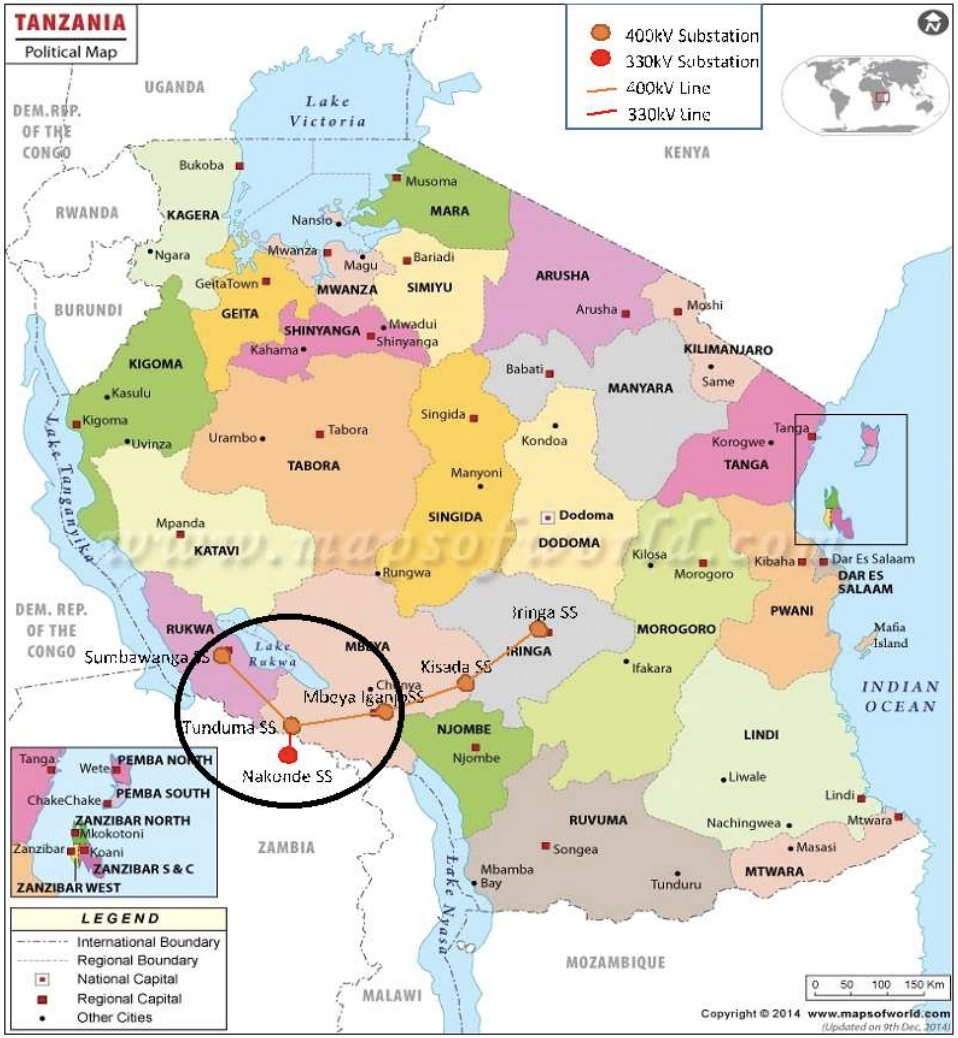
Source: Project Report, 2018
Meanwhile, the Zambian portion of the Taza interconnector is being reviewed by the World Bank for a US$292 million funding commitment and is expected to be presented to the Executive Board on 21 January.
According to the latest Environmental and Social Management Plan, published in November 2024, the World Bank has agreed in principle to provide the bulk of the funding for the plan, with smaller contributions expected from the EU and UK governments.
The project will construct a 608km transmission line from Pensuro in central Zambia through Mpika and Kasama to Nakonde on the Tanzanian border.
The proposed scope includes 186km of 330kV single-circuit line from Pensuro to Mpika and associated substation extension works at Pensro and Mpika. Expansion of the 200km 330kV single-circuit line from Mpika to Kasama and associated substations between Mpika and Kasama. 212km 330kV double circuit line from Kasama to Nakonde. 15km of 400kV (charging at 330kV) double circuit line from Nakonde to the Tanzanian border. 12km of 132kV double-circuit line from Isoka to Nakonde (loop-in and loop-out of the 66kV Isoka-Nakonde line). and the new Nakonde 330/132/66kV substation.
The General Procurement Notice was issued by Zambia Electricity Supply Corporation (Zesco), the project implementing agency, in October 2024 and can be viewed here.
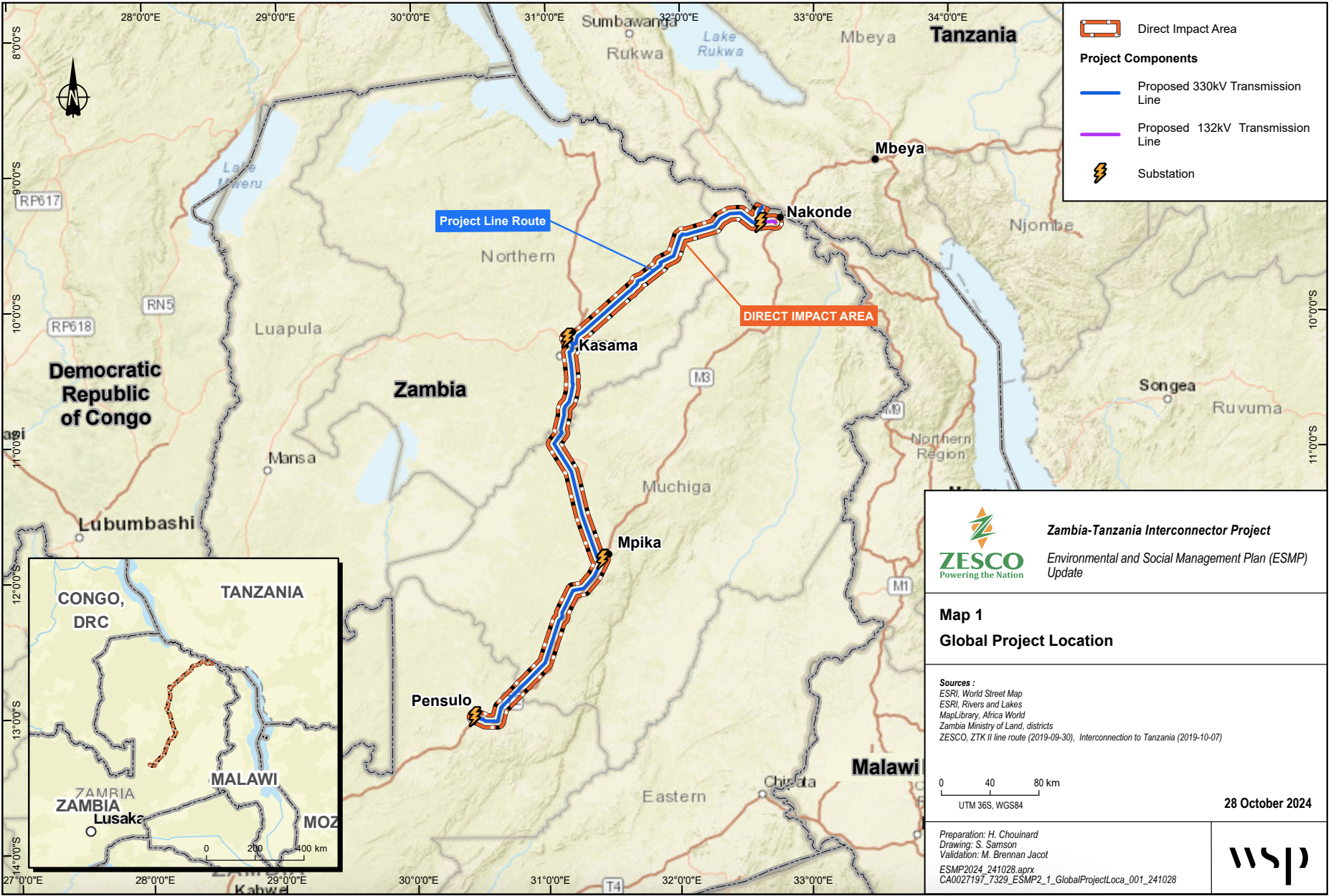
Source: Project Report, November 2024
The Taza transmission line is also envisaged to enable power evacuation infrastructure for the proposed Karunwisi and Rhubu River hydropower projects in Zambia, with a total installed capacity of over 300MW.
The EAPP-SAPP interconnection will also facilitate the development of the North-South Transmission Corridor, a project in conjunction with the African Union’s Infrastructure Development Program for Africa (PIDA). The proposed 8,000km line would run from Egypt to South Africa via Sudan, Ethiopia, Kenya, Tanzania, Malawi, Mozambique, Zambia and Zimbabwe.
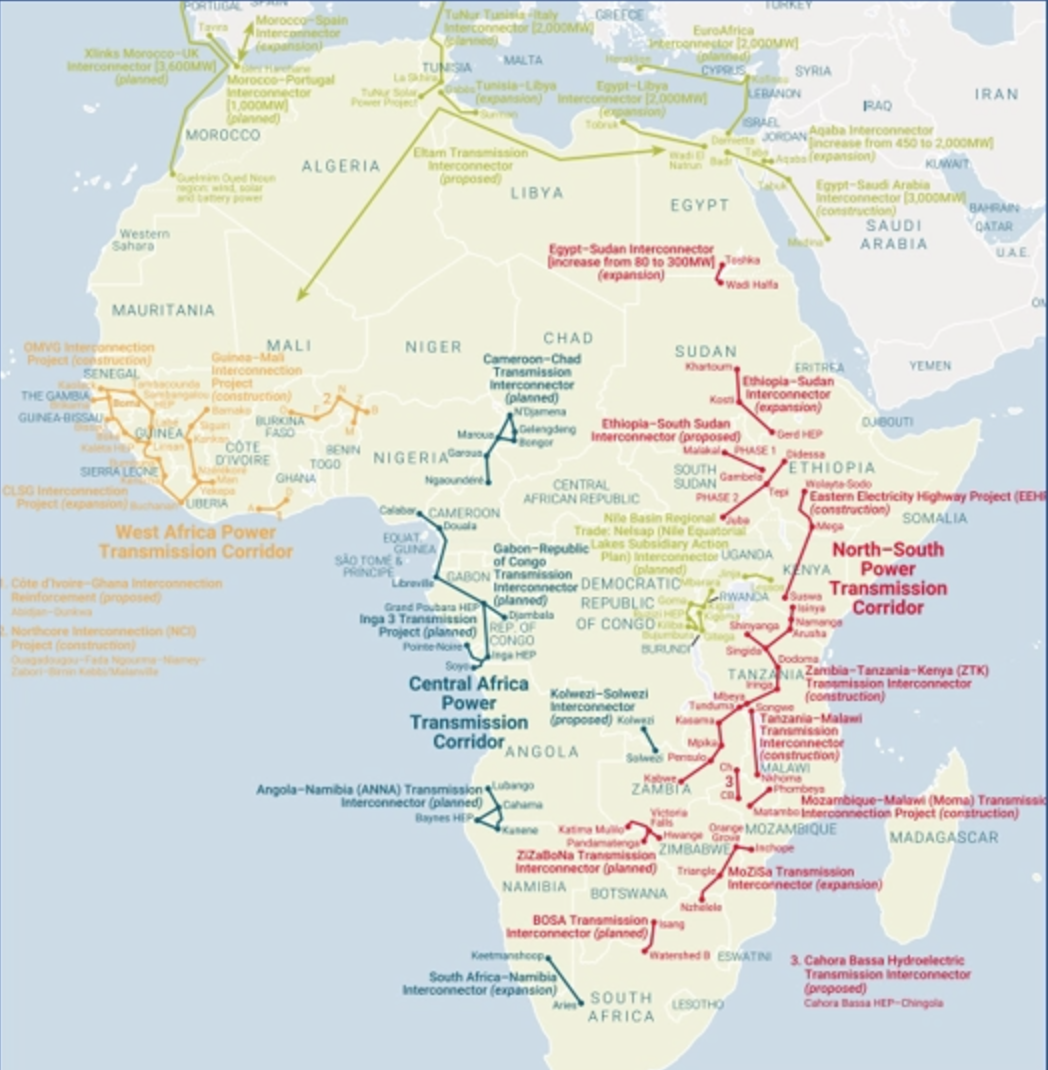
Source: Africa-EU Energy Partnership, August 2023
Top photo: Ethiopia-Kenya interconnector (Source: Facebook@Ketraco)
