


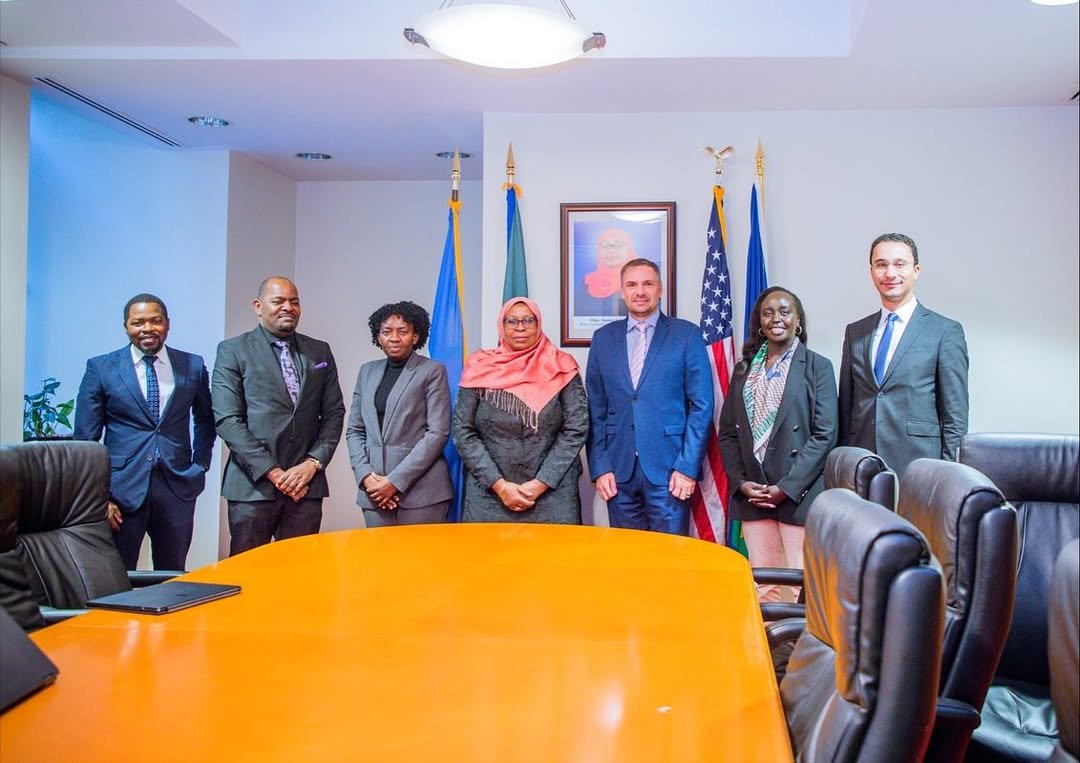
Tanzania recently announced new measures to expand cooperation with the pan-African infrastructure investment platform, Africa50, to accelerate the implementation of medium- and large-scale development projects.
The announcement was made in Washington by Amina Khamis Chabaan, Deputy Undersecretary of the Treasury, after a meeting with John Pierre Fourie, Africa50’s Director of Strategy, Relations and Investment. The meeting focused on how both sides can leverage innovation, sustainable financing and regional partnerships to deliver projects that advance Tanzania’s long-term development goals.
According to Shabane, the cooperation aims to strengthen Tanzania’s capacity to implement strategic projects in transport, energy, water and digital connectivity, which are key areas for Tanzania’s Third Five Year Development Plan and National Development Vision 2050. He emphasized that the Africa 50 approach, which combines project development and financing within one framework, is closely aligned with Tanzania’s ambitions to modernize its economy and improve infrastructure development through a mixed public-private investment model.
Also read: Tanzania confirms new natural gas discovery in Mtwara region
Africa50 was established in 2012 by African governments and the African Development Bank (AfDB) and aims to address one of the continent’s most persistent barriers to growth: the infrastructure financing gap. The platform operates two key arms. Africa50 Project Development and Africa50 Project Finance work together to take viable projects from concept to completion. Its mission is not only to finance infrastructure, but also to unlock the flow of capital by building bankable projects and attracting private investors into the traditional public domain.
The partnership between Tanzania and Africa50 is expected to accelerate projects with tangible social and economic impact. He noted that by working together, the Government and Africa50 can build on recent advances in the transport and energy sector, where strategic corridors and renewable energy initiatives are helping to rebuild regional connectivity. “This cooperation gives Tanzania the opportunity to implement large-scale projects that directly support industrialization and trade integration while improving livelihoods,” she said.
Africa’s infrastructure deficit remains substantial, estimated at between $130 billion and $170 billion annually, according to AfDB data, with a funding gap of nearly $100 billion.
East Africa alone requires major investments in roads, energy and digital networks to sustain growth and achieve the goals set out in the African Union’s Agenda 2063. For Tanzania, which has recorded stable GDP growth averaging around 5 percent in recent years, the challenge is not only to build infrastructure, but also to ensure long-term sustainability and resilience to climate change.
Africa50’s investment strategy prioritizes green and climate-resilient infrastructure. This is consistent with Tanzania’s goal of reducing carbon intensity while expanding access to energy and mobility. The platform focuses on renewable energy projects, sustainable transport and smart cities, and fits into the broader push for green growth across the continent. Recent examples include Africa50’s investments in solar power projects in Egypt and Rwanda and digital infrastructure in West Africa.
The Tanzanian government hopes to attract similar initiatives that support local job creation, technology transfer and regional trade.
The meeting in Washington also considered the role of innovation and capacity building in sustaining infrastructure development. Both sides agreed on the need to develop organizational expertise that can manage complex projects locally, rather than relying heavily on external contractors. This is in line with Africa50’s focus on building African-led project management capacity and fostering partnerships that sustain economic value within the continent.
Also read: Follow the money: How South Africa’s financial watchdog is cracking down on illegal wildlife trade
The creation of Africa50 is rooted in the 2012 Declaration on Infrastructure Development for Africa (PIDA), in which African heads of state called for innovative financing mechanisms to accelerate infrastructure development. As of 2025, African50 counts more than 30 shareholder countries, including Tanzania, and continues to expand its portfolio of projects across transport, energy, ICT and urban development.
Cooperation with Tanzania is a step towards diversifying funding sources and aligning infrastructure expansion with sustainability principles. While reliance on traditional concessional financing has often limited the pace of development, partnerships like Africa50 offer a model that combines commercial viability with development objectives. By leveraging private capital alongside public funds, Tanzania can pursue projects that deliver tangible benefits, such as lowering logistics costs, improving market access, and expanding renewable energy capacity.

The government also indicated that cooperation with Africa50 will support the implementation of flagship national projects under FYDP III, such as energy interconnection with neighboring countries, upgrading the central corridor, and investing in port and airport facilities. Such projects are essential to the country’s role as a regional hub for trade and logistics in East and Central Africa.
The new partnership confirms the growing view that sustainable infrastructure means more than just building, it means long-term resilience, economic inclusion and environmental stewardship. This cooperation, through Africa50’s mixed finance approach and Tanzania’s policy linkages, has the potential to demonstrate how African countries can take control of their development agendas using regional instruments designed by Africans and for Africa.
Also read: Kenya Agribusiness Summit launches new blueprint for agricultural transformation
Shaban concluded that “Tanzania’s cooperation with Africa50 is not just about funding projects, but reimagining the future of providing infrastructure across the continent.”
Connect with us on LinkedIn: Sustainability in Africa matters
