


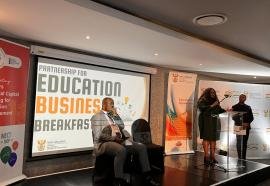
Basic Education Minister Siviwe Gwalbe called on the private sector to consider taking its involvement in the education sector to the next level.
The Minister emphasized that the private sector has the resources, expertise and capacity to have a significant impact on the educational environment.
Additionally, the country is seeing a growing number of private sector entities involved in education initiatives, including investing in infrastructure, providing technology, supporting teacher training, and even partnering with educational institutions to design relevant, future-oriented curricula.
The Minister was speaking at the Partnership for the Business of Education breakfast held at the Johannesburg Council for Persons with Disabilities (JOCOD) in Lenasia on Monday.
The Business Breakfast was designed to foster meaningful dialogue and establish partnerships to alleviate budget constraints in the education sector.
Minister Gwalbe used the event to outline the strategic priorities of the Seventh Government and discuss how collaboration between the public and private sectors can foster sustainable improvements in the education system.
“Today I would like to call on our private sector partners to consider taking their involvement in the education sector to the next level.
“As the seventh government of South Africa’s Government of National Unity (GNU), we are fully committed to improving educational outcomes across the country.
“We recognize that this cannot be achieved by governments alone. The private sector has an important role to play and we are here to facilitate, support and collaborate with you in ways that have the greatest impact,” she said, adding that gradual investment in education goes beyond just financial support and means active participation.
The Minister invited private sector partners to work closely with the Department of Basic Education (DBE) to co-create programs that build the skills needed for a competitive and productive economy.
“We need your input, insights, and innovations to shape our education system so that learners are prepared for real-world challenges and opportunities.”
Investing in quality education
Following the country’s launch of the GNU in May, the minister stressed that education is an important issue that everyone can agree on, regardless of political leanings.
He said all South Africans had a keen interest in the quality of the country’s education sector, adding that since the dawn of democracy, much had been done to provide access to basic education.
But 30 years later, the country now needs to shift its focus to quality education, she said.
The Minister referred to an international study that revealed that around 80% of learners tested (as a sample) were unable to read meaning in any language.
Although this is a small sample, she said it is very concerning.
“Without improving literacy, reading, numeracy and other skills, the DBE will be unable to fulfill its core functions, which is why every priority of the seventh administration speaks to this goal.
“We need to ensure that through early years learning we can achieve the goal of reading with meaning by Year 4. Governments tend to focus solely on the quality of outcomes, such as maths pass rates, rather than the foundations of learning.
“I am trying to reorient this plan and this mindset. Let’s get the basics right and we will achieve a lot in the education sector,” the minister said.
Minister Gwalbe emphasized that quality education is the foundation on which the country can build a prosperous future.
“This is a tool that empowers young people to innovate, become leaders, and contribute meaningfully to their communities and economies.
“But to achieve this, our education system must be strong, comprehensive, and responsive to the needs of a modern workforce.”
She further emphasized the need to provide not only basic literacy and numeracy skills, but also the skills needed for 21st century jobs and challenges, such as digital literacy, critical thinking, adaptability and creativity.
priorities
Touching on priorities, the Minister said the Seventh Government has identified several key priorities, including improving access to and strengthening the quality of early childhood development (ECD).
“A strong foundation in reading, writing and numeracy is important. Early childhood development sets the stage for lifelong learning and personal growth. We want all South African children to leave ECD with a strong foundation in reading, writing and numeracy,” the Minister said.
Other priorities include improving literacy and numeracy at all levels of schooling, special education, accelerating teacher development, and safety in schools.
“Learners need a safe and conducive environment where they can focus on their learning without interruption. This includes not only basic facilities such as dignified flush toilets, but also a learning environment free of crime, extortion, contaminated food and other dangerous chemicals,” she said.
The Minister noted the high number of learners in Naledi, Gauteng who have fallen ill and who have tragically lost their lives due to food purchased from local spaza shops and consumed on school premises.
“Last Wednesday, I began the process to ban a dangerous chemical known as an organophosphate from all schools in South Africa. This is a proactive step to prevent the risk of this chemical being used as a pesticide in any school,” she said.
Read | President Ramaphosa says food poisoning incidents will be managed at the highest level
– SAnews.gov.za
