


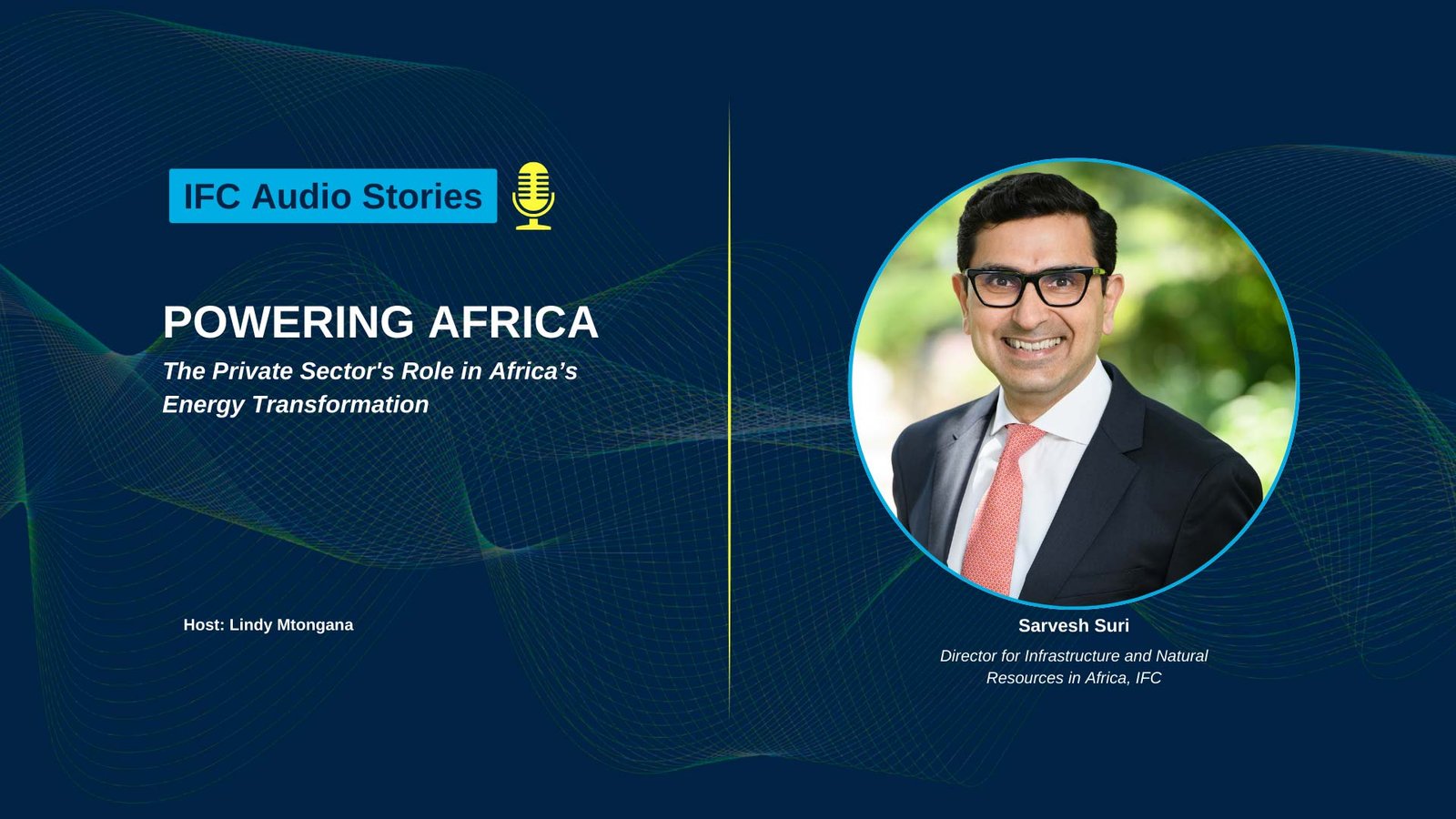
Lindy Montongana: This is IFC Audio Stories exploring private sector solutions to global development challenges. I’m your host, Lindy Montongana.
Spring meetings conclude here in Washington, DC. The Spring Meeting is an annual event in which the International Monetary Fund and the World Bank Group invite leaders from business, government, and civil society to address issues such as the global economic outlook, poverty alleviation, and, of course, development.
Well, one of the big topics this year was to provide electricity to Africa. This means that reliable, affordable and sustainable energy is urgently needed to drive Africa’s development and lift millions of people out of poverty.
We sent wandering reporter Kamryn Billet to find out how much this resonates with Spring Meeting attendees.
Kamryn Billet: “My question to you is: What does this word mean to you? Power is a human right.”
Kamila Atta: “For me, power means giving people control over their lives, autonomy, independence and the ability to do what they want without restrictions.”
David Barot: “Power is light, power is livelihood, power is jobs, economic growth. And in 2024, without power, you can’t live in this world, you can’t make a just living. And of course, it’s clear that power is a human right today.”
Lindy: So let me give you a perspective from the International Finance Corporation. This time we are joined by Sarvesh Suri, Director of Infrastructure and Natural Resources for Africa at IFC. Sarvesh, welcome to IFC Audio Stories.
Sarvesh Suri: Thank you.
Lindy: To start, could you explain the scale of Africa’s electricity shortage and its impact on development?
Sarvesh: There are currently more than 600 million people in sub-Saharan Africa who are not connected to the grid or have no electricity in their homes. Unfortunately, at the current pace of electrification, more than 500 million people will remain without access to electricity by 2030, deferred by the fallout from the coronavirus and the war in Ukraine, in sub-Saharan Africa. By 2030, approximately 400 million people will be living in fragile and conflict-affected environments. So what is very clear to us at the World Bank Group is that we need to change the pace of Africa’s electrification, and we need to take this seriously as a battle to empower Africa in the future. You asked the question, what are the implications for development? Therefore, if we focus on number seven of the United Nations Sustainable Development Goal, which is universal access to clean and reliable electricity, Africa is the region where the battle for energy access will be won or lost. Without access to reliable, affordable and sustainable electricity, the region will not be able to achieve its development aspirations or achieve the economic transformation needed to lift millions of people out of poverty. On a human level, a lack of electricity means children are unable to study in earnest in the evenings, schools are not digitally connected, and hospitals remain short of medicines that need to be stored at cold temperatures. Small manufacturers and small businesses are unable to actually power machines or increase productivity, thereby creating the jobs that millions of people need to lift themselves out of poverty. Therefore, I strongly believe that power is truly a human right, and that it touches on two of the most fundamental issues for IFC. The first is that it affects quality of life. And the second is that it hinders economic development, thereby holding us back from fully fulfilling our mission of creating opportunities to improve people’s lives.
Lindy: During the Spring Meetings, World Bank Group President Ajay Banga made important announcements about the Bank’s efforts to accelerate the electrification of Africa. Let’s listen:
Ajay Banga, President of the World Bank Group:
“As you know, C.O.P. At 28, the World Bank made a commitment to connect 100 million Africans to affordable energy by 2030. What we’re doing today is doubling down on that commitment by bringing together all parts of the bank across Africa to really think about how we can make this happen. If we can reach 300 out of 600 by 2030, that’s 50 million people. That’s great.”
Lindy: Sarvesh: Of course, that’s World Bank Group President Ajayi Banga, who, alongside African Development Bank President Akinwumi Adesina, announced an ambitious commitment to provide affordable electricity access to 300 million people across Africa by 2030. What is the role of IFC and the private sector in achieving this goal?
Sarvesh: The private sector is at the heart of the challenge of empowering Africa. But this large-scale effort to mobilize the private sector will not be easy. That’s pretty ambitious. It’s literally like fighting a battle, and we know from IFC that we have to fight this battle on all fronts. We have developed a five-pillar strategy to tackle this issue across transmission, distribution and generation in both on-grid and off-grid sectors.
Therefore, our five-pillar strategy is: First, for the first time in Africa, we are working to create opportunities for private sector solutions to transform the transmission and distribution sector. Second, we will focus on off-grid solutions. So basically, remote areas that are not currently connected to the grid or areas that are not close to large cities are best served by what we call independent small-scale mini-grids, with small power sector generators and small connections within the area connecting 1000 households. So we at the World Bank Group started focusing on off-grid renewable energy solutions. Third, it will continue to play an important role in on-grid power generation, the large power plants that are critical to providing the continent’s real electricity needs. Fourth, we are focused on being at the forefront of innovation and introducing new technologies to the sector. And fifth, we are also focused on modernizing and corporatizing state-owned powers and institutions, and moving some power assets out of government hands and into the private sector to operate more efficiently.
Lindy: I like this analogy of this being a battle. So you have your partner, the private sector, and your weapon, this five-pronged approach. But what about in regions where this is particularly difficult: countries characterized by fragility, conflict and violence? What are some of the challenges in implementing these electrification projects? How does IFC navigate these complexities?
Sarvesh: So the complexity of the fragile environment is much greater than in other countries in Africa. The political risks facing retail investors in a fragile environment are extremely high. So the first thing we do in working with governments in addressing fragile environments is to get a firm commitment from governments to reform, which is really needed to drive national action, and also to bring private sector participants into the country. Another challenge faced by fragile environments is that the policy environment in these countries is generally unstable. Therefore, it is also very important to mobilize the combined efforts of the World Bank Group to develop and implement projects in this area. Here are just a few examples of projects we support in vulnerable environments. So last year, we provided nearly $100 million in debt to a company called SCATEC Release. Today, it is a company that is truly innovating at the product level, including in the way power projects are delivered. So they’re essentially taking a containerized solar power solution in the sense that they can put the solar power plant in a shipping container and transport it very easily on the back of a trailer to a very remote part of a vulnerable country. By doing so, and by innovating contract arrangements, we can reduce the time from start to finish for small power projects to up to nine months, compared to the traditional IPP standard of three to seven years. Innovations like this, where entire power generation projects can be packaged in shipping containers and deployed very quickly on site, are therefore essential to making a difference in fragile environments.
Lindy: That’s a really great innovation, and just hearing about it, I can already imagine the impact it’s going to have. Now, let’s take the perspective of a private company. Now, at Spring Meeting, our wandering reporter Kamryn Billet caught up with Folake Soetan, CEO of Ikeja Electric. The company, headquartered in Lagos, Nigeria, is the largest private electricity distribution company in sub-Saharan Africa.
Folake Soetan, CEO, Ikeja Electric Plc
Energy access in Nigeria is about 54%. Therefore, one of the important things is to ensure that we have a legal and regulatory framework and policies that encourage institutions such as the World Bank and IFC to support local mini-grid suppliers and power companies and ensure that they implement projects that improve energy access in Nigeria.
Lindy: So Folake touches on how the private sector is looking to governments and institutions like the World Bank and IFC to scale up projects. Sarvesh, final words on Ajay Banga’s announcement. In just six years, 300 million people in sub-Saharan Africa will have access to affordable electricity. How is this done?
Sarvesh: This is truly a battle that has to be fought on every level. But we also need an “all hands on deck” approach. That is why we are working closely with all stakeholders, including governments themselves, private sector participants and customers, as well as other MDBs and donors, to bring everyone on board on this agenda, in order to power the 250 million people we want to power by 2030.
The World Bank stands ready to support government reforms and financing, IFC and MIGA, as well as mobilize private enterprise. We have significantly increased our investments in equity and debt. We have significantly strengthened our PPP advice to governments, as well as our technical and upstream advice to private sector actors. And now, in collaboration with MIGA, which is also launching a unified assurance platform to provide political risk insurance, we will work together to realize the ambitious challenge of achieving SDG 7, which puts Africa firmly back on track to excite by 2030.
Lindy: That’s very exciting. Imagine in 2030 you might be looking back at this as a tipping point.
Sarvesh: It’s a very happy moment. This is a challenging moment for all of our teams. But we are very ambitious in this ambition. And countries on other continents, such as Asia and Latin America, have achieved 100% electrification. Now it’s Africa’s turn.
Lindy: Certainly. Thank you very much, Sarvesh.
Sarvesh: Thank you.
That’s all for today. I would like to express my sincere gratitude to our guest, Mr. Sarvesh Suri (Director of Africa, Infrastructure and Natural Resources, IFC). Visit ifc.org to learn more about how the agency is scaling up solutions and investments to connect millions more Africans to electricity. Thank you for listening to IFC Audio Stories. This episode was hosted and produced by me, Lindy Montongana, with additional reporting by Camryn Billet. Until next time, goodbye!
