


641
Onomeamuge
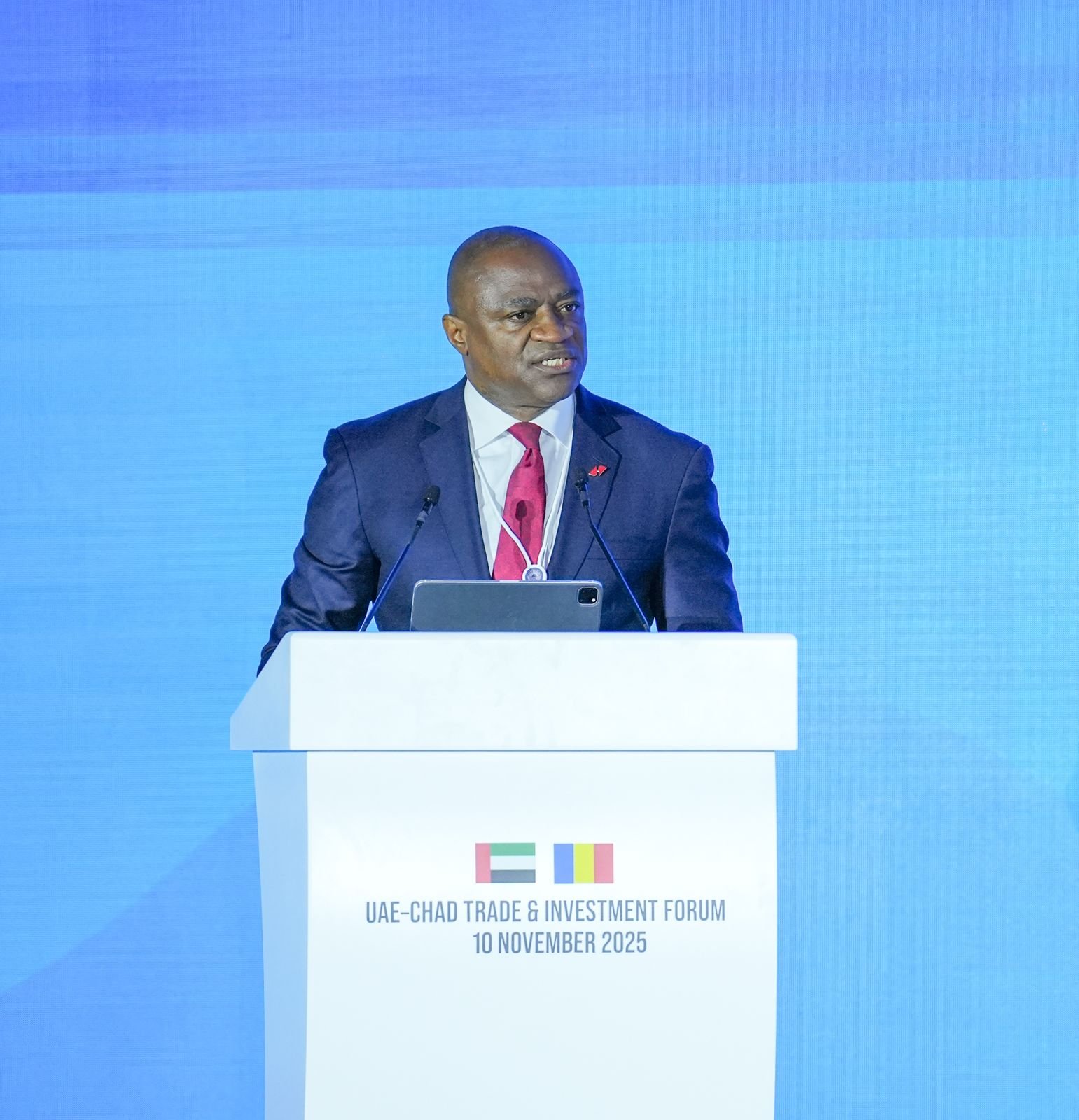
Addressing participants at the UAE-Chad Trade and Investment Forum in Abu Dhabi, Oliver Arauba, Group Managing Director of UBA Group, called for new financing models to promote Africa’s competitiveness, saying Africa needs to channel capital and partnerships into productive projects.
At the opening session of the UAE-Chad Trade and Investment Forum on Monday, the Group Managing Director of UBA Group told attendees that Africa is decisively moving from dormant promises to active realization. In a keynote address themed “Financing Africa’s Competitiveness – Building Bridges and Accelerating Progress,” UBA GMD laid out three challenges: mobilizing capital, building profitable projects, and deepening partnerships, especially between African institutions and Gulf investors.
“For too long, the story around Africa has been one of possibility. But I stand before you today and declare that the age of possibility is over. We have now entered the age of action,” he said.
The forum, co-hosted by the United Arab Emirates and the Republic of Chad, serves as the launching pad for Chad’s national development program, Chad Connection 2030.
The plan, valued at an estimated $30 billion and comprising 268 projects across infrastructure, industrialization and human development, provides the highlight of Africa’s transition to an ambitious, results-oriented strategy.
“The $30 billion Chad Connection 2030 plan is not just a document, it’s a statement of intent. … Competitiveness doesn’t come from the boardroom. Competitiveness is built on the ground,” Arauba said.
The UBA executive noted that the capitals that will transform Africa exist within and outside the continent. He cited African Finance Corporation (AFC) estimates showing that Africa’s total domestic financial assets are approximately $4 trillion ($2.5 trillion in commercial banking assets, $725 billion in foreign exchange reserves, $455 billion in pension assets and $320 billion in insurance assets). But less than 15 percent of that pool goes into productive infrastructure.
“At UBA, we have always believed that the capital exists within and beyond the continent to transform Africa. The challenge is never a lack of capital, but a lack of bankable structures and trusted partnerships,” he said.
Mr. Arauba further emphasized UBA’s position not only as an intermediary but also as a financial architect that mobilizes domestic institutional capital, partners with development finance institutions (DFIs), and attracts global investors to African-led infrastructure projects.
He cited developments in Tanzania, where UBA has injected more than $400 million into the Julius Nyerere hydropower project. And in Nigeria, banks invested more than $700 million in the power sector after privatization and participated in a $10 billion syndicate for the Dangote refinery.
Turning to Chad, Mr. Arrauba outlined UBA’s commitment to the country’s development priorities. He cited Chad’s goal of achieving 60 percent electrification by 2030 and expanding access to water to an additional 11 million people.
“Chad’s goal of 60% electrification by 2030 will enable factories to operate, agricultural cold chains to function and a digital economy to thrive,” he said.
“This means recognizing that access to water for 11 million more people will drive economic transformation. Safe water reduces the burden on health care, enables the food processing industry, and unlocks agricultural productivity across the value chain,” Arauba added.
In explaining the mechanisms for financing Africa’s competitiveness, the keynote highlighted a partnership model consisting of international expertise and capital (such as Gulf hubs and global financial centres), African institutional banking with local knowledge, and DFIs providing de-risking tools and concessional finance.
UBA GMD said that multiplier effect is the key to unlocking the vault for Chad’s $30 billion plan. UBA operates in 20 African countries and global centers including Dubai, London and New York, and will lead in structuring syndicated transactions, solar and water treatment PPPs, digital platforms and regional energy grid connections.
Reflecting on his practical efforts, he said: “We are here to be a financial engine, a trusted partner, and a bridge that connects visionary plans to concrete reality.” He emphasized inclusivity, pointing to UBA’s presence far beyond the capital, including branches in Beira in Mozambique, Nzerekole in Guinea and Gulu in Uganda. We will ensure that small and medium-sized enterprises, farmers, and entrepreneurs, who form the backbone of the economy, are not left behind.
At the UAE-Chad Trade and Investment Forum, Chad’s development plans were formally announced and several memorandums of understanding worth billions of dollars were signed.
