


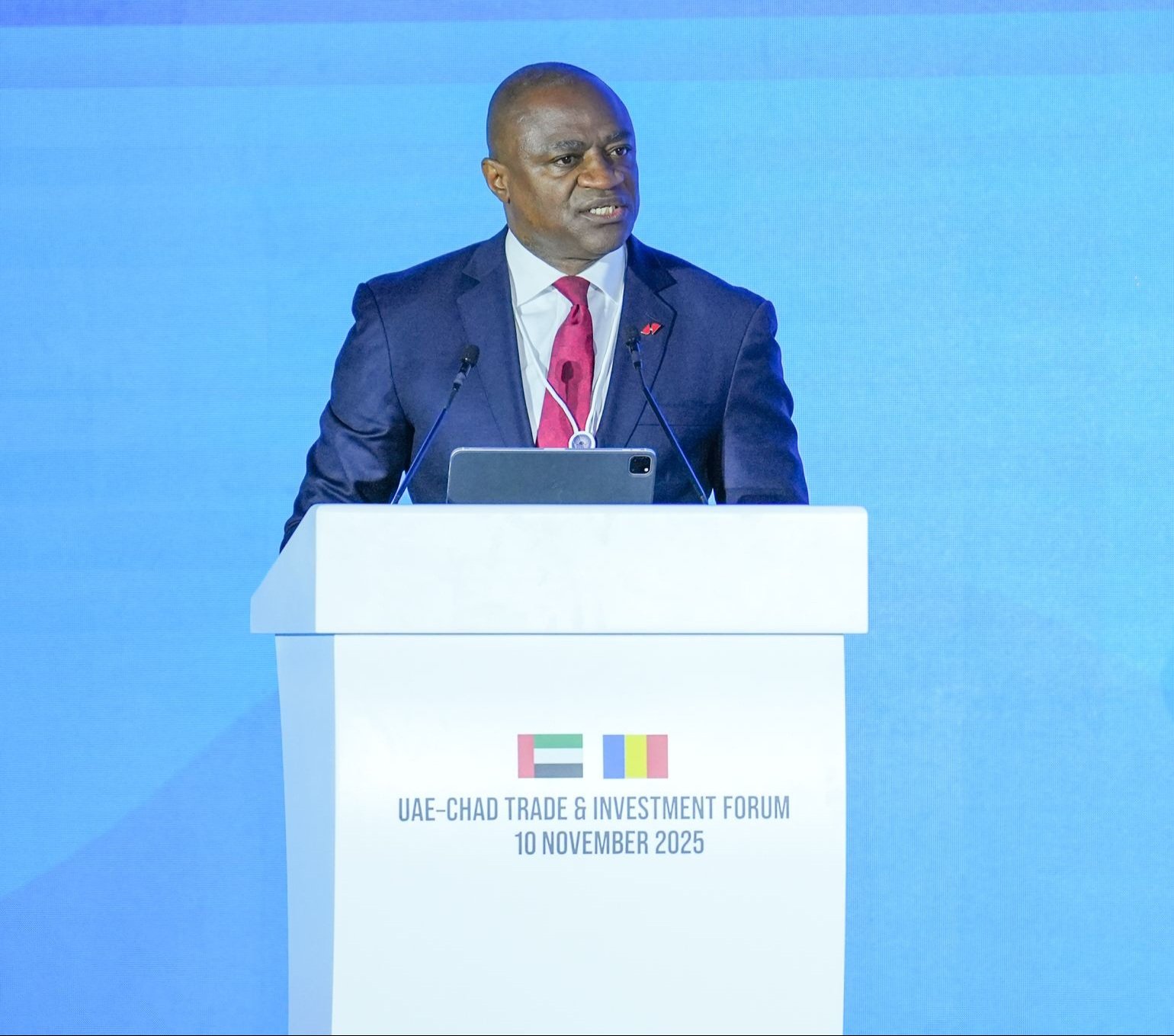
UBA’s Arauba says ‘the era of possibility is over’ as bank works to advance Chad’s $30 billion growth plan
Written by Jeffrey Agbo
United Bank for Africa (UBA) Group Managing Director Oliver Arauba has declared that Africa has moved beyond the stage of possibility and into the stage of implementation, with the continent embracing large-scale development and strategic financing partnerships.
Speaking at the UAE-Chad Trade and Investment Forum in Abu Dhabi on Monday, November 10, 2025 on the theme ‘Financing Africa’s Competitiveness – Building Bridges and Accelerating Progress’, Mr Araouba said: ‘For too long, the narrative around Africa has been one of possibilities. But I stand before you today and declare that the era of possibilities is over. We have now entered the era of implementation.’
He described Chad’s $30 billion Chad Connection 2030 plan as a “statement of intent” and “a detailed roadmap to move the country from the periphery to the center of global economic competitiveness.” He added that the initiative, with 268 projects focused on infrastructure, industrialization and human development, proves that “competitiveness is not born in the boardroom, it is built on the ground.”
Mr. Arauba identified reliable energy, access to water, and strong governance as key pillars of sustainable financing. “That means understanding that a reliable power grid is the foundation for industrial growth,” he said. “Chad’s goal of 60% electrification by 2030 will enable factories to operate, agricultural cold chains to function and a digital economy to thrive.”
He also highlighted the transformative impact of water infrastructure, noting that by reducing health costs, boosting agriculture and supporting the food processing industry, “an additional 11 million people will have access to water and economic transformation will be accelerated.”
On financing mechanisms, the UBA chief called for a model of cooperation involving African banks, global investors and development finance institutions. “The answer lies not in a single source of information, but in a strong collaborative model, where African financial institutions like UBA step up as financial architects, not just intermediaries,” he said.
He stressed that Africa’s challenge is not a lack of capital, but a lack of “bankable structures and reliable partnerships.” Citing the African Finance Corporation, he said the continent’s domestic financial assets are worth about $4 trillion, but “currently less than 15% of these assets are directed toward productive infrastructure essential for growth.”
Arauba cited UBA’s project portfolio across the African continent, including $400 million for the Julius Nyerere hydropower project in Tanzania, $700 million for Nigeria’s power sector, $10 billion for participation in the Dangote refinery syndicate, and $315 million for road infrastructure in Ghana.
In Chad, it revealed: “We have already committed more than $102 million in direct investments in securities in Chad, making us a leading investor in important national projects, from a $49 million domestic gas project to bring clean energy to homes, to a $6.7 million wind farm in Amjaras, and critical funding for road maintenance and communications modernization.”
He emphasized inclusivity, saying that “true competitiveness requires an inclusive economy,” adding that UBA’s presence has expanded to remote areas in countries such as Mozambique, Guinea-Conakry and Uganda, enabling small businesses, farmers and entrepreneurs to access finance.
The UBA chief also outlined a three-tier partnership model for Africa’s growth. “International expertise and capital, particularly from partners such as the UAE… African institutional banking and local knowledge… (and) development finance institutions (DFIs) such as the World Bank and AfDB.”
He said that if these factors were aligned, “strategic anchor investments in Africa could attract international capital at a ratio of 10:1 or even 20:1”, describing this as “the key to unlocking the vault” of Chad’s $30 billion plan.
Arauba reaffirmed UBA’s readiness to partner with Chad, saying: “Chad Connection 2030 is a bold invitation to the world: ‘Come and build with us.'” At UBA, we don’t just accept the invitation. We are already rolling up our sleeves. ”
He concluded with a message of unity and common purpose, quoting the founding father of the UAE, Sheikh Zayed bin Sultan Al Nahyan. “They were able to do so because they recognized the need to work together and mobilize resources and skills to collectively face any challenges they faced.”
“Let’s keep that spirit in mind,” Arauba urged. “Let us combine our resources and skills. Let us come together to drive Chad’s transformation and in doing so usher in a new era of African competitiveness.”
