


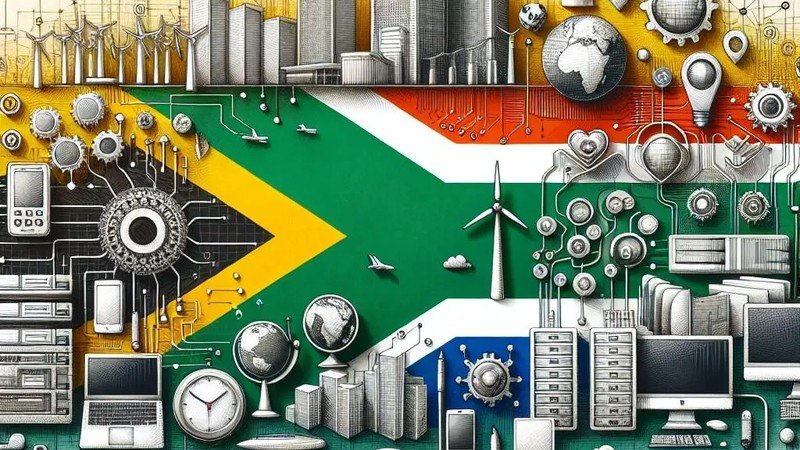
The Fifth Industrial Revolution is driving new and complex transitions as we continue to pay attention to the global crisis of climate change and its impact on human development. The transition driving the information and communications technology sector is manifesting itself in nearly every aspect of society, from the use of drones in supersonic warfare, emergency medical evacuation, weather forecasting, energy modeling and utility management, self-driving passenger vehicles, etc. At the heart of these applications is an intangible resource called “data.” It is stored, processed, and transported through large, energy-consuming infrastructure such as cables, fiber, and data centers.
As economies compete to attract investment in digital infrastructure, environmental risks cannot be ignored when navigating the energy vortex that underpins modern economies, according to the World Economic Forum. The key question remains: what will feed the production lines that this technology promises? So what is the environmental impact of this build-out? And how does this digital boom fit in with the country’s imperatives of a just transition, diversifying the economy and preparing the skills of the future?
South Africa is the new destination of this revolution. Huge investments are flowing into data centers, from international cloud providers to local infrastructure companies looking to capitalize on Africa’s growing demand for connectivity, artificial intelligence (AI), cloud services and digital transformation.
Unaccounted environmental costs for data centers
Data centers may seem sophisticated, but they are energy-intensive. Globally, these facilities account for almost 2% of total electricity consumption. In South Africa, the market is expected to reach a capacity of approximately 962.4 MW by 2030. To put this into context, it is a critical part of a power system that relies heavily on a constrained power grid and coal.
There are two problems. The first is power supply (mainly from fossil sources) and the second is the cooling and resiliency demands of data centers operating in a warming climate. Servers generate heat and refrigeration uses more electricity. And in South Africa’s climate, this means extra loads, extra diesel backup, and extra strain on an already unstable power grid.
If these facilities are simply connected to the existing power grid without deep coordination with renewable energy, the environmental and economic trade-offs will be significant. But that footprint can be offset by promoting economic revitalization, inclusivity, and sustainability through innovative interventions such as solar power generation, the use of natural cooling, improved energy efficiency, the use of existing infrastructure such as municipal pipelines, and stranded assets (such as decommissioned power plants). At least, that’s the whole package. Minister of Power and Energy Kgosiensho Ramogopa called for investment in data centres.
Digital infrastructure in the context of a just transition
These facilities could become anchors for the growth of the digital economy. These will pave the way for new jobs in infrastructure, maintenance and operations. It also paves the way for breakthrough developments in cloud, AI, data management and digital services exports. Additionally, as we build new sectors, we seek to diversify away from mature and declining industries. This presents an opportunity for the Global South to diversify away from primary industries.
Without careful planning, it could lock us into high-energy, high-carbon infrastructure rather than supporting clean growth. If data centers were to be powered by coal-rich sources or require diesel backup during load shedding, it would undermine the very transition goals we claim to pursue.
Overcoming skills, work and diversity
If approached strategically, data centers can support the challenges of the ‘new economy’. Its operations create a new generation of “factory floor” roles for the digital economy, including facility management, cooling system monitoring, and infrastructure operations.
At higher skill levels, there is a growing demand for expertise in emerging areas such as networking specialists, server and cloud engineers, and edge computing. These competencies must be actively developed by South Africa’s young workforce. Importantly, these roles can be overlaid with green skills such as responsible electricity sourcing, managing energy efficiency and monitoring carbon emissions, helping to bridge digital and climate change.
Beyond jobs and skills, data centers also provide opportunities for local economic diversification. Rather than concentrating infrastructure only in major cities, facilities can be located in secondary cities and areas facing industrial decline, supporting economic regeneration beyond traditional coal-dependent hubs.
Digital growth and climate responsibility need to be signaled in parallel
Data centers can only support South Africa’s climate and development goals if all new centers are powered by renewable energy. Designed for energy efficiency and cooling innovation. Create inclusive local jobs by favoring local workers and including historically disadvantaged groups. Promoting the diversification of the local economy by locating facilities in non-metropolitan areas aiming for economic development, rather than in regular large cities. It is clearly aligned with transition objectives and managed through transparent oversight and accountability.
If we do it right – including data centers in just transition strategies and plans, building human skills, diversifying beyond old industries, and securing clean power – the results can be transformative. Otherwise, the digital leap risks becoming an environmental liability.
This challenge is important. But as the country re-envisions a post-fossil, digitally-enabled future, the choice is between rebuilding spaces with climate-resilient infrastructure that promotes sustainable human development, or seizing the net-zero opportunity without heeding the risks.

Nthabiseng S. Masinghe, Senior Communications Specialist, Presidential Climate Commission;
*** The views expressed here do not necessarily represent the views of Independent Media. IOL.
business report
