


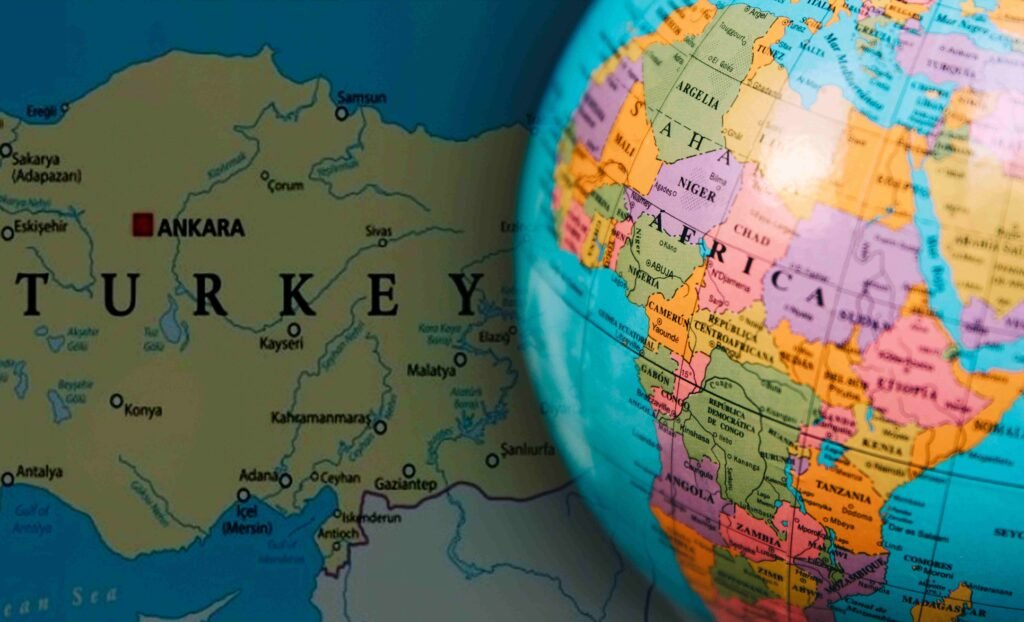
By Bonface Orcho: Turkey is building lasting influence across Africa through trade, defense, and infrastructure. From ports to schools, Ankara embeds systems that could shape Africa’s economic and geopolitical future.
Turkey is courting African countries with a strategy of expanding its influence on the continent, which has long been contested by the United States, China and Russia. Unlike these great powers, Ankara is turning its network of trade agreements, energy projects, drone deployments, infrastructure and port investments, social institutions, and construction contracts into lasting operational influence across Africa.
“Turkey is combining hard and soft power in ways that few outside actors have attempted, linking military deployments, infrastructure, and institutional commitments to create leverage that survives the natural cycles of political change and contracts,” said Jamie Akol, an Africa policy expert at the Africa Policy Institute in Nairobi.
Turkey’s involvement across the continent has expanded rapidly over the past two decades, with trade between Ankara and African countries expected to exceed US$37 billion in 2024 and reach US$40 billion in 2025, according to the Turkish Ministry of Trade.
To date, Turkish contractors have completed more than 2,000 infrastructure projects across Africa, including airports, roads, hospitals and housing, worth approximately US$100 billion.
Its commercial base now supports broader strategic measures. One of the most notable is the expansion of energy cooperation between Türkiye and Somalia. On February 15th of this month, Turkey’s deep-sea drilling vessel Kagri Bey departed from Tashuk Port for Somali waters, marking the first time that Turkey has deployed such a deep-sea drilling vessel overseas for energy exploration.
Tashuk Port in Mersin province on Turkey’s Mediterranean coast serves as a logistics base for ships bound for the Indian Ocean. A statement from Turkey’s Energy Ministry said drilling work is expected to begin in April or May, once transportation and security arrangements have been made.
According to Reuters, the drilling mission is based on a hydrocarbon cooperation agreement signed in March 2024 that granted Turkish Petroleum Corporation the right to explore, develop and produce oil and gas in Somalia’s onshore and designated offshore concessions.
Turkey’s energy minister said the agreement “strengthens Turkey’s presence in the Horn of Africa” and commits Ankara to bringing Somalia’s energy resources into production.
Somalia has long been considered to have untapped oil and gas potential, and the agreement combines Turkey’s technological capabilities with Somalia’s sovereignty to develop the sector. Engagement with Somalia is also connected to other aspects of Türkiye’s influence structure.
Ankara opened its largest overseas military base in Mogadishu in 2017 and regularly trains Somali security forces. Turkish contractors also manage Mogadishu’s port and airport under long-term concessions, and Turkey is building a major national hospital in the country.
In addition to its drone and training programs, Turkey has recently expanded its air power in the Horn of Africa. Turkish authorities have announced that F-16 fighter jets have been deployed to Mogadishu. The deployment follows Ankara’s condemnation of Israel’s recognition of Somaliland, underscoring its use of military presence to project influence and protect Somalia’s sovereignty.
Other regional powers are also increasing their aviation capabilities. The United States is expanding Kenya’s Mandabay Air Base with a US$70 million runway project to support counterterrorism operations, underscoring the Horn of Africa as a contested space for multipolar strategic engagement, according to US officials.
Beyond Somalia, Turkey’s strategic engagement with Ethiopia reached a new peak on February 17, 2026, during President Erdoğan’s first official visit to Addis Ababa in more than a decade.
Turkey’s investments in Ethiopia exceeded US$2.5 billion in 2025, spanning textiles, railway infrastructure and energy, and bilateral trade amounted to approximately US$253 million, making Turkiye the country’s second-largest foreign investor after China.
During the visit, the two governments signed a memorandum of understanding on energy cooperation, establishing a framework for joint power generation, hydropower development, grid infrastructure and renewable energy projects.
The agreement will provide Ethiopia with technology transfer and engineering expertise, while giving Turkish construction and energy companies greater access to one of East Africa’s fastest-growing markets.
The 9th Turkiye-Ethiopia Joint Economic Commission also adopted a protocol strengthening commitments on trade, investment and technical cooperation, with both countries aiming to increase bilateral trade to US$1 billion.
“Africa represents a strategic horizon for Ankara,” Akol said. “This brings both new markets and geopolitical influence. Access to ports, untapped energy resources, and regions where traditional powers are retreating gives Turkey the opportunity to set new standards in trade, security, and governance.”
In Mozambique, Turkish contractor ENKA is building a 456-megawatt power plant, followed by long-term operation and maintenance work and building multi-year technical links, according to a regional energy report.
Ports form another strategic dimension. Turkish companies operate long-term concessions in the port of Mogadishu and are pursuing redevelopment deals at Sudan’s historic Suakin port, with the aim of reviving Ottoman-era infrastructure with potential for civilian and dual use, according to the Observer Research Foundation. In Libya, the presence of Turkish companies and naval forces is supporting access to key maritime infrastructure at Misrata and other ports, strengthening Ankara’s Mediterranean connections.
Indirect involvement is also underway in Djibouti, Egypt, Kenya, Senegal, and Tanzania, including the provision of tugboats, Ro-Ro transit agreements, and private investment, creating an extensive network of influence in East and North Africa.
Türkiye’s diplomatic activities strengthen these commercial and security investments. According to diplomatic reports, the Turkish government has nearly quadrupled the number of embassies in Africa since the early 2000s and is building a dense network of bilateral missions to facilitate contracts, projects and political dialogue. According to the airline’s data, Turkish Airlines currently connects Istanbul with dozens of cities in Africa, expanding people-to-people connections that support trade, tourism and institutional cooperation.
However, Türkiye’s expansion into Africa is not just about contracts and military matters. It is becoming increasingly institutionalized. Banking, logistics, healthcare, and security infrastructure are concentrated under a single foreign umbrella. This concentration creates depth of operation. This brings Turkish systems, compliance practices and financial channels directly into the continent.
“Unlike the United States, China and Russia, Turkey is institutionally embedded,” Akol explained. “School, banking, media and regulatory standards allow Turkey’s influence to be operational and permanent, not transactional.”
The model is now visible elsewhere as well. In Senegal, Turkish company Summa built the Dakar Arena and the 50,000-seat Abdoulaye Wade Stadium, and manages Blaise Diagne International Airport under contract.
Education is also an area of interest for continental Türkiye. The Maarif Foundation operates schools in more than 20 African countries, teaching the Turkish curriculum and language. The country’s scholarship program has also brought thousands of African students to Turkish universities over the past decade. In North Africa, Turkish companies are linking construction and financing with cultural institutions in Algeria, Tunisia and Morocco, and incorporating language centers and educational activities alongside commercial projects, according to regional reports.
However, this multi-layered approach also comes with risks. Observers have raised concerns about governance and transparency in long-term port concessions and construction contracts, and the political implications of defense exports are being debated in the capital, where accountability and civilian oversight are at stake.
As in the case of Somalia, frontier energy exploration involves operational and safety challenges that can delay projects and incur significant insurance and maritime safety costs. Critics also warn that dependencies with tightly intertwined institutional ties can be difficult to dismantle once embedded in a national system.
“By systematically replacing old external dependencies with Turkish systems, technologies and networks, Ankara is covertly redefining the parameters of its influence on the continent,” Akol pointed out.
Banking relationships, educational networks, and media influence are long-term assets that shape perceptions and organizational behavior beyond project timelines.
Finally, Akol added, “Fragile states, emerging energy markets, and a changing postcolonial order provide scope for Turkey to arrive early, build trust, combine economic, military, and cultural influence, and position itself to shape the region’s trajectory in the long term.”
bird story agency
