


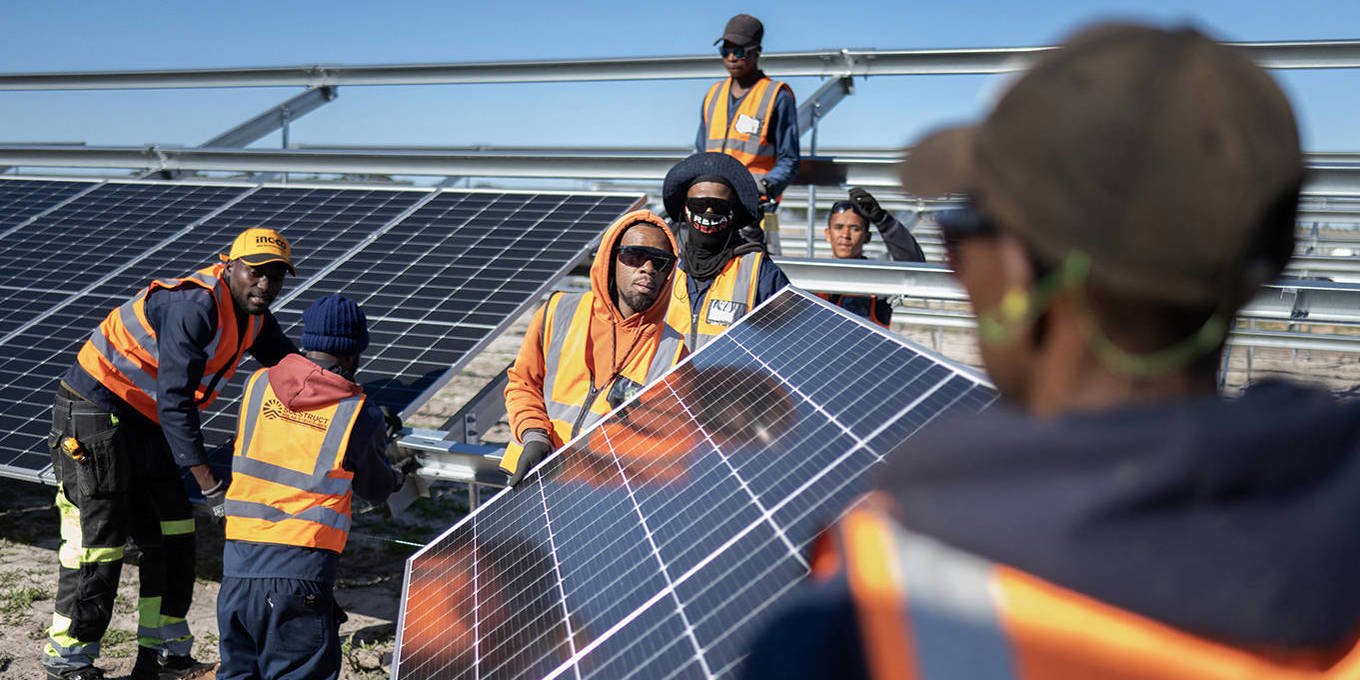
With its vast solar resources and rapidly growing population, Africa has the potential to achieve a green transition with sustainable and inclusive growth. But to achieve this, Africa-led initiatives will need to mobilize international capital to close a $2.8 trillion funding gap.
NEW YORK – The post-war global development system has changed dramatically, and it was a source of conversation and consternation at last week’s United Nations General Assembly and climate change talks. Multilateral development banks are under strain, and major donors such as the United States and the European Union are cutting their foreign aid budgets. Resource scarcity is particularly evident when it comes to supporting sustainable development and green transitions in emerging markets. African countries alone face a $2.8 trillion funding gap to support their and our common climate goals.
Aiming for a humanist superintelligence
JDawnInk/Getty Images
In search of the economic principle of the AI bubble

Spencer Pratt/Getty Images
mamdani’s big bet

Andres Kudacchi/Getty Images
But despite the layoffs, African leaders are writing the next chapter of climate action. Entrepreneurs in Nairobi, fund managers in Lagos, grassroots innovators, public and private institutional investors, and political reformers from across the continent are coming together to build a green economy.
Africa, with its rich natural resources and rapidly growing workforce, has the potential to achieve a clean energy transition that fosters sustainable and inclusive growth. But the loss of traditional development finance makes it more urgent than ever for investors, philanthropists and other private sector actors to support the region’s green revolution. To this end, we at the Soros Economic Development Fund (SEDF) are strengthening African-led solutions as engines of sustainable economic growth and widespread prosperity.
Clean energy is central to these efforts. Currently, approximately 600 million people across Africa remain without access to electricity, a major obstacle to promoting resilient economies that can create jobs and mobility opportunities for millions of African youth every year.
Fortunately, we know what works. Scaling up proven technologies such as off-grid solar power and climate-resilient infrastructure can help foster what African Climate Ventures’ James I. Mwangi calls “climate-positive growth.” But large-scale deployment of these and other renewable energy technologies remains too slow. For example, Africa has 60% of the world’s solar resources, but accounts for just 1% of installed solar power capacity and 2% of global clean energy investment.
These gaps are primarily due to real and perceived risks that prevent public and private sector investors from deploying capital in the region. At SEDF, we believe the biggest risk is doing nothing. Although Africa accounts for only 2-3% of global carbon emissions, it is the world’s most vulnerable continent to climate change. By 2030, as many as 118 million of the poorest people – those living on less than $1.90 a day – could be exposed to droughts, floods and extreme heat.
Africa’s population is expected to nearly double to 2.5 billion by 2050, urbanization is accelerating, and energy demand is expected to soar. Without clean electricity and climate-resilient infrastructure, this population boom could become a carbon catastrophe. And, as we have seen in countries around the world, governments that fail to achieve resilience and shared economic prosperity are vulnerable to instability, migration pressures, and political change, all of which are systemic risks to democracies and open societies.
That’s exactly why we invest because of the risk, rather than in spite of the risk. To date, SEDF has committed $55 million to initiatives led primarily by African investors and entrepreneurs, with additional contributions planned. In some deals, we take first-loss positions in our blended capital stack to encourage more commercial partners to participate.
In both cases, we hope that over time the effectiveness and economic benefits will be proven, attracting a wider range of investors and unlocking more capital for green growth in Africa. And with each investment, we aim to strengthen local capital markets infrastructure through innovative and lasting partnerships, such as the recently announced Alliance for Green Infrastructure in Africa and Acumen’s Hardest-to-Reach initiative. Getting this model right is essential, especially given the continent’s growing demand for critical and rare earth minerals and the opportunities that ensure this mineral wealth leads to widespread prosperity.
In short, we are betting on a future where African-led, inclusive and climate-smart growth benefits us all.
