


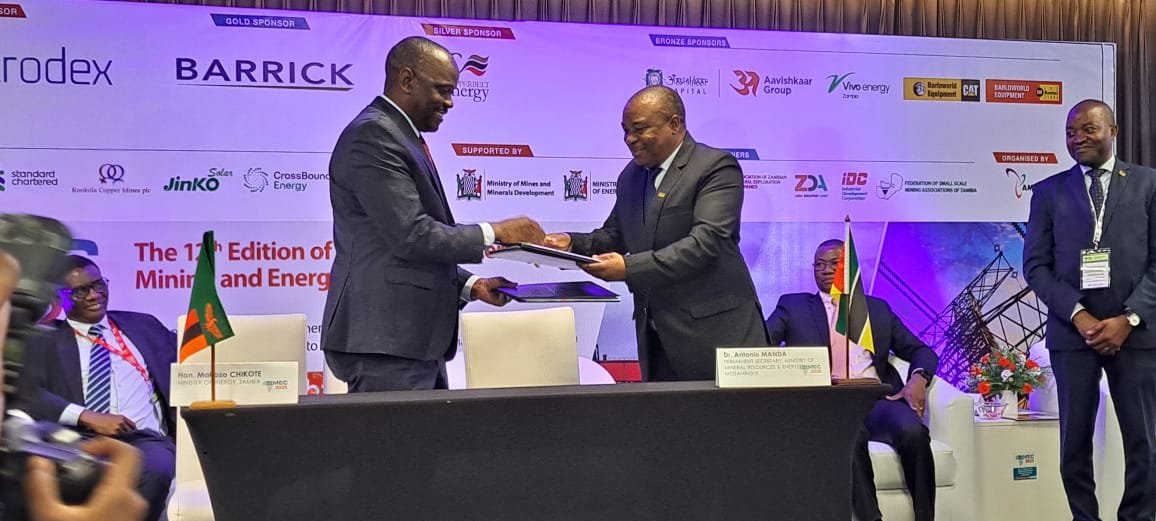
On March 19, Zambia Electricity Supply Corporation (ZESCO) signed an inter-power company memorandum of understanding (IUMoU) with Mocambique Electricity (EDM) of Mozambique for the development of the Mozambique-Zambia (MOZA) power interconnection project.
The agreement was signed during the 2025 Zambia International Mining and Energy Conference (ZIMEC) held in Kitwe on March 19-20. The project includes the construction of approximately 375 km of 400kV transmission line from Matambo in Mozambique’s Tete Province to Chipata in Zambia’s Eastern Province, and the construction of a low-voltage transmission line between Feira/Luangwa in eastern Zambia and Zumbo in northern Mozambique.
The main components include the construction of two single-circuit 400kV transmission lines connecting the Matambo substation and the Chipata West 330kV substation, which will be upgraded. Approximately 278km of the project is located in Mozambique and 97km in Zambia.
Source: Project Information Memorandum, August 2022
The Matambo substation is a strategic facility that connects Mozambique’s central and northern power grids. It is currently powered by the 2,075MW Cahora Bassa Hydropower Station (HCB) and other hydro and gas power plants, and will be supplied by the planned 1,500MW Mfanda Nkwa hydropower facility.
Zambia is currently suffering from a severe drought affecting power generation and agriculture, affecting almost half of the population. The sharp decline in rainfall is causing a major energy crisis, as hydropower accounts for 85% of the country’s total power generation capacity, leading to a deficit of more than 1,400 MW.
The MOZA interconnector appears to be the perfect solution to Zambia’s deficit, with peak domestic demand of just over 1GW compared to Mozambique’s installed capacity of around 2.8GW. The country is already a major electricity exporter in the Southern African Power Pool (SAPP) and is pursuing a US$80 billion energy transition plan that aims to play a leading role in decarbonizing Southern Africa’s electricity system by exporting electricity generated from renewable sources to neighboring countries.
The feasibility study for the MOZA project was completed in February 2022 with primary funding from the New Partnership for African Development – Infrastructure Project Preparation Facility (NEPAD – IPPF) and SAPP. According to the World Bank’s late December 2024 report, outstanding activities in the project include the procurement of consulting services to finalize the bidding documents, a task for which grant funds are being mobilized. The financial audit was completed in July 2023.
The estimated cost of the entire plan is US$411.5 million, with the Zambian portion accounting for US$132.4 million.
Once completed, the MOZA project is planned to work in conjunction with planned interconnections to Malawi and the Democratic Republic of the Congo (DRC), as well as internal reinforcement of transmission lines within SAPP. In the long term, the interconnector is expected to connect these markets, leveraging Zambia’s natural geographical location adjacent to Africa’s eastern, central and southern power pools.
Top photo: Signing of a memorandum of understanding between power companies (Source: Facebook@Mozambique Ministry of Energy)
