


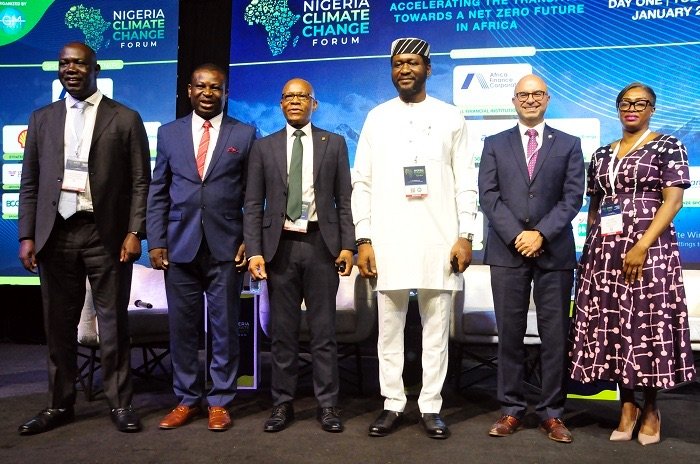
access Bank PLC has strengthened its leadership in sustainable finance and climate action as a Gold Sponsor of the Nigeria Climate Change Forum (NCCF) in Abuja. The forum brings together Africa’s most influential policymakers, global investors and sustainability pioneers to drive urgent action towards a net-zero future for the continent.
At NCCF, Dr. Gregory Jobome, Executive Director of Risk Management at Access Bank, gave a compelling presentation on “The Role of Innovation and Technology in Africa’s Net-Zero Transition”. He stressed the urgent need for Africa to leverage cutting-edge technology and sustainable finance to leapfrog traditional development models to accelerate the transition to clean energy.
Dr. Jobome also highlighted Africa’s increasing vulnerability to climate change, especially in scenarios where global temperatures exceed 1.5°C. He called for urgent and transformative action to reduce risks and ensure resilience to climate change.
In a high-level panel discussion, Head of Enterprise Risk Management at Access Bank Group provided insight into the possibilities for financing renewable energy projects in Nigeria. The session highlighted the Bank’s leadership in pioneering sustainable finance solutions, including green bonds, blended finance, and public-private partnerships (PPPs), and outlined Africa’s energy transition roadmap.
Access Bank continues to lead the way in financing Africa’s low carbon transition through groundbreaking initiatives.
•Africa’s first corporate-certified green bond – invests in climate-resilient projects and sets a precedent in green finance for the region.
•Securing climate finance – attracting global capital to accelerate efforts on renewable energy, low-carbon transport and climate adaptation.
•Drive investment in renewable energy – Funding solar farms, wind energy projects and energy efficient infrastructure to drive Africa’s clean energy revolution.
•Lead the decarbonization movement – deploy solar-powered ATMs, promote paperless banking, and implement waste recycling programs to reduce your organization’s emissions.
Pioneering innovation for Africa’s green economy
Access Bank recognizes the critical role of innovation in sustainability and promotes innovative financial and technology solutions to strengthen Africa’s resilience to climate change.
•Smart, low-carbon infrastructure – funding sustainable buildings, energy-efficient systems and green supply chains to promote urban sustainability.
•Circular economy innovation – Increase investment in waste-to-energy technologies, biodegradable packaging and sustainable manufacturing to foster a circular economy in Africa.
A unified call to accelerate climate change countermeasures
As Africa’s leading sustainability-driven financial institution, Access Bank is at the forefront of the collective effort towards a net-zero future. Through strategic collaboration with governments, international financial institutions, and industry innovators through the Sustainable Finance Accelerator Program, the Bank is mobilizing large-scale investments to advance Africa’s green transition.
“Africa is experiencing a wave of innovation and technological progress, much of it in collaboration with global partners. But we are still in the early stages. We need to scale up our efforts to create meaningful opportunities for Africa’s rapidly growing youth population who aspire to participate in the green economy. Financial institutions have a vital role to play in this transformation,” said Dr. Jobomeh.
Additionally, Minister of Women’s Affairs Hajia Imaan Sulaiman-Ibrahim emphasized that women play an important role in driving Africa’s net zero agenda. She noted that women are disproportionately affected by climate change and called for stronger public-private partnerships to empower women in climate action.
The NCCF served as an important platform for key stakeholders to engage in insightful discussions and shape actionable strategies for Africa’s sustainable future. Access Bank remains committed to driving impactful, long-term solutions that will ensure the continent’s resilience and prosperity for generations to come.
