


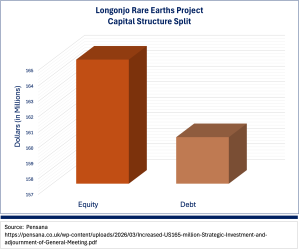
The $165 million stock transaction enables an extensive capital program of more than $325 million for integrated rare earth production in Angola.
The Lobito Corridor and US import and export support reflect a broader shift to “friend support” for critical technical metals.
Parallel projects in South Africa, Malawi and Uganda are supplying specialized heavy elements needed for high-tech and defense applications.
Mining company Pensana has secured a $165 million strategic investment from rare earth mining investment platform Cascade Natural Resources to fast-track its Longonjo rare earth project in Angola. This funding will provide the critical capital needed to unlock a further $160 million debt package supported by the Export-Import Bank of the United States (EXIM) and help keep the mine on track for its 2027 production goal.
Angola is spearheading a new form of mineral diplomacy, leveraging the Lobito Corridor to reduce dependence on China’s rare earth processing. As prices for magnetic metals rise and supply chains become more strategic, African countries are increasingly positioning themselves as suppliers to Western high-tech industries. However, whether this new African “magnetic shield” can withstand price competition with China remains an open question.
Breaking the monopoly: Angola’s midstream sovereignty
Rising prices for neodymium and praseodymium strengthen the commercial case for supplies from outside China. While the traditional model relied on exporting raw ore for processing overseas, Pensana is pursuing an integrated approach designed to supply Western defense and advanced manufacturing supply chains, including a proposed offtake agreement with Toyota Tsusho, the trading arm of the Toyota Group.
A $160 million U.S. Export-Import Bank debt package supports this strategy and reflects a broader policy push to secure critical mineral supply chains for U.S. manufacturing. The planned introduction of a heavy rare earth recovery facility will ensure that elements such as dysprosium and terbium are processed within a transparent, Western-cooperative framework, reducing the risk of future export restrictions.
Angola is also differentiating its output by leveraging the potential ‘green premium’ tied to sustainable infrastructure. The Longonjo facility will reduce the carbon footprint of rare earth oxides by harnessing low-cost hydroelectric power from Ruaka Dam. This is an increasingly important factor for EV manufacturers and data center operators facing more stringent ESG requirements.
The initial carbonate production target is 20,000 tonnes per year, and the project will also serve as the basis for the Lobito Corridor. A rail-integrated logistics model could reduce transportation costs by an estimated 30% and increase resilience to product cycles, while also helping to maintain price competitiveness.
Africa’s frontier: turmoil on many fronts
South Africa is reinforcing this regional shift through its Steenkampskraal mine, which boasts one of the world’s highest total rare earth oxide levels at 14.5%. This high-grade profile supports lower production costs and provides a potential buffer against aggressive pricing strategies that have historically been used to alienate new entrants to the rare earth sector.
In Malawi, the Songwe Hill project is being developed as a key link in Europe’s industrial security strategy. The project will strengthen the EU’s supply of neodymium and praseodymium by supplying a dedicated separation plant in Poland, creating a “mining, refining and recycling” loop that bypasses processing hubs in Asia.
The Makuutu project in Uganda completes this new network by targeting ion-absorbing clay deposits that are an important source of heavy rare earths. These materials are essential for high-performance magnets used in advanced defense systems, and this could accelerate demand for alternative suppliers, especially as the U.S. military faces a 2027 legislative deadline to eliminate Chinese-made magnets from front-line hardware.
