


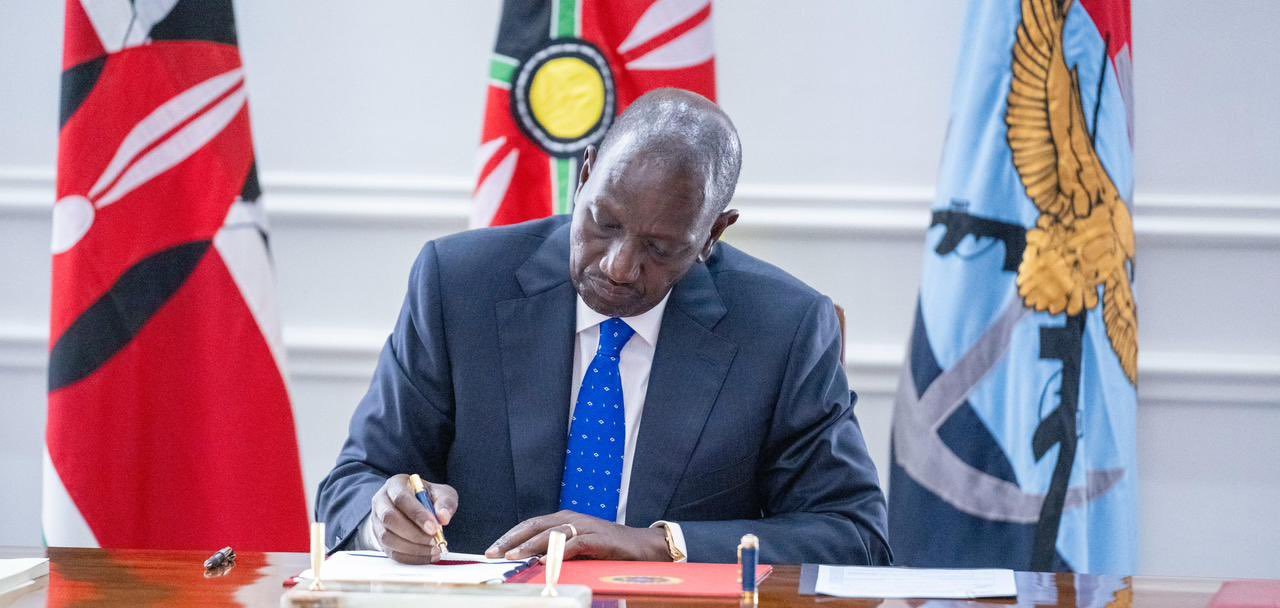
The government plans to start implementing major projects across the country, starting with the Jomo Kenyatta International Airport (JKIA), following the enactment of the S5 trillion National Infrastructure Fund.
President William Ruto, while assenting the National Infrastructure Bill in the Nairobi State House of Assembly, said the fund set up with Sh106 billion in seed capital raised through the Kenya Pipeline Company’s initial public offering will be utilized for the expansion of the country’s aviation hub, JKIA.
“Today, I am pleased to announce that the expansion of the Jomo Kenyatta International Airport will be the first major project to be funded through this new model. The project will be built with approximately 20 billion Kenyan shillings of equity participation from the National Infrastructure Fund and domestic institutional investors,” President Ruto said.
This comes barely a week after the government launched tenders for airport expansion into airport cities and special economic zones (SEZs), with bidders required to have a capital base of Kshs 100 billion.
The administration aims to leverage seed capital 12 times to raise at least Ksh1.2 trillion for infrastructure investment, and President Ruto said it would mobilize Ksh5 trillion to meet the country’s infrastructure development needs.
The government expects additional funds to be mobilized through the private sector, led by pension funds and local commercial banks, which currently have an asset base of 2.8 trillion silicate.
President Ruto said the fund would be key to reducing Kenya’s debt exposure as a result of the development of capital projects such as railways, ports, roads and energy, which are often financed through external borrowing to fill a funding gap estimated by the World Bank at Sh516 billion annually.
“When infrastructure projects are financed in foreign currencies and revenues are earned in Kenyan shillings, exchange rate fluctuations pose significant risks. This challenge has long affected many utilities, especially the power sector,” he added.
According to Treasury Secretary John Mbadi, raising funds through the privatization of mature state-owned enterprises will ensure the country can make better use of its assets.
“We need to wake up to the reality that mature assets can be put to better use. We can prioritize investing in commercially viable public assets where these companies can raise resources and generate assets that will yield greater economic value in the future than what we are realizing today,” he said.
African Finance Corporation CEO Samaira Zubair praised the fund as a means to meet African countries’ infrastructure investment needs, currently estimated at $130 billion to $170 billion annually.
“Africa will rise if African capital builds African infrastructure that drives African industries. The Kenya Infrastructure Fund embodies this philosophy. It mobilizes domestic capital, funnels that capital into strategic infrastructure, and creates the conditions for industry and value creation to happen here in Kenya,” Zubairu said.
The NIF Act provides for a Governing Council to be the highest decision-making body, consisting of the Secretary to the National Treasury, who is also the Chairman, the Governor of the Central Bank of Kenya (CBK), and the Attorney General.
The President will also appoint six other non-civil servants with proven expertise in the field of finance to the Council for three-year terms.
The council is expected to dictate investment policy and hire a board of directors, and the CEO will be responsible for managing the fund.
