


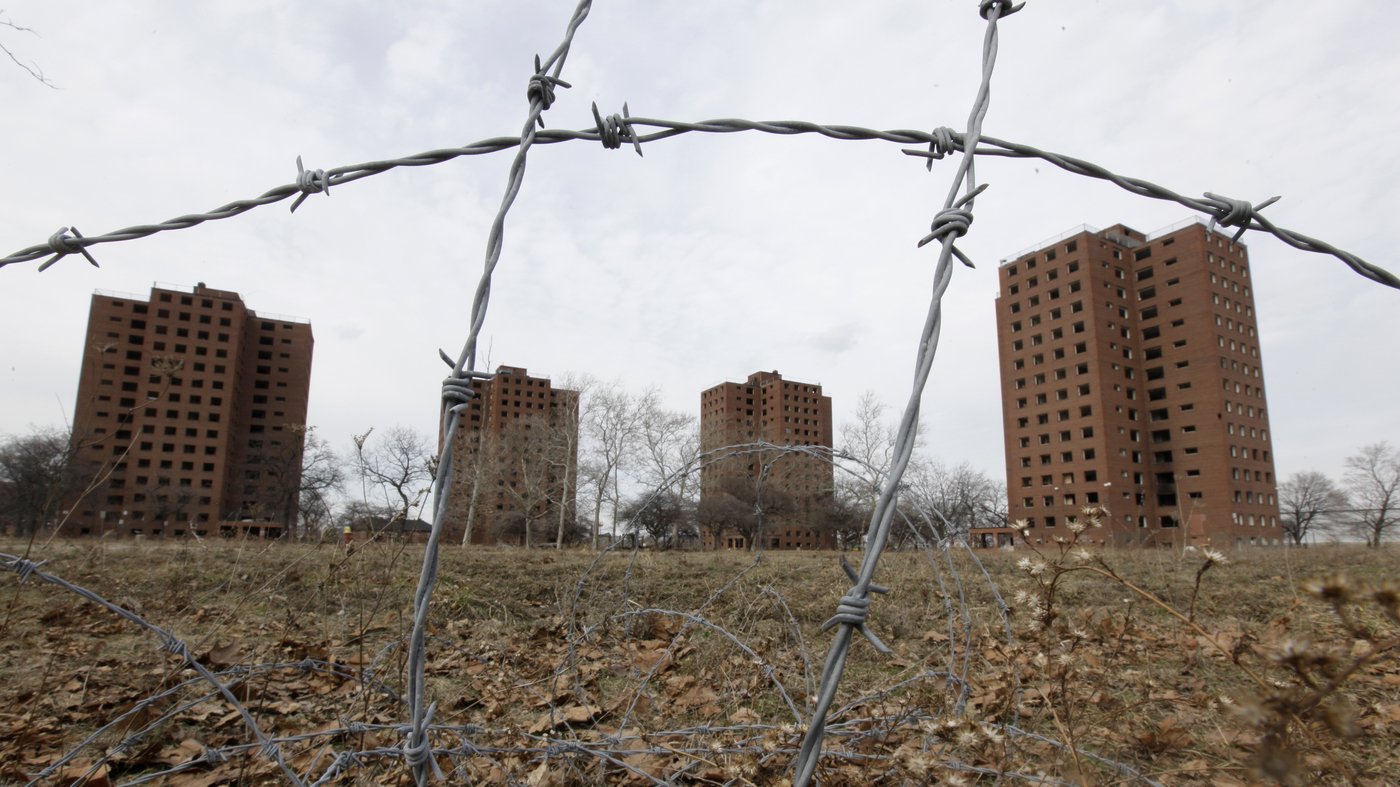
Federal housing policies developed after the Great Depression forced African Americans and other people of color out of new suburban communities and instead into urban housing projects such as the Brewster-Douglas Tower in Detroit. Paul Sancia/AP Hide Caption
toggle caption
Paul Sancia/Associated Press

Federal housing policies developed after the Great Depression forced African Americans and other people of color out of new suburban communities and instead into urban housing projects such as the Brewster-Douglas Tower in Detroit.
Paul Sancia/Associated Press
In 1933, faced with a housing shortage, the federal government initiated a program explicitly designed to increase and segregate America’s housing stock. Author Richard Rothstein has said that the housing programs initiated under the New Deal amounted to a “state-sponsored system of racism.”

The government’s efforts “were primarily aimed at providing housing for white, middle-class, and lower-middle-class families,” he says. African Americans and other people of color were excluded from new suburban communities and forced into urban housing projects instead.
Rothstein’s new book, The Color of the Law, examines local, state, and federal housing policies that mandate racial discrimination. He pointed to a policy in which the Federal Housing Administration, established in 1934, furthered racial discrimination efforts by denying mortgage guarantees in and near African-American neighborhoods, a policy known as “redlining.” At the same time, the FHA was subsidizing builders who mass-produced subdivisions for whites, with the condition that they would never sell any homes to African Americans.

Rothstein says these decades-long housing policies have had a lasting impact on American society. “The segregation of today’s metropolitan areas has led to stagnation in inequality, because families have a much harder time upward mobility when they live in isolated areas with no opportunities,” he says. “If we want more equality in this society, if we want to reduce hostility between police and African-American youth, we need to take steps to desegregation.”
Interview highlights
How the Federal Housing Administration Justified Discrimination

color of law
The forgotten history of how our government segregated America
Written by Richard Rothstein
Purchase a book
The Federal Housing Administration’s rationale was that if African Americans bought homes in these suburbs, or even if they bought homes near these suburbs, the property values of the homes they insured, the white homes they insured, would decline. Therefore, their loans will be at risk.
There was no basis for this claim on the part of the Federal Housing Administration. In fact, when African Americans sought to buy homes in all-white or mostly white neighborhoods, property values rose because African Americans were willing to pay more for real estate than whites. That’s simply because African Americans had a very limited housing supply and very few options. Therefore, the rationale used by the Federal Housing Administration was not based on any type of research. It was never based in reality.
About how federal agencies used red lines to segregate African Americans
The term “redlining” comes from the New Deal and the federal government’s development of maps of every metropolitan area in the country. And those maps were color-coded first by the Homeowners Finance Corporation, then by the Federal Housing Administration, and then adopted by the Department of Veterans Affairs. These color codes were designed to indicate safe places to secure your mortgage. And wherever African-Americans lived, wherever African-Americans lived nearby, they were colored red to show appraisers that the area was too dangerous to warrant a mortgage.
About the FHA manual that clearly defines racist policies

It was in something called the Federal Housing Administration’s Underwriting Manual that said, “Incompatible racial groups should not be allowed to live in the same community.” This means that loans made to African Americans are not insured.
In one development…in Detroit…the FHA wouldn’t move forward with the development unless the developer built a six-foot-tall wall, a cement wall, separating the development from the nearby African-American neighborhood, making it impossible for African-Americans to even set foot in that neighborhood.
The Federal Housing Administration’s underwriting manual recommends that highways are a good way to separate African Americans from white neighborhoods. So while this was a government regulatory issue rather than a legal issue, it cannot be argued that this was some kind of “de facto” situation because it was not hidden. The regulations written into law and published in underwriting manuals are as much unconstitutional expressions of government policy as they are written into law.
The long-term effects of African Americans being barred from buying homes and building wealth in the suburbs.
Currently, the average income for African Americans is approximately 60% of the average income for whites. But African-American wealth is about 5 percent of white wealth. Most middle-class families in this country derive their wealth from home ownership. Therefore, this large difference between the 60 percent income ratio and the 5 percent wealth ratio is due almost entirely to federal housing policies implemented throughout the 20th century.
African American families who were prohibited from buying homes in the suburbs by the Federal Housing Administration in the 1940s, 1950s, and even into the 1960s never enjoyed the same appreciation in equity values that whites did. So…homes in the Daly City development south of San Francisco, Levittown, and all parts of the country in between sold for about twice the median national income in the late 1940s and 1950s. It was affordable for working class families with FHA or VA mortgages. African Americans could afford to buy those homes just like whites, but they were prohibited from buying them. Currently, these homes sell for at least $300,000 (or) $400,000, which is six to eight times the median national income. …
So in 1968, we passed the Fair Housing Act that effectively said, “African Americans, now you’re free to buy a house in Daly City or Levittown”…but that’s an empty promise because those houses are no longer affordable to the families who could afford those houses back when white people bought houses in the suburbs and had the equity and wealth that came with it.

White families used their home equity to send their children to college. They were able to take care of their parents in old age and did not rely on children. They can leave wealth to their children. African Americans did not have any of these advantages, and African Americans were often prohibited from purchasing homes in these suburbs.
About how housing projects went from catering to white middle-class and lower-middle-class families to catering primarily to black people and the poor.
Public housing for civilians began in this country during the New Deal, an attempt to address the housing shortage. It was not a welfare program for the poor. No housing construction occurred during the Great Depression. Middle class families, working class families lost their jobs and their homes during the Great Depression. So there were a lot of unemployed middle-class working-class white families, and this was the constituency that the federal government was most interested in. So the federal government launched a program to build white-only public housing in cities across the country. The liberal instincts of some Roosevelt administration officials led them to build some projects for African Americans as well, but they were always separate projects. They weren’t integrated. …
There were numerous vacancies in the White Project. The Negro Project had a long waiting list. Over time, it became so visible that when federal public housing authorities opened up white-designated projects to African Americans, they filled them. At the same time, industry left cities, African Americans became impoverished in those areas, and projects became projects for the poor, not working-class people. There was no subsidy before, but now there is a subsidy. …and they became vertical slums that we have come to associate with public housing. …
Vacancies in white housing projects were primarily the result of Federal Housing Administration programs aimed at suburbanizing America, which subsidized mass-produced builders to create “whites-only” subdivisions and also subsidized families who lived in white housing projects and whites who lived elsewhere in central cities to move out of central cities and into whites-only suburbs. In other words, it was the Federal Housing Administration that removed overcrowded public housing for white families, and the public housing agency was given the responsibility of providing housing to increasingly poor African Americans who were unable to pay full rent.
Radio producers Sam Briger and Thea Challoner and web producers Bridget Benz and Molly Seavey Nesper contributed to this story.
