


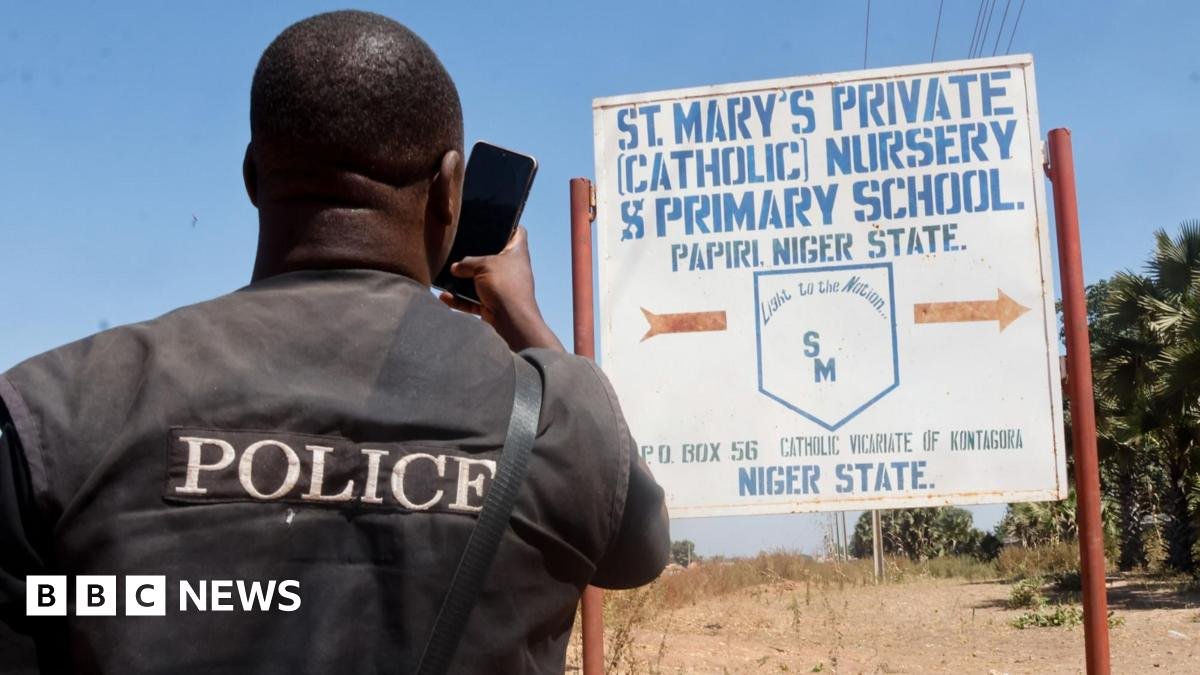
Some analysts cited by AFP believe the kidnapping at St. Mary’s School in Papiri, western Niger, was led by a notorious Boko Haram militant commander known as “Sadiku,” who has previously been linked to other high-profile kidnappings and attacks.
Boko Haram remains most active in the northeastern state of Borno, where it began its insurgency in 2009, but splinter groups and other criminal networks operate across much of Nigeria’s northwestern and north-central regions.
Days before Christmas, it was announced that security forces had rescued all remaining students and staff taken by gunmen from St Mary’s School on November 21st.
In an angry rebuttal to the AFP report, the information minister said the news agency’s claims relied solely on “anonymous shadow sources” and contradicted official statements from intelligence agencies and senior politicians.
One source cited by AFP claimed the ransom amounted to about 40 million naira (about $30,000, about 22,000 pounds) per prisoner, while another suggested a total of 2 billion naira (about $1.5 million) was paid.
The report also claims that the funds were airlifted to Boko Haram’s Gwoza enclave in Borno state and handed over to local commanders.
“The claim that the ransom was delivered to the rebels by helicopter with cross-border receipt confirmation is a fiction,” Idris said in a statement.
The domestic spy agency, the Department of State Services (DSS), “dismissed this allegation as false and ridiculous,” he said.
The minister further said that Nigeria is “facing organized, profit-driven criminal gangs”.
“The successful rescue of the students without any casualties was the result of professional intelligence and operational precision,” he added.
Boko Haram gained notoriety in 2014 after kidnapping more than 200 schoolgirls from the village of Chibok.
Since then, the country has faced a surge in mass kidnappings, and analysts say ransom payments by family members, intermediaries and, in some cases, state authorities have helped facilitate what some describe as a “commercial kidnapping industry.”
A 2022 law criminalizes ransom payments, but enforcement is difficult and families often rely on ransom payments to secure the release of their relatives.
Security experts cited in local news reports have long argued that official denials do not necessarily reflect the complexity of behind-the-scenes negotiations.
The controversy comes at a sensitive time for Abuja as the government is under diplomatic scrutiny, particularly from the United States.
On Monday, a report from the U.S. Congressional delegation made sweeping recommendations aimed at tackling what it described as the long-standing persecution of Christians in Nigeria.
The proposal was introduced at the White House by Republican Riley Moore, who said the report was developed after months of field research, hearing from expert witnesses, consultation with religious leaders and consultation with displaced communities in central Nigeria.
“I traveled to Nigeria as part of a bipartisan delegation and saw firsthand the horrific atrocities Christians face and the instability with which the Nigerian government must contend,” he said.
The report calls for new bilateral security agreements, sanctions, and reforms such as a ban on Nigerian beef exports to force armed nomadic groups to disarm.
He also proposed legal reforms to protect religious freedom in Nigeria.
The Nigerian government has yet to respond to the recommendation, which stems from concerns raised by the administration of US President Donald Trump late last year about the treatment of Christians in Nigeria.
President Trump said a “genocide of Christians” was underway in the country, a claim strongly rejected by the Nigerian government, which claimed Muslims, Christians and people of no faith were victims of the attack.
