


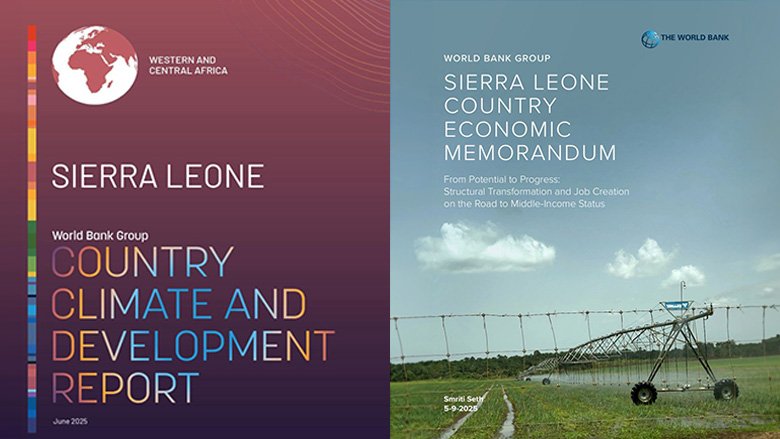
Freetown, June 16, 2025 – The World Bank today released the Sierra Leone Country Economic Memorandum (CEM) and Country Climate Development Report (CCDR). These two core analytical reports provide critical insights into the country’s economic and climate challenges and provide strategic pathways for sustainable growth and resilience.
“These reports provide a comprehensive roadmap to address the economic and climate challenges facing Sierra Leone,” said Abdu Muwonge, World Bank Country Manager for Sierra Leone. “While the National Economic Memorandum emphasizes the interconnectedness of economic challenges and the need for ambitious reforms, the CCDR emphasizes the urgency of climate action. The World Bank is committed to supporting Sierra Leone in implementing these strategies to achieve inclusive growth and build resilience.”
CEM analyzes Sierra Leone’s economic situation, noting that despite its resource richness, it has persistent poverty and low per capita GDP growth compared to similar low-income countries. Key challenges to growth include macroeconomic instability caused by lax fiscal and monetary policies, weak institutions, and poor governance, with fiscal deficits often exceeding targets due to overspending and weak supervision. High public debt limits private investment, while a small and uncompetitive private sector limits diversification beyond mining. Domestic companies face growth challenges due to limited access to credit, electricity and land, compounded by a mismatch in workforce skills.
To address these challenges, the report proposes the following growth strategies focused on mining, agriculture, agro-processing and labor-intensive sectors.
Restore macroeconomic stability through fiscal consolidation and improved debt management. Recalibrating the role of the state by reevaluating state-owned enterprises and investing in climate-resilient infrastructure. Revitalizing the private sector by improving access to infrastructure, improving credit, and reducing barriers to foreign investment. Building human capital by improving the quality of education and developing skills in line with market demands.
“CEM is an important tool in understanding the economic challenges facing Sierra Leone. The country has significant economic growth resources and potential, and this report provides a roadmap for achieving sustainable development while creating jobs for a growing workforce,” said World Bank Senior Economist Smriti Seth, lead author of both reports.
CCDR examines Sierra Leone’s socio-economic development prospects in the context of climate change, highlighting the impacts on agriculture, infrastructure and the economy. Sierra Leone ranks among the top 15 economies most affected by climate change, with projected temperature rises and unusual rainfall patterns threatening agriculture and infrastructure, potentially causing losses of 9-10% of GDP by 2050. Economic impacts include reduced labor and crop productivity, increased maintenance costs and damage to capital stock due to flooding. Poverty and inequality are expected to worsen, with nearly 600,000 more people expected to fall into poverty by 2050.
To build resilience and reduce threats to climate change, the report suggests three ways to:
Developing green energy and sustainable cities through investments in resilient infrastructure and renewable energy. Promote climate-smart agriculture by strengthening policy frameworks and investing in climate-smart technologies. Strengthening the resilience of societies by improving health infrastructure and expanding social protection systems.
Implementing these climate change measures will require significant financial resources, with funding coming from domestic taxes, private sector green investments, and international aid.
“CCDR complements CEM by showing that climate change is not only a threat to Sierra Leone’s development goals, but also a powerful lens through which to identify opportunities to build a more resilient and sustainable future by aligning growth strategies with climate change priorities to protect long-term progress,” added Sabrina Haq, World Bank environment expert and lead author of CCDR.
