


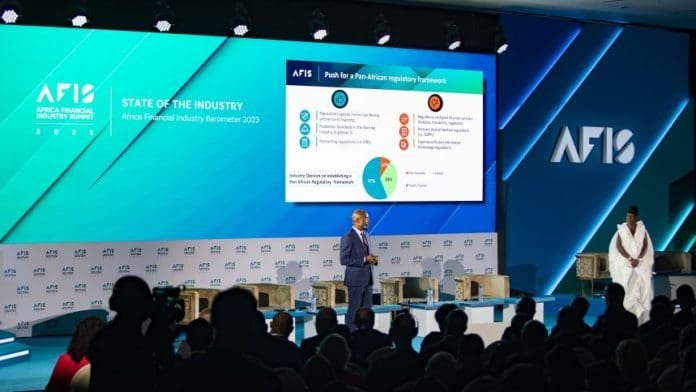
Africa’s financial industry is entering a rational growth phase, with profitability and cybersecurity emerging as top priorities after years of rapid expansion, according to the fifth edition of the African Financial Industry Barometer released on Thursday.
The report, produced by Deloitte and the African Financial Summit (AFIS), surveyed executives from more than 70 institutions across Africa, including banks, insurance companies, fintechs, microfinance institutions and capital markets players, between May and September 2025. The survey results show that the sector is getting back to basics and making profitability, cybersecurity and operational efficiency new pillars of its development model.
Executives rated their organization’s three-year economic outlook for 2025 at 8 out of 10, up 0.72 points from 2024, with 74% optimistic and just 4% pessimistic. The new confidence is driven by easing inflation, increased visibility into business operations, and sustained commercial momentum.
Microfinance institutions had the highest level of trust at 9 out of 10, ahead of insurance companies at 8.35 out of 10, while fintech companies normalized their expectations to 8.33 out of 10 after peaking at 9.25 out of 10 in 2024. Pan-African groups reported a strong sense of trust with a score of 8.44 out of 10, while international companies reported high confidence with a score of 7.82 out of 10 and capital market participants showed high confidence with a score of 7.82 out of 10. 7.5 out of 10 respondents remained cautious as volatility persisted.
Profitability has emerged as a strategic priority for 46% of institutions surveyed in 2025, indicating a transition to maturity after several years of sustained expansion. Three factors currently dominate transformation planning. Financial performance is 84 percent, customer experience is 85 percent, and digital transformation is 81 percent, all of which will increase from 2024 onwards.
The strategic shift is reflected in improved fundamentals, with the player’s net operating margin increasing by 69%, return on equity (ROE) by 57% and return on assets (ROA) by 58%, despite continued pressure on asset quality and cost of risk. However, operational efficiency decreased by 6 points to 54%, demonstrating the complexity of cost management in a more constrained environment.
Cybersecurity has evolved from a technical issue to a systemic risk, with 58% of institutions reporting high or very high exposure to strategic and regulatory risks. At the same time, 51% cite cybersecurity as their main concern, compared to 39% in 2024.
When it comes to regulatory priorities, 97% of respondents put cybersecurity at the top of their expectations list, ahead of digital identity at 92% and combating illicit financial flows at 87%, an increase of 18 points compared to 2024. While 65-70% of agencies have fully operational prevention, detection and response systems, the barometer highlights gaps. Investments are focused on detection, but response and remediation capabilities remain limited.
More than half (54%) of institutions surveyed consider themselves to be digitally mature now, an increase of six points from 2024. Fintech companies remain at the forefront, with 67% in the leadership sector, but insurance companies have made the most significant progress, with 59% now in senior roles, up 19 points from 2024.
Artificial intelligence is primarily seen as a risk management tool, with 77% of financial institutions expecting AI to have a strong or transformational impact on fraud detection, 70% on credit risk analysis, and 70% on process optimization. Offer personalization rounded out the top use cases at 72 percent and chatbots at 68 percent.
The Pan-African Payment System (PAPSS) stands out as the best-run continental integration initiative, with 35% of institutions rating it as very well-run, an increase of 15 points compared to 2024. Financial institutions are seeing measurable results with 25% lower costs and 23% faster settlement times for payments within Africa.
28% of respondents identified payment system interoperability as a top transformation priority by 2030, driven by the ambition to connect 1.6 billion combined bank and mobile money accounts.
While financial inclusion remains a strategic pillar for 39% of financial institutions, led by microfinance institutions at 100% and fintech at 67%, insurers are actively repositioning into underpenetrated areas through partnerships with carriers and microfinance institutions.
When it comes to environmental, social and governance (ESG) issues, the Barometer reveals a stage of practical engagement, with impact investing continuing to be the most structured aspect of initiatives at 66 per cent, while integration of ESG criteria has fallen to 57 per cent as institutions focus on areas with quickly measurable impact.
Gender equality has made significant progress, with 47 per cent of institutions having team equality policies in place and 44 per cent having dedicated reporting on gender indicators.
Ambroise Depuis, managing partner of Deloitte Francophone Africa, said Africa’s financial sector is maturing, confidence is high, fundamentals are strengthening and continental integration is a reality. He pointed out that remaining challenges such as cybersecurity, data quality and availability, and interoperability are issues for the ecosystem being built, not something to be defended against.
Frédéric Morley, Deputy CEO of Events at Jeune Afrique Media Group, said this barometer highlights a very clear return to fundamentals in the African financial industry. He noted that in the face of a more constrained environment, management has refocused its priorities on financial performance and operational efficiency.
The Africa Finance Summit was founded in 2021 by Jeune Afrique Media Group with support from the International Finance Corporation (IFC), a member of the World Bank Group. AFIS aims to build a robust financial industry that contributes to the real economy and sustainable development.
