


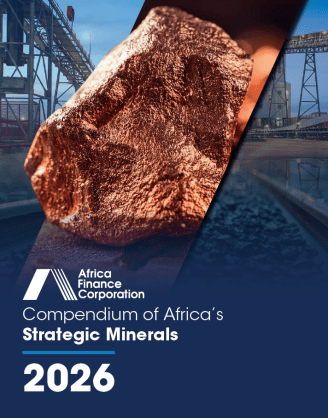
Africa has an estimated mineral value of US$29.5 trillion at mine sites, representing approximately 20% of the world’s mineral resources, but only a fraction of the economic value embedded in this wealth is being captured, according to new research published today by Africa Finance Corporation (AFC) (www.AfricaFC.org) (http://apo-opa.co/4txjr5p).
Of this total, USD 8.6 trillion remains untapped, reflecting an unexplored continent where fragmented geological data, uneven survey coverage, and limited transparency still drive risk perception and constrain investment. The report argues that improving the availability and quality of geological data is a necessary first step to reducing project risk and freeing up exploration capital.
The study also highlights that the value of mine sites significantly underestimates Africa’s true potential, as it fails to capture the much greater value created when minerals are processed into steel, aluminium, fertilizers, batteries and alloys. Measured at the point of industrial use, Africa’s mineral resources will expand by an order of magnitude, revealing considerable potential value.
Launched at the Mining Indaba in Cape Town, the Africa Strategic Minerals Compendium reframes the sector through an African development perspective, placing industrialization, infrastructure and long-term regional needs at the heart of minerals strategy.
“Today, AFC is proud to launch Africa’s Strategic Minerals Compendium, an initiative that reframes the sector through an African perspective and transforms endowments into actionable channels for our collective prosperity,” said Samaira Zubair, President and CEO of AFC. “This compendium maps the complete value chain, linking reserves and production to processing capacity, power and transport infrastructure, and regional industrial corridors. This increases data transparency and reduces exploration risk, lowers capital costs and leads to smarter mining investments that enable the infrastructure needed for mining and integrated regional value chains.”
Mineral development based on African demand
The compendium notes that mineral production, infrastructure development and demand are rarely located in the same place or coincide on a large scale, and calls for strong regional planning based on the foundations of Africa’s long-term needs.
The steel value chain illustrates this misalignment. Africa has some of the world’s largest reserves of ferroalloys such as manganese, chromium, and nickel, and the supply of iron ore is entering a new growth cycle. However, these supply chains remain commercially tied to the Asian steel cycle rather than Africa’s own development trajectory.
We see that this exposure has economic costs and is still ongoing. A slowdown in Asian steel demand linked to China’s real estate slump and construction slump is sending shockwaves through Africa’s minerals market. In the Democratic Republic of Congo, production quotas have been imposed on cobalt to manage oversupply and price collapse. South Africa’s primary steel manufacturing capacity has been suspended due to weak domestic demand, high costs and fragmented supply. In Gabon, major manganese operations are regularly halting production in response to demand for soft alloys from Asia.
These gains come even as Africa continues to expand its transportation networks, power systems, housing, and industrial capacity that require these materials. The constraint is not a lack of demand, but a lack of demand lock-in, or the inability to align mineral production, processing capacity and infrastructure investment around Africa’s long-term material needs.
Infrastructure connecting minerals, processing and demand
The compendium places infrastructure at the heart of minerals strategy, not as a passive enabler, but as a system that connects raw materials, processing capacity and demand. Electricity costs and reliability, transport connections, and access to industrial sites will ultimately determine whether benefits are possible.
To this end, the report maps mineral deposits and production assets along railways, ports, power generation hubs and power grids to identify where regional value chains can realistically be developed. Targeted interventions are called for in shared rail corridors and cross-border power transmission, especially in mineral-rich regions where coordinated infrastructure can scale up, reduce delivery costs, and support regional industrial platforms.
Infrastructure is also central to Africa’s competitiveness in a world of green industrialization. Clean electricity, efficient logistics, and integrated corridors like Lobito can reduce carbon intensity and improve access to markets where low-carbon, traceable supply chains are increasingly sought after.
African minerals in a fragmented global economy
This compendium situates Africa’s minerals strategy within a rapidly changing geoeconomic landscape shaped by trade tensions, export controls, industrial policy, and efforts to reduce concentration risks. These changes are increasing the strategic relevance of Africa’s mineral resources, but only if the continent can provide reliable, value-added alternatives.
Rather than positioning Africa as a marginal supplier of raw materials, the report argues for selective integration into strategically exposed segments of global supply chains, where diversification would greatly enhance resilience, particularly for minerals with highly concentrated processing markets. These include manganese, rare earths, graphite and uranium, important alloying raw materials for defense, aerospace and clean energy technologies.
Encouragingly, momentum is building.
Angola is developing one of the world’s largest and finest magnetic metal rare earth deposits. Mozambique is a major source of raw materials for graphite and anode materials. A battery-grade manganese sulfate project is underway in southern Africa. Uranium production is scheduled to resume in Namibia and Malawi from 2024 to 2025.
Download AFC’s Africa Strategic Mineral Resources Compendium at http://apo-opa.co/4txjr5p.
Distributed by APO Group on behalf of African Finance Corporation (AFC).
Media inquiries:
Yewande Thorpe
communication
African Finance Corporation
Mobile phone: +234 1 279 9654
Email: yewande.thorpe@africafc.org
About AFC:
AFC was established in 2007 with the aim of promoting viable infrastructure and industrial investment across Africa. AFC’s approach combines industry expertise with a focus on financial and technical advisory, project structuring, project development and risk capital to address Africa’s infrastructure development needs and drive sustainable economic growth.
After 18 years, AFC is Africa’s partner of choice, with a proven track record of investing in and delivering high-quality infrastructure assets that provide essential services to core infrastructure sectors such as energy, natural resources, heavy industry, transportation and telecommunications. AFC has 48 member countries and has invested more than US$18.5 billion in 36 African countries since its founding. www.AfricaFC.org
