


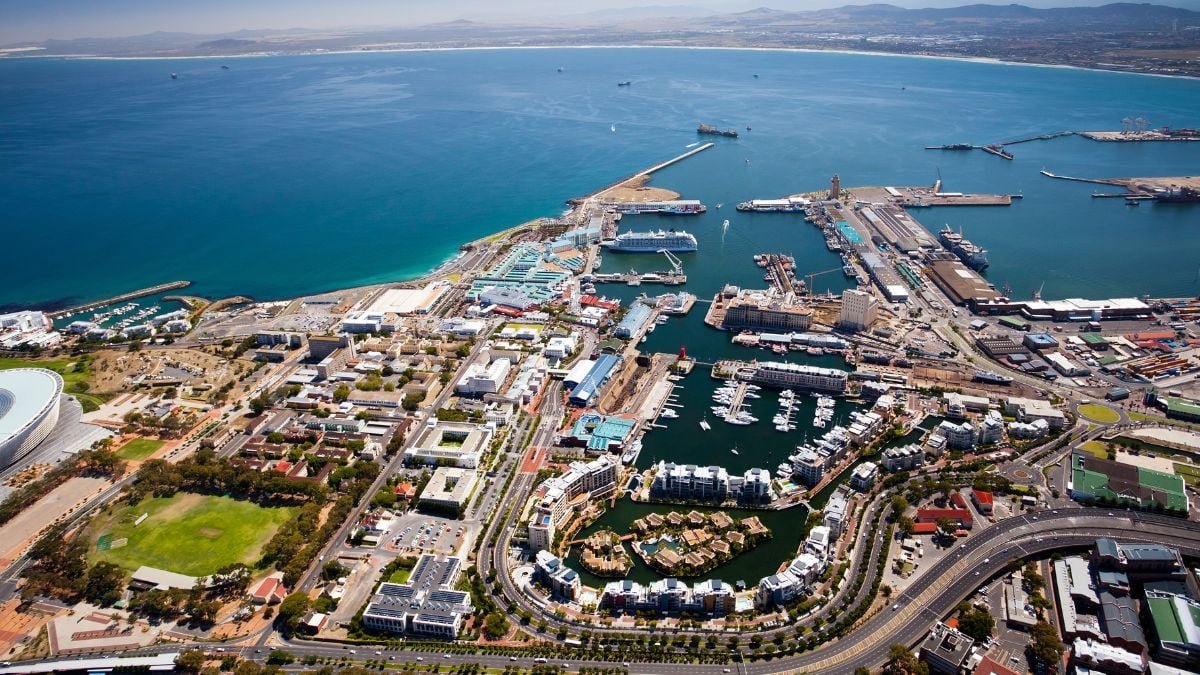
The V&A Waterfront is considered one of the most valuable areas in South Africa, with retail sales expected to exceed R11 billion in 2025 and just over R30 million per day.
The waterfront was established in the mid-19th century. It is named after Queen Victoria and her second son Prince Alfred, who started construction of Cape Town’s port in 1860.
At the time, Cape Town served as an important transit point for ships traveling between Europe and the East, but the port was exposed to severe winter storms and shipwrecks were frequent.
To improve safety and carrying capacity, the British colonial government developed a breakwater and two harbor basins.
Victoria Basin was completed in 1869, followed by Alfred Basin in 1905. These developments established the port as an important component of South Africa’s trading, fishing and naval infrastructure for much of the 20th century.
In 1988, Transnet, then operating as Portnet, formed the Victoria & Alfred Waterfront Company to redevelop the historic quayside into a mixed-use precinct. This was the beginning of the modern V&A Waterfront.
A major ownership change took place in 2011, when Growthpoint Properties acquired a 50% stake in V&A Waterfront, with the Public Investment Corporation holding the remaining 50% on behalf of the Public Employees’ Pension Fund.
The transaction was worth approximately R9.6 billion and was the largest single real estate transaction in South Africa at the time. Since then, the value and income of the precinct has steadily increased.
The V&A Waterfront currently supports over 83,000 direct and indirect jobs and contributes over 1.5% of the Western Cape’s GDP.
Announcing the district’s latest milestone, V&A Waterfront CEO Graham Wood said the figures showed the district was resilient and growing.
“Despite significant development, construction and infrastructure improvements across the precinct, we welcomed 25 million visitors in 2025, the same as the previous year,” Mr Wood said.
“Even without the luxury retail building being completed, the V&A delivered another impressive year of growth with retail sales increasing by 7% to more than R11 billion in 2025.”
Expecting big growth

Wood, who was appointed CEO this year, brings experience from senior positions at Sun International, Tsogo Sun and Valor Hospitality Partners in the US.
He pointed out that 2025 ended with a New Year’s Eve celebration live streaming by global internet star IShowSpeed, whose broadcast attracted more than 47 million views.
“This was an incredible exposure for the V&A, Cape Town and South Africa,” Mr Wood said. After a 10-month renovation, InterContinental Table Bay Cape Town reopened in December with added momentum.
“Demand for our 13 hotels remained strong over the holiday period, with occupancy rates of 69% in December, reinforcing V&A Waterfront’s strength as a global tourist destination,” Mr Wood said.
Looking to the future, he said 2026 will be marked by the opening of the long-awaited luxury retail building and the opening of the Cape Town Hotel Edition in the third quarter.
“It will work seamlessly with our new superyacht Basin, scheduled to open in October, and will become a new benchmark for modern luxury.”
Cruise tourism is also playing an increasing role. In 2025, Cape Town Cruise Terminal welcomed 74 ships, 126,000 passengers and 45,000 crew members.
“Despite the short-term impact of geopolitical developments on cruises, the cruise market has long-term growth potential,” Wood said.
He added that Cape Town’s global profile continues to grow, supported by strong international air access and cooperation between government and industry.
“Tourism is a major economic driver, accounting for 9% of GDP and supporting approximately 1.8 million jobs,” Mr Wood said.
“V&A is proud to play a leading role in this sector and confidently looks forward to 2026 being a year of further growth, benefiting jobs, small businesses and the economy.”
V&A Waterfront in photos


