


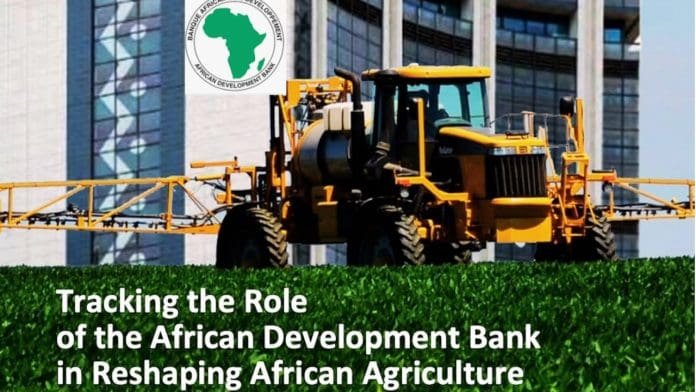
The African Food Sovereignty Alliance (AFSA), one of the continent’s most prominent food system advocacy coalitions, has released a new report that subjects the African Development Bank (AfDB) to its most detailed project-level financial review to date, revealing that a significant portion of bank lending continues to favor industrial agriculture over smallholder-based agroecological models, which AFSA argues are better suited to Africa’s climate and food security realities.
The report, researched on behalf of AFSA by Dr Keiron Ordine, is based on an analysis of 20 AfDB-supported agricultural projects to examine whether the bank’s investments are consistent with its commitments to food security and climate resilience. Research suggests that this is often not the case. The study identifies recurring patterns across the projects studied. While financing is directed toward agro-industrial value chains built on monocultures and synthetic inputs, farmer-managed seed systems, agroecological practices, territorial markets, and indigenous agricultural knowledge remain structurally underfunded and marginalized in project design.
The report also reveals a persistent lack of transparency and participation. Communities affected by AfDB-supported agricultural investments are regularly consulted during project preparation, but are rarely given meaningful agency to shape investment decisions, the study concludes. The distinction is important: AFSA argues that consultation without co-creation produces projects designed around the priorities of lenders and corporate value chain actors, rather than the small-scale farmers who generate the bulk of Africa’s food supply.
The launch comes as AfDB continues to scale up agricultural lending across Africa. In February 2026 alone, the bank announced a $200 million loan to support Nigeria’s National Agricultural Growth Plan, a $211 million agricultural value chain project in eastern Angola, and a joint food sovereignty initiative in partnership with the World Bank in Ivory Coast. AfDB’s leadership under President Sidi Ould Tarr has placed agricultural transformation at the center of four fundamental strategic visions.
AFSA does not dispute the scale of the need to facilitate these investments. Sub-Saharan Africa’s food imports are projected by the AfDB itself to exceed $110 billion annually, yet undernourishment rates in much of the region have shown little improvement since 2005. The coalition’s argument is not against investment in African agriculture, but against the model in which it is being funded. AFSA argues that the expansion of monocultures, reliance on certified commercial seeds and synthetic fertilizers, and the consolidation of corporate value chains degrade soils and concentrate market power, making smallholder farmers even more economically vulnerable in the medium term.
The new report builds on AFSA’s previous analysis of the AfDB’s Dakar II initiative, which examined the bank’s agricultural agreements in 40 countries and found proposed land acquisition targets for more than 25 million hectares in 23 countries, News Ghana reported. Where this report engages with policy structures, Odain’s research descends to the project level and tracks individual funding decisions to assess whether stated policy commitments to resilience and food sovereignty are reflected in actual investment patterns. AFSA’s conclusion is that there remains a large gap between rhetoric and portfolios.
The Coalition is calling on the AfDB and African governments to redirect public agricultural finance to agroecology, crop diversity, farmer-controlled seed systems, and local food economies, and the report is positioned not just as a critique but as a roadmap to an alternative financing agenda.
