


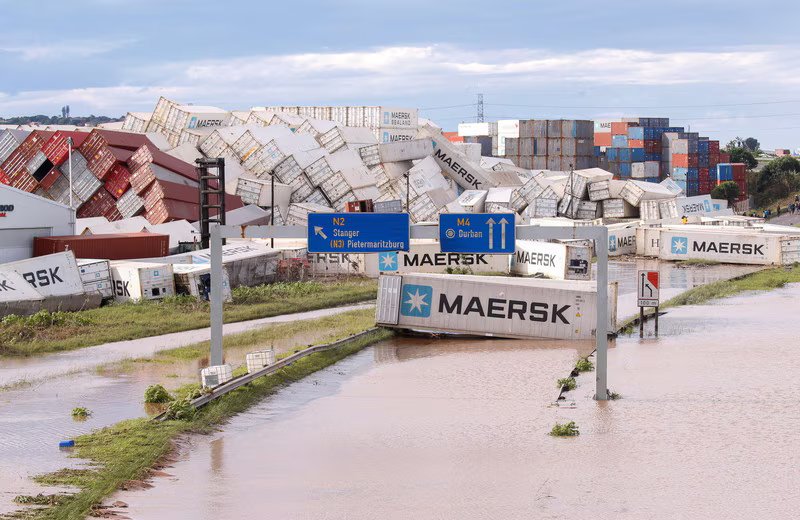
In April 2022, KwaZulu-Natal experienced its worst climate disaster since 1987, according to a study by researchers from the University of the Witwatersrand in South Africa and the University of Brighton in the UK. Catastrophic flooding forced the evacuation of logistics companies along the coast and brought economic activity to a halt. The flood was devastating for those who witnessed the aftermath of its destruction. But perhaps more ominously, they served as a warning to policymakers about the reality of climate change and its impact on South Africans’ lives, the economy, and its institutions.
KwaZulu-Natal is a province characterized as South Africa’s economic hub, with more than 60% of imports and exports passing through the Port of Durban. Its overall contribution to gross domestic product (GDP) is estimated at over 16%, making it South Africa’s second largest economic market.
At the time of the crisis, I was working as a senior professional in the Group Chief Executive Office of a state-owned company, as part of a team tasked with drafting a report assessing and outlining the extent of the infrastructure impact, to help quantify the damage and associated repair costs across port and rail infrastructure. But as I interrogated the report, it quickly became clear that this intellectually reflective exercise required us to confront some deep truths about the state of our infrastructure.
My first reality check was that as a result of historic underinvestment and policies dating back to the 1970s that outlined investments in national infrastructure, our infrastructure was not prepared to adequately protect against climate disaster. For the first time, South Africa faced climate change in its past, and unfortunately, the country’s infrastructure was ill-prepared.
Investing in climate-resilient infrastructure
According to the Organization for Economic Co-operation and Development (OECD), the defining characteristic of climate-resilient infrastructure is one that is “planned, designed, constructed and operated in a way that anticipates, prepares for and adapts to changing climate conditions.” The OECD further suggests that climate-resilient infrastructure can withstand and recover quickly from disruptions caused by climate conditions. ”
However, for many countries in the developing world, the new sense of urgency in responding to these climate disasters presents an opportunity for additional investment in infrastructure that supports the three intersecting challenges. One of the biggest challenges in designing new systems to address current challenges is policy misalignment, regulatory decisions, and policy frameworks that unintentionally impede the use of innovative ecosystem-based solutions.
In developed countries, infrastructure development is more feasible because the roles of the private and public sectors are clearly differentiated. However, policymakers need to be well prepared and work effectively to create a conducive environment for infrastructure investment. This will help reduce the risks associated with building climate-resilient infrastructure that protects citizens. Building strong systems, organizations, and institutions that can absorb disruption, operate under a variety of conditions, and move quickly and fluidly is a key pressure on most governments. To achieve this, policymakers need to understand the interconnected variability of the modern world and act as cross-functional operators.
Indeed, these changing dynamics will require policymakers to thoughtfully address the highly complex nature of the interconnections between society, the built environment, and natural systems, and ultimately develop policies that can fully mobilize public and private investment. Now more than ever, cities and communities are aware of the need to adapt to the inevitable changes in climate conditions. With more than half of the world’s population living in cities and the frequency and intensity of extreme weather events predicted to increase, the resilience of critical national infrastructure systems has become a priority as well.
discover
What is the World Economic Forum doing about climate change?
See more
From 2020 to 2030, Africa’s seven largest coastal cities (Lagos, Luanda, Dar es Salaam, Alexandria, Abidjan, Cape Town and Casablanca) are projected to grow by 40% (from 48 million to 69 million people), compared to an expected continent-wide growth rate of 27% (from 1.34 billion to 1.69 billion), according to a report on the future demographics of coastal cities. Small coastal cities are likely to expand even more rapidly. For example, Port Harcourt in Nigeria is expected to grow by 53% over the next 10 years. Globally, Africa’s coastal regions are expected to experience the highest rates of population growth and urbanization in the world. These demographic pressures are driven by the economic importance of Africa’s coastal cities.
Therefore, investing in climate-resilient infrastructure can bring many benefits, including improved reliability of service delivery, extended asset life, and protection of asset returns to ensure the protection of economic interests. Simply put, such investments can not only strengthen resilience to climate change, but also bring additional economic benefits to developing countries. But it is equally important to consider economic realities while mitigating climate change. This can be achieved through a combination of structural measures as well as management measures such as changes in maintenance schedules and adaptive management to account for future uncertainties.
In some cases, action must be taken now to address the risks from climate change, while in other cases, greater flexibility to respond later is a priority. One proposal is to ensure that state-owned utilities, professional associations and regulators have sufficient capacity to leverage climate projections and foster cross-sector partnerships to better understand and address infrastructure interdependencies.
Policymakers must act urgently
As an economist, John Maynard Keynes made a valid point. When the private sector is frozen, governments must be the investors of last resort. However, in today’s knowledge economy, investing in infrastructure and creating demand for increased production is not enough. Governments and policy makers therefore need to take early action, which is more cost-effective than delaying when the benefits of such action are high and the necessary adaptation measures take a significant amount of time to implement. Addressing these challenges requires a coordinated policy response, involving collaboration between the public sector, infrastructure owners and operators, professional bodies, and investors.
In conclusion, policymakers need to engage thoughtfully when addressing the highly complex nature of the interconnections between social systems, the built environment, and natural systems, and ultimately develop policies that ensure adequate mobilization of public and private investment. Now more than ever, cities, communities and economies around the world need to build climate-resilient infrastructure.
