


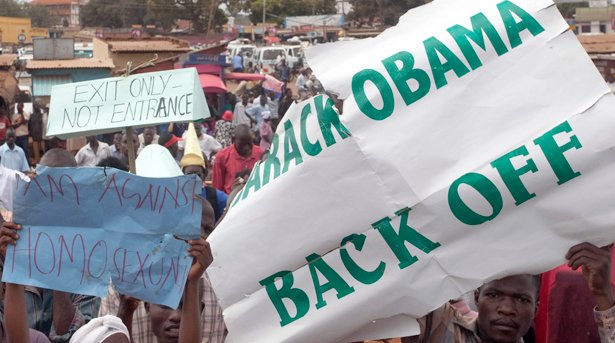
A new U.S. effort to improve sub-Saharan LGBT rights may already be sparking a backlash.
Ugandan activists hold placards and chant slogans at anti-gay protest/Reuters
MONROVIA, Liberia — After a private ceremony in Liberia’s capital, a newlywed gay couple traveled to the coast known locally as Miami Beach with a small group of friends. It was a Sunday in late January, a time when there is often mist in the sky, but the private beach was crowded anyway. The group, mostly young gay men, had just started drinking club beer, chicken, and Pringles. Another bather walked directly into one of the newlyweds. He refused to apologize to the “fag gang” and an altercation broke out, which was calmed down when the beach owner threatened to kick everyone out if the disturbance continued. The man left, but none of the wedding participants cared about it.
Upon leaving around 6:00 p.m., the group found a mob of about 20 people waiting for them. The mob threw stones and empty bottles, which the besieged wedding party threw back. When it was over, only one of them had sustained more than a minor injury. One member of the group fainted from an asthma attack and had to be carried away. But the altercation, and the violent homophobia that inspired it, underscores the growing tensions over gay rights in Liberia — tensions that have become increasingly pronounced since the announcement of new U.S. policies aimed at combating homosexuals.
Last December, Secretary of State Hillary Clinton gave a landmark speech at the United Nations Human Rights Council in Geneva, declaring that “gay rights are human rights” and announcing the United States’ first government-wide policy promoting the decriminalization of homosexuality abroad (this speech coincided with a memorandum issued by President Obama). She vowed to “ensure that our country’s foreign assistance promotes the protection of LGBT rights,” but did not provide specifics. Within days, newspapers in Liberia, one of America’s closest allies in the region, condemned this policy in particular and homosexuality in general. Sub-Saharan Africa is characterized by widespread homophobia and chronic dependence on foreign aid, particularly from the United States, and the idea that these two issues might now be linked seems to have upset many here.
On January 19, three days after Clinton attended the second term inauguration of Liberian President Ellen Johnson Sirleaf, winner of the 2011 Nobel Peace Prize, Sirleaf’s press secretary announced that she would veto any bill that would recognize gay marriage or legalize homosexuality. In February, Liberian lawmakers introduced a bill to ban same-sex marriage. The bill would amend current laws banning incestuous marriage and polygamy, making same-sex marriage a first-degree felony, punishable by up to 10 years in prison. Later that month, another lawmaker introduced a bill that would make “same-sex sexual activity” a second-degree felony, punishable by up to five years in prison. The bill also makes it a crime to “intentionally engage in acts that arouse or attempt to arouse sexual intercourse in another person of the same sex (male/female).” Both bills are currently being considered in committee.
Liberia’s backlash was notable not only because the Liberian government makes disagreements with the United States as rare as possible, but also because it brought unprecedented regional attention to gay rights issues. Like most sub-Saharan African countries, Liberia has laws restricting homosexual acts, making voluntary sodomy a misdemeanor punishable by up to a year in prison. However, the most recent State Department human rights report states that “there have been no criminal convictions under the law in recent years” and that in 2010 there were “no reported cases of violence based on sexual orientation.” Members of Liberia’s LGBT community said that while they were previously not accepted in most cases, they were indeed able to live peacefully underground and free from sexual assault. But the latest backlash against this new U.S. initiative comes in the form of a backlash against gay Liberians, with some in the community questioning whether U.S. plans to help them will actually make their lives even worse.
“In the beginning, people were free to do whatever they wanted, but now they’re restricting the dress code,” explains a 26-year-old gay Liberian man. “Let’s say there are five of us and we all want to go out. Someone is going to decide not to go with us, because there’s a very good chance that one of us in the group is well known to be gay. Everyone carries their own burden, because some people walk in a feminine way, and some people dress in a feminine way. So we say, ‘Oh, we can’t go together, let’s spread out.’
These fears are not unique to Liberia. In Uganda, home of a widely condemned 2009 bill that called for the execution of some homosexuals, presidential adviser Yoweri Museveni responded to Clinton’s comments by saying, “I don’t like her tone at all. . . . Homosexuality is taboo here, it’s an abomination to Africans, and I can tell you that this idea of Mr. Clinton and Mr. Obama will continue to be considered an abomination.” Every country on the continent that I can think of. ” In early February, the authors of the 2009 anti-gay bill reintroduced the bill (but said the death penalty provision would be removed).
However, some countries appear to be more open to reconsidering their gay rights policies. Malawi, which President Obama had previously criticized for jailing two married men in 2010, announced two days after President Clinton’s speech that it would review its ban on homosexuality “in light of public sentiment.” Months before Mr. Clinton’s speech, Kenya’s chief justice had declared that “gay rights are human rights.”
Part of the backlash in some countries has to do with misunderstandings. Many African media outlets have consistently reported that this policy makes U.S. foreign aid conditional on gay rights. Graham Reid, director of Human Rights Watch’s LGBT rights program, said Western countries have threatened to cut off aid in the past, which may help explain today’s misperceptions. In October, for example, British Prime Minister David Cameron threatened to withhold some aid from countries that have outlawed homosexuality, only to have the money redirected from a program called “budget support” favored by recipient governments to other programs such as humanitarian aid.
Reid suggested that misplaced fears about aid cuts could harm efforts to advance gay rights. “This is a very troubling issue, because cutting general development assistance because of a vulnerable and unpopular minority can affect that minority,” he said, even if fears that foreign aid would be lost, as with U.S. gay rights promotion, are actually unfounded. “They could become even more stigmatized and more vulnerable because they cause aid cuts and suddenly appear to be making life even more difficult for their own people.”
Nevertheless, U.S. authorities were unable or unwilling to correct the records. Clinton did not mention the issue during her January trip, although it was a hot topic. Linda Thomas-Greenfield, the outgoing U.S. ambassador to Liberia, said in an interview with a fellow journalist who asked about the policy on my behalf that this approach partly reflected concerns that further statements would worsen the situation rather than calm it down. “I think our policy has been very clear from Washington that there is no link between our long-term aid and the policies related to this issue. But my view was that we shouldn’t fan the flames because we know how irresponsible the press is here,” she said. “We provided them with information, accurate information. There is no guarantee that the public statement we provided will be released in the manner that we would like it to be released.”
Thomas-Greenfield, who said he had discussed gay rights with Sirleaf, disputed that the new policy had led to violence against gays. “I don’t think[Clinton and Obama’s]statements are the cause of this behavior,” she said. “I believe this conduct is criminal and should be addressed here in the Liberian government. These views are not the result of U.S. government policy.”
Some of the largest recipients of U.S. foreign aid in Africa are also some of the worst in terms of gay rights in the sub-Saharan region.
Nigeria, for which the State Department has requested $660 million in aid for fiscal year 2012, banned gay marriage in late November. The move is somewhat unnecessary, given that homosexual acts are already punishable by up to 14 years in prison in the country’s Christian south, and death by stoning in the Muslim north. Homosexuality is also illegal in Ethiopia (the US provided $608 million in aid in 2012). Homophobia is so strong in Ethiopia that the human rights report found that the majority of gay men who called Addis Ababa’s AIDS information center “sought help changing their behavior to avoid discrimination.” Uganda ($528 million in 2012) became virtually synonymous with intolerance following its “gay murder bill” and the 2011 murder of gay rights activist David Cato.
Homosexuality is illegal in Kenya ($751 million, the largest source of U.S. aid south of the Sahara) and Tanzania ($572 million), but no one was punished for homosexuality in either country in 2010 (the 2011 human rights report has not yet been released). South Africa ($562 million) is the only country in Africa to legalize same-sex marriage. Last July, South Africa led the United Nations’ first resolution on gay rights, which was passed despite strong criticism from other African countries.
Most of Africa’s laws against homosexuality did not originate in Africa. Western colonial powers had enacted this law long ago, replicating laws they had in their own countries but had since largely abandoned. Many Africans believe that homosexuality is an export from the West, when in fact only codified homophobia was. Some evangelical Christians, many of them Western, are now continuing this tradition by supporting anti-gay movements in Uganda and elsewhere.
African leaders may also be seeking to make gay people “easy scapegoats” for their countries’ problems, particularly “economic hardship and political instability,” said Human Rights Watch’s Reid.
He said the new gay rights initiative “gives more weight and weight” to U.S. efforts to advance gay rights and makes clear that “LGBT issues are part of the human rights agenda.”
Mr. Clinton’s speech may have helped fuel the recent backlash against homosexuals in Africa, but it did not create the underlying homophobia, said Court Williams, Liberia director for ActionAid International. “Some people have children who are gay or lesbian, and you just say, ‘Don’t talk about it, keep it hidden.’ Or maybe your family won’t talk to you. They ostracize you. That was the common practice.”
Even members of Liberia’s LGBT community, who are concerned about the short-term impact of U.S. policy, acknowledge that the rhetoric and violence has escalated since early December, but is not a new problem. A man who was in the wedding party attacked by a mob in Miami Beach in late January says nearly everyone in the group had been through far more frightening incidents before. “Everyone has their own story.”
He said he hopes U.S. policy will help improve the situation for gay Liberians in the long term, but worries that the path to equality will be more difficult. “It’s good that this issue is out there and people are hearing about it and getting used to hearing about it,” he says. “But really, let’s face it, I feel like I don’t want to be a part of it. You never know how far people will go.”
