


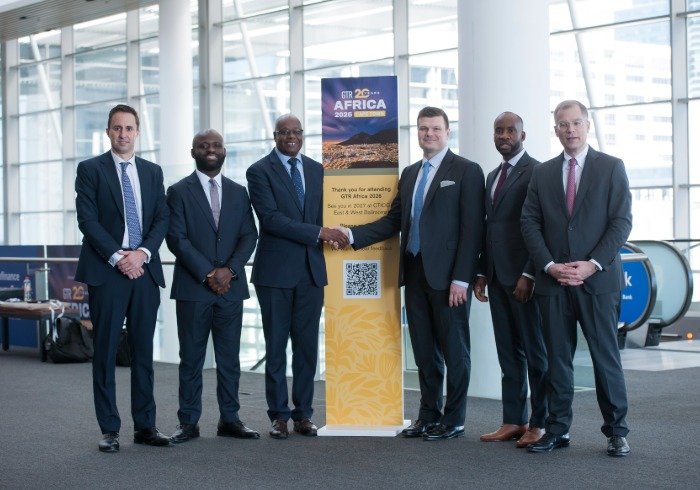
Deutsche Bank has entered into its first partnership with British International Investment (BII), agreeing to a US$150 million risk-sharing program aimed at growing trade finance in Africa’s most challenging markets.
The partnership will be formalized through an unfunded master risk participation agreement, with the UK development finance institution providing a backstop to ongoing short-term financing provided by Deutsche Bank through its network of domestic financial institution partners in Africa.
The partnership, announced on the sidelines of last week’s GTR Africa event in Cape Town, will target the continent’s least developed countries as defined by the United Nations, including Zambia, Ethiopia and Rwanda.
According to the African Development Bank, the gap between supply and demand for trade finance between the continents is estimated to be at least US$100 billion annually. Available liquidity “tends to flow to larger, lower-risk economies, leaving smaller, more vulnerable markets underserved,” the BII said.
It said the program would “guide more capital and support more trade flows to some of Africa’s…most difficult-to-access markets.”
“Why this is important is the recent trend of some international banking groups withdrawing from Africa, limiting the funds available for trade finance,” said Ndaba Mpofu, managing director and head of financial services debt and trade finance at BII.
“It’s an ongoing struggle,” he told GTR.
Mpofu said some African companies are forced to trade with cash as collateral, which means “working capital is tied up no matter how long it takes to import the product and get it on the shelves.”
“Working with partners to extend loans and support the working capital cycle of banks and their borrowers is a key part of enabling banks to do more,” he said.
BII’s risk-sharing program has supported more than US$30 billion in trade since 2015, but this agreement is the first with Deutsche Bank.
“There is a real alignment of interests between what[Deutsche Bank]is trying to do in Africa and our presence and knowledge of the continent, and by partnering we can achieve more in terms of market access for trade finance products,” Mpofu said.
Anand Jha, global head of trade finance financial institutions at Deutsche Bank, said Deutsche Bank plans to make a range of trade finance products available through the program.
“We’re seeing a lot of banks in frontier markets taking a siled approach in terms of focusing on letters of credit and guarantees,” he told GTR.
“For Deutsche Bank, these products to import essential goods are just a starting point, and we hope to resolve the financing requirements of these countries over time through other more innovative means, such as supply chain finance and ECA-backed financing.”
Jha added that many of Deutsche Bank’s corporate clients “see Africa as the last major long-term growth frontier.”
“For them, Africa is not just an opportunity for the next one or two years, but a strategic market for the next 20 or 30 years,” he said. “When they ask how we can support them in Africa, every market has its own characteristics, and that’s where this partnership comes into play.”
