


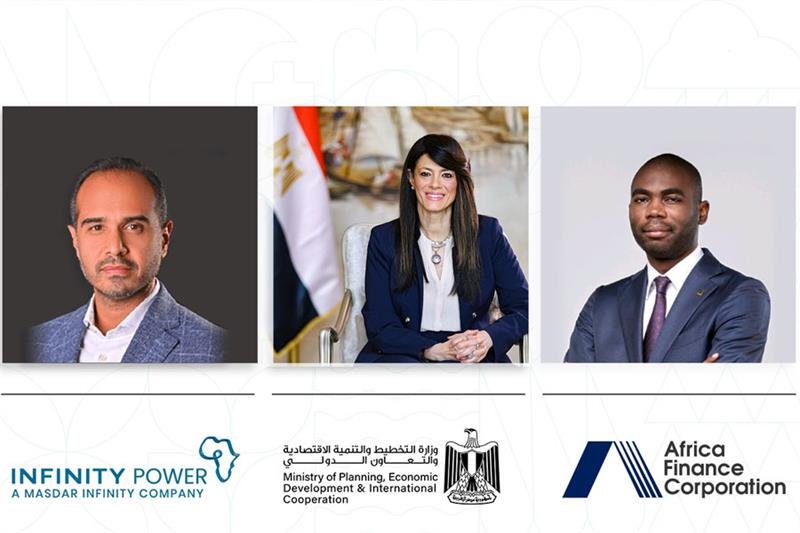
This came after a high-level meeting on Monday between Minister Al Mashat, AFC Capital Partners Investment Director Elie Alloko, and Infinity Power’s Business Development Director for North Africa Mokhtar Aboulaata.
During the meeting, Minister Al-Mashat discussed strengthening cooperation to support Egypt’s green transformation agenda, especially in the energy and transport sectors.
The discussion centered on the Infrastructure Climate Resilience Fund, launched by the AFC in partnership with the Green Climate Fund (GCF), which aims to direct concessional financing and technical assistance to sustainable infrastructure projects across Africa.
AFC and Infinity Power officials provided an overview of the fund’s structure and highlighted recent efforts to mobilize capital for private companies developing climate-resilient infrastructure across the continent.
Mr. Almashat also emphasized Egypt’s strong commitment to making the most of partnerships with international financial institutions and global climate investment mechanisms.
He added that Egypt’s selection among seven countries to benefit from the $1 billion Climate Investment Fund (CIF), the world’s first concessional initiative focused on reducing industrial emissions, reflects international confidence in the country’s development and climate change strategy.
“The inclusion of Egypt in the CIF Industrial Emissions Program is an important milestone that will strengthen our country’s competitiveness and demonstrate to global investors that Egypt is serious about the green transition,” the minister said.
The International Monetary Fund (IMF) plans to complete the initial review of Egypt’s Resilience and Sustainability Facility (RSF) loan program by the end of 2025.
The program, approved by the fund in March at the country’s request, will allocate about $1.3 billion, or 49% of Egypt’s IMF quota, to support economic reforms focused on climate change.
The first review is expected to be completed on September 15, 2025, with a total of three reviews scheduled before the program ends on September 15, 2026. The first tranche of funding is expected to exceed $2.3 million.
According to the IMF, Egypt will account for only 0.73% of global greenhouse gas (GHG) emissions in 2022. However, Egypt’s emissions have more than doubled since 1990, and its large population makes it the third largest emitter in the MENA region.
The energy sector remains a major source of emissions, accounting for more than 70% of the country’s total emissions. Egypt’s current energy mix remains heavily dependent on fossil fuels, with 58% natural gas and 34% oil, with a small contribution from renewables.
The report highlighted Egypt’s growing energy demand and widening oil and gas trade deficit.
The report found that Egypt’s dependence on natural gas exports makes the economy increasingly vulnerable to global transition risks as the world moves towards cleaner energy sources.
follow me:
Short link:
