


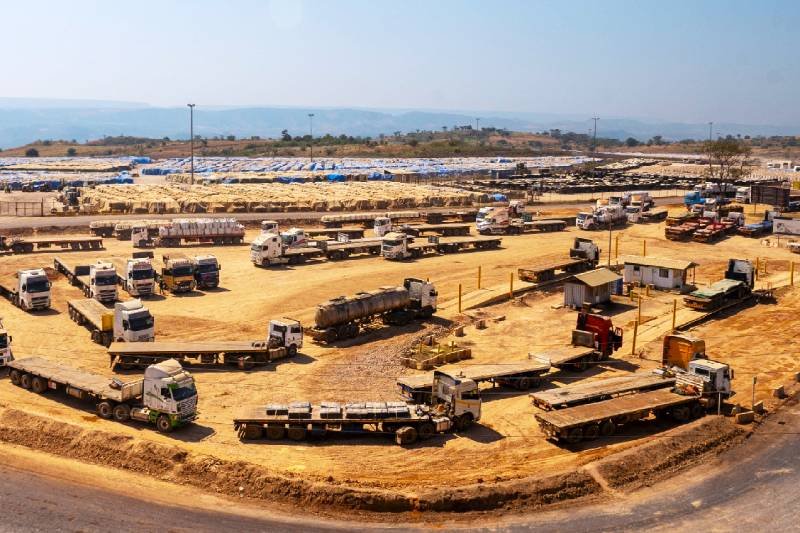
A truck loaded with copper prepares to leave the Tenke Fangurmet mine, one of the world’s largest copper and cobalt mines, in the southeastern Democratic Republic of the Congo. (Photo: AFP/Emmett Livingston)
Global demand for critical minerals (nickel, graphite, manganese, cobalt, copper, lithium, and rare earth minerals) used in defense and aerospace systems, electric vehicles (EVs), semiconductors, artificial intelligence, and medical devices is rapidly increasing. China currently controls more than half of the world’s critical mineral production and an estimated 87 percent of its processing and refining. China also produces nearly 70 percent of rare earth minerals, manufactures 93 percent of high-strength rare earth permanent magnets, and is responsible for 95 percent of the necessary heavy processing of critical minerals.

Data source: IEA
While China’s critical minerals strategy has focused on its processing and refining capabilities, the Chinese government has been diversifying upstream by acquiring major mining assets in Africa, including the Hoemakau copper mine in Botswana (2023), the Goulamina lithium mine in Mali (2024), and the Guara rare earth mine in Tanzania (2025). For example, China’s BYD, the world’s largest EV maker, has secured six lithium mines in Africa, ensuring enough feedstock (or raw materials) until 2032.
China has weaponized its dominant position in refining critical minerals by restricting exports to competitors, requiring licenses for products containing even minimal Chinese content, and banning exports with potential military uses. As a result, competitors began to promote the construction of supply chains without China.
Critical minerals refers to a broad category of minerals, from cobalt to purified phosphoric acid (PPA), that are critical to modern technology and are central to national security, energy, and industrial applications. These are considered “important” because of their economic importance. Therefore, its composition may vary from country to country.
Rare earth elements are an important subset of minerals consisting of 17 elements (15 lanthanides plus scandium and yttrium) that are primarily needed for permanent magnets in electric motors, wind turbines, lasers, electronics, and other advanced technologies. Although they are not necessarily “rare,” they are found in low concentrations, difficult to mine, expensive, and harmful to the environment.

Image: Emeka Udenze
China’s dominance also extends to Africa’s critical mineral infrastructure. Through its Belt and Road Initiative, also known as the Belt and Road Initiative (BRI), China has stakes in the railway, port and power grid networks that link Africa’s vital minerals to global shipping routes. China produces 90% of the world’s solar panels and is projected to provide 60% of renewable energy capacity by 2030. Meanwhile, China’s policy banks issued $24.9 billion in BRI-related mining loans in the first half of 2025 alone, more than in 2024, which was a record year for China’s critical mineral loans. Weakening China’s grip on Africa’s critical minerals sector requires balancing China’s strong position in the sector’s mining, refining, production, and financing.
Africa has large reserves of cobalt, coltan, lithium, nickel, manganese, platinum and rare earths, making it a center of global demand for critical minerals. Nevertheless, Africa remains at the bottom of the value chain and is not the main beneficiary of this mineral wealth. The Democratic Republic of the Congo (DRC) epitomizes this contradiction: mineral-rich but poor, conflict-plagued and dependent on exports of raw materials.
How China Controls Critical Minerals
China is the world’s largest manufacturer and supplier of sodium-ion and lithium-ion phosphate batteries, controlling up to 98 percent of the market.
For decades, China has focused on key mineral sectors. It invested in rare earth processing in the late 1950s and was producing advanced rare earth products by the 1970s. By 2000, Chinese companies, many of them state-owned enterprises (SOEs), controlled more than half of world production through China’s vertically integrated mineral ecosystem.
Western companies initially facilitated China’s rise as a mining power. Attracted by the abundant labor force and high profits, many companies set up operations in China in the 1990s. However, there was a strict requirement for passing on techniques and skills. Once China achieved full-cycle manufacturing capacity, foreign participation in the separation and refining field was restricted, making it an area currently dominated by China.
After acquiring domestic expertise, China’s major state-owned enterprises expanded overseas under the 1999 “Go Out” strategy. They benefited from generous subsidies and tax credits to capture markets, especially in the Global South. This accelerated under the Belt and Road Initiative, a key element of the go-out strategy that aims to create economic corridors with China.
China’s overseas mine ownership will reach 1,250 mines by 2022, up from 40 in 1999. From 2000 to 2021, the Chinese government provided $57 billion in aid and loans for “transitional minerals” (key inputs to renewable energy technologies) in developing countries. About $24 billion of this went to Africa, making it the financier of China’s largest mineral projects in Africa and giving it access to resources and political influence. Additionally, Africa’s debt servicing burden has increased.
China’s state-owned companies receive preferential treatment from the government, which allows them to outbid their competitors and secure supply.
China’s state-owned companies receive preferential treatment from the government, which allows them to outbid their competitors and secure supply. At the same time, it could hinder African countries from enforcing regulations and leave them vulnerable to environmental, labor, and health exploitation. For example, civil society organizations in Zambia have accused the government of downplaying the 2025 Kafue River toxic spill caused by Sino Metals Reach Zambia, one of Zambia’s largest taxpayers.
Characteristics of China’s important minerals strategy
High risk tolerance
China’s state-owned enterprises, supported by extensive subsidies and public financing, operate with an unusually high tolerance for risk, absorb losses for years, dominate markets and gain a foothold in politically volatile regions. Most target brownfield projects (projects with existing facilities) rather than greenfield ventures (projects that build a production facility from scratch) and require high upfront costs.
Chinese companies’ willingness to operate in conflict areas also serves strategic purposes to reduce competition and secure long-term access to critical resources. However, this strategy comes at a cost. Chinese workers are being attacked not only in the Sahel, but also in volatile parts of central, eastern and southern Africa. Continued instability also fosters corruption, labor exploitation and environmental degradation, issues that often lead to criticism and resentment of Chinese mining companies.
national support
China’s state-owned enterprises benefit from generous government support, including about $200 billion a year in subsidies and political risk insurance. Chinese diplomats frequently negotiate directly with host governments on behalf of Chinese state-owned enterprises to maximize influence and facilitate access to Africa’s mining regions. With this government support, Chinese state-owned enterprises were able to capture a large share of Africa’s minerals sector. Of the 166 Chinese-owned mining projects around the world, 66 are in Africa, more (and probably underrepresented) than any other region. The Chinese government’s subsidies to Chinese mining state-owned enterprises, which encourage large-scale, low-cost manufacturing capacity, come at a cost to Africa’s mining sector, which faces difficult challenges in competing and making profits.
Diverse access
Chinese companies have adopted a variety of measures to secure and maintain a foothold in Africa’s mining sector.
Take-home contracts that guarantee future delivery of minerals regardless of ownership; Farm-in contracts that finance the exploration of future production rights; Lease contracts that supply Chinese technology and equipment for a fixed period; Minority stake acquisition as a junior partner;
This multi-layered approach allows Chinese companies to simultaneously act as miners, financiers, engineers and long-term buyers. This has entrenched China’s influence far beyond mere physical mine ownership and mining rights.
Critical infrastructure links
Chinese companies also dominate Africa’s infrastructure sector. Chinese companies build one in three major infrastructure projects in Africa and finance one in five. Similarly, it has installed 23 GW of power in 27 countries. This represents approximately 20% of the region’s capacity. It also serves more than a third of Africa’s ports, more than any other region, giving Beijing extensive logistics reach.
Chinese companies dominate Africa’s infrastructure sector.
Much of this infrastructure network is related to mining. The 100MW Chisamba solar power plant in Zambia was built by Chinese energy company SOE Power China to operate First Quantum Minerals, which is partly owned by Jiangxi Copper Industry Corporation. Similarly, DRC’s 240 MW Busuanga hydropower plant supplies Chinese state-owned company Sicomines’ vast cobalt-copper complex.
Transport corridor projects are strengthening Chinese companies’ influence in Africa’s important mineral sector. The 1,860 km Tanzania-Zambia Railway (TAZARA), currently undergoing renovation following a $1.4 billion investment from China Civil Engineering Construction Corporation (CCECC), connects Zambia’s Copperbelt with Dar es Salaam, Tanzania. CCECC will manage the railway line under a 30-year concession. Copper and cobalt mined from China’s Sikomine in the Democratic Republic of Congo will be transported via TAZARA to Tanzania, then Zambia to South Africa, ending in Durban and Richards Bay. Similarly, a Chinese-led consortium is funding Guinea’s 650km Simandou Railway, which will link the world’s largest iron ore deposits with the Atlantic Ocean.
Chinese companies are integrated into every step of these corridors, including road construction, trucking, rail operations, rolling stock, maintenance and financing, giving them significant influence over the timing, cost and reliability of Africa’s mineral exports.
