


Report by Dunia Ben Mohamed in Conakry – Images by Emmanuel Milimono
Africa is on the brink of a major digital transformation with the advent of reality-aligned artificial intelligence. The goal is clear. The goal is to create AI that is accessible to all, respects local languages and cultures, and addresses Africa’s challenges in education, health, agriculture, and financial inclusion.
According to a report by the African Union and African Development Bank, Africa’s AI market could generate nearly $20 billion by 2030, with the fintech, e-health and smart cities sectors expected to grow by 25% annually.
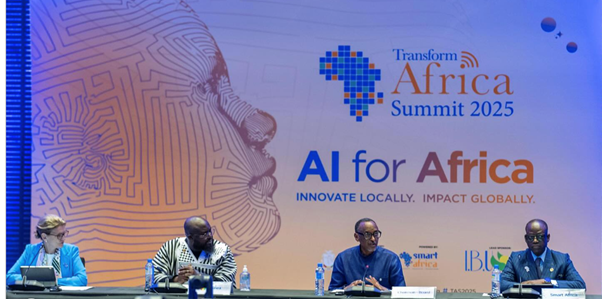
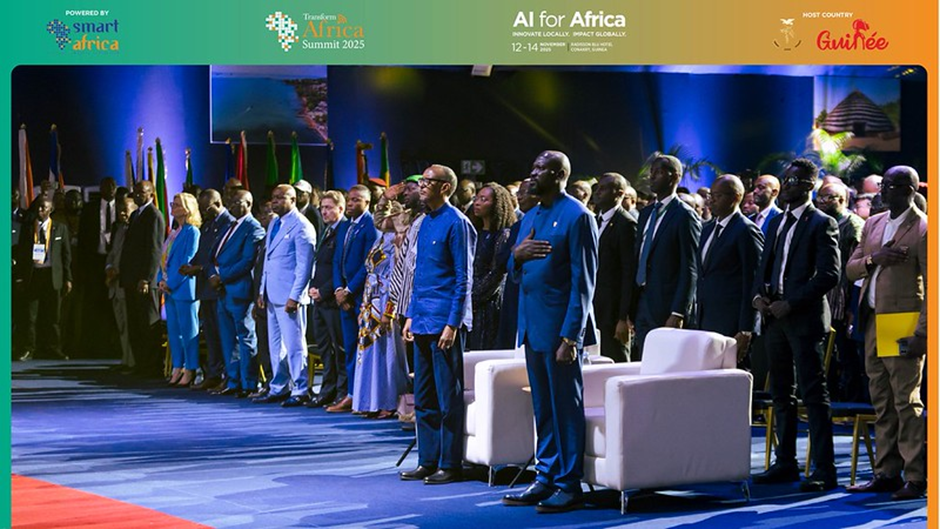
The Transform Africa Summit, the first of its kind in Francophone Africa, served as a strategic platform to materialize this vision. This edition focused on artificial intelligence in Africa, with governments, businesses and academic institutions exchanging views on the continent’s priorities, innovative initiatives and ways to ensure AI is inclusive, locally relevant and a driver of development across key sectors.
AI for Africa is the equalizer. Everyone will be able to actively participate in economic and social development, even if they are rural or illiterate.
« AI for Africa is the equalizer. Everyone will be able to actively participate in economic and social development, even if they are rural or illiterate,” emphasizes Smart Africa Executive Director Lasina Kone. He explains that adapting to local languages such as Wolof, Berber, and Arabic will help reach millions of people who were previously excluded from digital tools. Therefore, Africa’s primary languages should not be a barrier but a vehicle for digital inclusion.
In education, AI presents unprecedented opportunities. Personalized digital agents provide customized instruction to students even in remote locations, making knowledge accessible to people far from educational centers. In the health sector, AI-assisted diagnostic systems can quickly analyze data to identify abnormalities and direct patients to appropriate care. The economy is also benefiting from this transformation. Thanks to digital platforms, entrepreneurs, especially rural women, can create, sell and manage their activities while staying connected to global markets.
To achieve this, we need to develop the necessary ecosystem for “Made in Africa” AI.
Guinea, the host country of TAS2025, is one of the countries that has adopted a strategy focused on AI development. To address this foundation, the country is currently training 1,500 women in digital learning centers, giving them the skills to create value from home.
Rose Paula Preismou, Guinea’s Minister of Telecommunications and Digital Economy, emphasized that digital technology is a cross-cutting infrastructure that supports all sectors: “Digital must empower all sectors, whether it is energy, education, industry or health.” In Guinea, this translates into huge investments. These include the creation of a technopole, the training of hundreds of rural women, the development of digital learning centres, and the reform of the legal framework (data protection, tax incentives).
Our students must become AI creators, not just consumers
Training plays a key role in this strategy. Universities such as Carnegie Mellon Africa and Africa Virtual University educate students from more than 20 countries to become AI experts. Conrad Tucker (CMU-Africa) said, “We’re not just looking for consumers of AI, we’re looking for creators: engineers who can design algorithms, manage datasets, and build AI that’s adapted for Africa.” This technical expertise is essential to ensuring that AI models reflect African values, culture, and priorities. This educational approach aims to develop talent that can address local needs while contributing to the global AI ecosystem, he added.
AI development in Africa also requires a robust infrastructure and appropriate regulatory ecosystem. Initiatives such as the Smart Africa Data Exchange Platform (SADX), which was tested in Benin, Ghana and Rwanda, enable digital identity verification and cross-border interoperability, laying the foundations for a unified digital market.
Building pillars of technological sovereignty
Challenges still remain. Internet access, connectivity costs, data protection, and the creation of Africa’s representative datasets are essential to ensuring technological sovereignty.
One of the most strategic aspects discussed at the summit is digital sovereignty. In addition to using AI, it is also important to produce it locally, by creating African datasets, training talent, and hosting data on the continent. “We must protect our language, our values and our culture,” Kone insists. This sovereignty also depends on intercontinental cooperation. Emerging technologies, including AI, should strengthen Africa’s convergence, rather than deepen its divisions.
In this regard, the launch of Telemo, a dedicated public procurement platform born out of cooperation with Rwanda, is noteworthy. Similarly, the Smart Africa and YouthConnect Africa partnership signed during the summit demonstrates a commitment to mobilizing youth for digital transformation. Mentorship, innovation and entrepreneurship programs, and active participation in the digital economy are all initiatives aimed at creating a generation that can drive AI in Africa.
AI is more than just a technological revolution. It will be a catalyst to accelerate digital transformation and involve all Africans in the continent’s development.
Today, this ambition rests on solid foundations. Smart Africa is a pan-African organization founded in 2013 and active since 2016, coordinating 42 member states and representing approximately 1.2 billion people. The Alliance has led more than 18 continental projects on emerging technologies, spanning digital infrastructure, cybersecurity, education, and capacity building. As Rashina Kone emphasizes, “AI is not just a technological revolution. It is a catalyst that will accelerate digital transformation and involve all Africans in the development of the continent.”
As preparations for the next Transform Africa Summit are already underway, one thing is certain: Africa no longer wants to be a bystander to the artificial intelligence revolution. The company wants to leverage its talent, needs, language and unique vision for the future to become a driving force.
read more :
