


This article was produced with support from Shelter African Development Bank.
A firm handshake may have changed the future of housing in Africa.
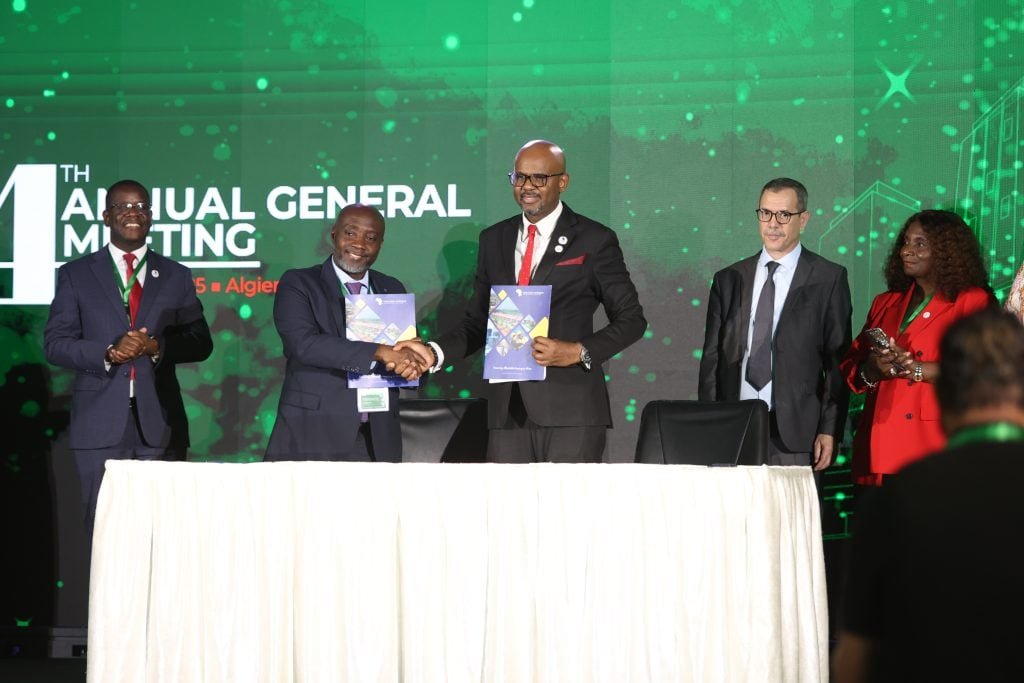
El Mawaqif is an Arabic name that evokes commitment, and when representatives from Shelter African Development Bank and the African Development Bank shook hands on Tuesday, July 15, 2025 in the El Mawaqif conference room of the Aurassi Hotel in Algiers, it seemed a very fitting setting to formalize the partnership between the two institutions.
The formalization of the strategic partnership between the two companies will take place in conjunction with Shelter African Development Bank’s 44th Annual General Meeting, strengthening the collaboration that has been active since 2018 and paving the way for structural investments in sustainable housing across the continent.
Dennis Ansah, Head of Private Sector Operations, African Development Bank Nigeria Country Office, who represents Mike Sarawu, AfDB’s Director of Infrastructure, Cities and Urban Development, outlined the details of the enhanced collaboration to the Algiers Parliament. “This letter of intent demonstrates our shared commitment to supporting the development of inclusive, climate-resilient and economically viable housing solutions,” he said, adding that the agreement is based on four strategic pillars.
The first pillar concerns strengthening policies and governance, particularly regarding land tenure and regulatory frameworks. The second focuses on promoting climate-smart housing, including simplifying the building permit process. The third pillar aims to support the implementation of structural projects, including construction site preparation (CDX), establishing a project portfolio and planning investment programs. Finally, the fourth pillar develops innovative solutions such as CD-Alpha Plus and the risk-sharing platform.
“Shelter Afrik has reached a certain maturity.”
The signing comes after six years of fruitful cooperation, during which time the partnership has already resulted in two concrete initiatives. The first, from the Cities and Urban Development Fund, is $500,000 in technical assistance to build the Africa Fund for Sustainable Housing and Urban Development. The second is part of the Transition Support Facility and will support the implementation of Habitat Africa’s legal framework and project operations in 14 countries.
Tierno Habib Khan, Managing Director of Shelter Afrik, welcomed the progress of the partnership and reflected on the journey so far. “As a major shareholder, we have supported this vision and helped realize it. Today, we are proud that Shelter Afrik has reached a certain maturity,” he said in a speech.
Highlighting the company’s transformation, the CEO said: “The company is now a modern and dynamic organization with a strong focus on growth, supported by leading companies and important shareholder institutions.”
This maturity is reflected in increased awareness on the ground, as explained by Tierno Habib Khan. “Every time we visit a country, our African Development Program partners call us and say: ‘You absolutely have to talk to that country or that country. It’s up to you to support that country’s housing policy.'”
diagnostic tools
Shelter Afrique relies on innovation to optimize interventions and has developed biosector diagnostic tools to identify all bottlenecks in the housing ecosystem. “This tool aims to remove obstacles to investment and create conditions for the effective development of this sector,” explained Tierno Habib Khan, while announcing the upcoming rollout in several countries.
These diagnostics, although tailored to local realities, serve as a basis for developing national partnership strategies for housing and urban development. This approach addresses the specific challenges of each market, while maintaining a consistent continental vision in the face of the scale of needs to be met.
The stakes are much higher than just an announcement. According to UN-Habitat, Africa needs to build an additional 51 million homes by 2030. With the urban population expected to double from 600 million to 1.2 billion by 2050, we are in a race against time.
However, challenges abound, including financing, regulatory frameworks, training of local actors, and adaptation to climate change. AfDB and Shelter African Union do not claim to be a silver bullet for this complex equation. But it does provide an organized response to one of the continent’s most pressing challenges.
The signing in Algiers marks a new step in the structuring of Africa’s housing sector, with two pan-African financial institutions combining their expertise and resources to meet the continent’s growing need for sustainable housing. This cooperation extends to countries that are not active at the local level, underscoring the ambition of a comprehensive approach to urban development in Africa.
