


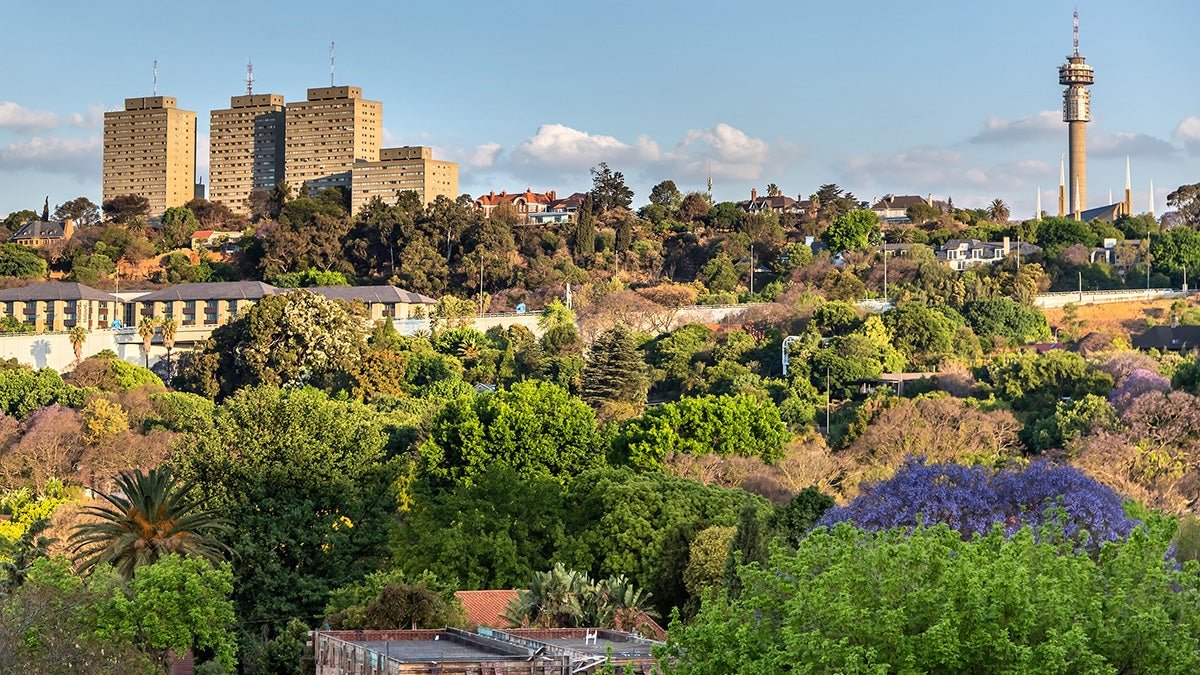
With a population of over four million people, Johannesburg is South Africa’s largest metropolitan area and faces many of the same tensions faced by large cities around the world, including rapid growth, energy access and waste concerns.
Its successful efforts to integrate environmental solutions into urban planning are therefore of great interest to city managers and government officials across Africa, who recently visited eco-districts and urban farms around Johannesburg to learn from the work being undertaken in collaboration with local and international partners, funded by the Global Environment Facility.
Launched in 2017, the Building a Resilient and Resource-Efficient Johannesburg: Increasing Access to Urban Services and Improving Quality of Life project shows how taking environmental considerations into account can improve housing, energy and waste management, increase access to municipal services, improve quality of life and foster sustainable urban development.
Leveraging an $8 million GEF grant with $124 million in co-financing, the City of Johannesburg is implementing the project in partnership with the Development Bank of Southern Africa (DBSA) and the United Nations Environment Program to invest in sustainable initiatives across the region in line with the city’s 2040 Growth and Development Strategy.
The project supports efforts across the city to improve energy access and water efficiency in public housing, support healthy waste management practices, establish high-density neighborhoods that combine residential and commercial use with energy-efficient buildings, and improve access to public transportation. It also incorporates investments in the creation of eco-districts and urban agriculture, with the aim of supporting sustainable farming practices such as organic farming, efficient irrigation methods and biodiversity-friendly food production at the community level.
Johannesburg is one of more than 90 cities participating in the GEF Sustainable Cities Programme. The program works in 33 countries to address land use planning, waste management, sustainable transport and energy, and green housing in an integrated approach. To date, the program has awarded $480 million in grants and generated nearly $5 billion in cofinancing for city initiatives that support environmental goals and generate socio-economic benefits.
“Johannesburg was selected for this project because of its complex urban challenges but strong policy and institutional foundations. We wanted to show that if it works here, it can be replicated anywhere in South Africa,” said Thandeka Mlaza-Lloyd, Director of Spatial Transformation Projects at the City of Johannesburg.
One of those efforts is to redesign public housing with a focus on more efficient use of resources. For example, in a 20-year-old apartment complex pilot, we renovated 172 one- and two-bedroom rental units, reducing residents’ energy bills by 50 percent and water usage by 13 percent. Improved waste management and solar-powered public lighting are improving the safety and health of low-income residents living in buildings.
The changes are obvious. The newly painted and well-maintained complex boasts clean walkways and hallways, and high-quality lighting in public areas. The garbage collection area is also well-maintained and has bins for residents to separate and dispose of different types of waste. One resident started a recycling business based on waste collection within the housing complex.
The urban agriculture portion of the project contributes to increasing local food availability and empowering smallholder farmers by integrating them into broader food supply chains. Some of the produce will be sold at the Municipal Joburg Market, Africa’s largest fresh produce market.
Improving food distribution can help reduce waste. At the same time, another part of the project will specifically address biodegradable waste through the construction of a new biogas plant at Johannesburg’s largest landfill site to convert biodegradable waste into renewable energy. The Joburg market will be the main raw material source for the plant, reinforcing the integrated approach of the initiative.
Lessons learned from this project will be incorporated into future urban investment guidelines for the Johannesburg Social Housing Corporation and other government agencies.
It has also resonated throughout the region. The project recently attracted more than 100 participants from the GEF Expanded Constituency Workshop in Angola, Botswana, Eswatini, Lesotho, Malawi, Mozambique, Namibia, South Africa, Zambia and Zimbabwe, which focused on how developing countries can access resources and make the most of their impact.
As part of the GEF Sustainable Cities Programme, the project also benefits from the opportunity to exchange experiences with other cities facing similar challenges. In this way, the program supports cities in their efforts to lean towards resilient and inclusive urban development and reverse historic biodiversity loss, land degradation and pollution associated with urbanization.
Building on project experience and successes, South Africa is developing new projects to strengthen climate resilience, biodiversity conservation and sustainable urban development in Johannesburg and other secondary cities as part of the GEF Sustainable Cities Programme.
