


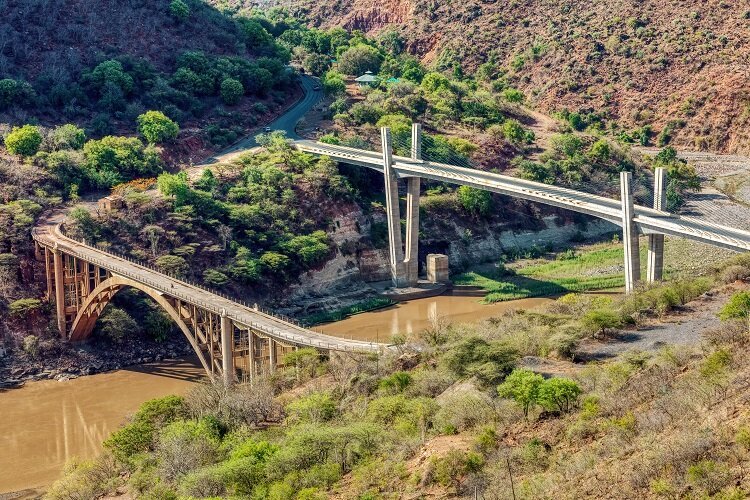
These projects are expected to improve business and ease daily life, which often has to go on for hours without electricity or water. The goal is to stimulate economic growth by freeing up natural resources and creating jobs for local people.
Without further ado, here are some of the major infrastructure projects that are changing Africa and how they are impacting the continent.
1. Nairobi Expressway
The Nairobi Expressway is Kenya’s first major road project to be implemented under a public-private partnership (PPP) framework. The road will connect Jomo Kenyatta International Airport in the east of Kenya’s capital Nairobi with the Nairobi-Nakuru Expressway in the west. The project will widen the existing road to four lanes each way (eight lanes total) and install sidewalks, drainage channels, overpasses, and street lights. Once completed, the 27km partially elevated road section will form a key element of the Northern Corridor, which will ease the flow of traffic in and out of East Africa’s major commercial hub and provide passage for 85% of cargo bound for neighboring landlocked countries.
2. Second Niger Bridge Project, Nigeria
The second Niger Bridge is under construction on the Niger River in Nigeria and will connect Asaba City in Delta State to Onitsha City in Anambra State. The project consists of a 1.6-kilometre reinforced concrete river crossing bridge with a length of up to 150 metres, and includes ancillary infrastructure connecting to the bridge, including a motorway interchange, toll plaza and a 10-kilometre long expressway. Once completed, the second Niger Bridge will minimize traffic congestion on the existing Niger Bridge. The bridge was built in 1965 and is part of the Trans-African Highway, which spans from Lagos to Mombasa, Kenya, and is a major East-West connection within Nigeria.
3. Marine Drive Project in Ghana
The Marine Drive project, a government initiative, aims to improve parts of Accra’s coastline and transform them into art tourism and hospitality precincts. It will be home to many tourist resorts with shopping malls, hotels, casinos, conference centers and office complexes. There will also be a water theme park, beach soccer field and playground.
The project covers more than 240 acres of land stretching from Christiansborg Castle to Biden-Powell.
Investment Profile (Tourism):
The Marine Drive Tourism Investment Project aims to plan and develop 241 acres of land stretching from Christiansburg Castle in Osu to the Kwame Nkrumah Mausoleum. @MOTACGhana. For more information, please visit https://t.co/WKiAmNOmh9. #GhanaOnTheGo pic.twitter.com/VtA48spw0C
— Ghana Investment Promotion Center (@gipcghana) July 9, 2018
4. Walvis Bay Container Terminal in Namibia
The southwestern coast of Africa has played an important role in trade and shipping since the late 15th century, and continues to do so to this day. With military bases, extensive container facilities and ownership of ports in Sri Lanka, Greece and Antwerp, it’s no wonder so many countries are interested in this part of Africa.
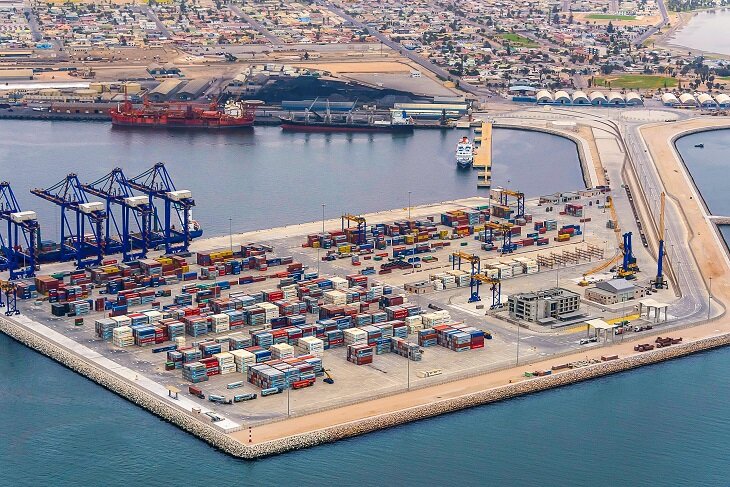
This newly reclaimed container terminal in Windhoek, Namibia opened in August 2019. This increases the handling capacity of Walvis Bay Port from 350,000 TEU to 750,000 TEU per year. Additionally, vessel waiting times have been reduced to less than eight hours and container transit times have been reduced from 14.5 days to 9.5 days.
The project will also provide the capacity to meet future demands from both coastal and landlocked countries to the east and north-east of Namibia.
5. North Africa’s Trans-Maghreb Highway
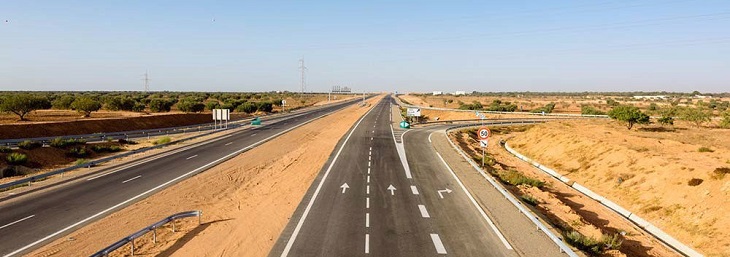
One of the major infrastructure projects in Africa today is the Trans-Maghreb Highway, a highway that runs through the Maghreb region of North Africa (passing through Mauritania, Western Sahara, Morocco, Algeria, Tunisia, and Libya).
Once completed, it will connect approximately 55 towns and cities in North Africa, a population of more than 60 million people, 22 international airports, and numerous ports and other industrial areas. The Trans-Maghreb Highway is highly strategic, not only creating and promoting a North African trade bloc, but also connecting Maghreb countries with the rest of the African continent, and connecting Europe and Egypt via Morocco with Asia and Africa. The project has been compared to the Trans-Siberian Railway because it connects the local economy in many ways.
6. Ghana-Burkina Faso Railway Interconnection Project
The Burkina Faso-Ghana rail interconnection project will extend from Mpakadan in Ghana, via Hohoe and Yendi, to Ouagadougou, the capital of Burkina Faso. The project is scheduled to begin in mid-2022 and will span approximately 1,100 kilometers.
The railway will also connect to the regional capitals of Ho, Dambai and Nalerig in Ghana, while in Burkina Faso the railway line will pass through major cities such as Po, Zabre, Tenkodogo and Manga.
Once completed, the railway will create a vital connection between Ghana’s Tema port and Burkina Faso’s capital Ouagadougou, facilitating trade between the two countries.
7. Tower of Mohammed VI, Morocco
The total area of the Mohammed VI Towers in Morocco is 102,800 square meters. It is a 55-story high-rise mixed-use building. There are luxury hotels, luxury apartments, office space, and large viewing terraces. There are also a total of 40 elevators installed throughout the tower and podium.
According to the project’s designers, the tower can withstand high winds, flooring and other seismic activity. For added sturdiness, a tuned mass damper system is set to be installed on the top floor of the tower.
The structure will feature approximately 3,350 square meters of solar panels and an internal energy recovery system to heat the water, and will comply with the highest international quality standards. Wastewater recycling and rainwater harvesting systems have also been added to the tower’s design.
8. Pinnacle Towers in Kenya
Pinnacle Towers in Kenya will have a total of 70 floors. It includes a 45-story Hilton hotel, 200 residential units, 20 floors of office space, three-story underground parking, a gaming zone, a helipad, a three-story luxury mall, an infinity pool, and an observation deck.
The 900-foot-tall twin towers cost approximately $200 million to build. It is controlled and led by the White Lotus conglomerate and East African petroleum products distributor Hass Petroleum. It is currently under construction in Nairobi, Kenya.
9. Trans-Aqua Project in North Africa
Transaqua is a large-scale water infrastructure project first proposed in the 1970s. Recently, the project has been discussed again, with politicians claiming it has the potential to reshape regional politics on the continent.
The $50 billion project aims to build a 2,400 km canal to divert water from the Congo River basin to Lake Chad and replenish the now-shallow waters. When completed, Transaqua will create a new water source for countries in the northern part of the continent, including Egypt, Chad, and Libya. It also provides irrigation for the crops.
summary
Africa has undergone significant changes over the past 50 years as a result of economic growth. And these major infrastructure projects in Africa mentioned above are changing the industry more than we can imagine.
We look forward to sharing more about these projects in future posts, but for now we want you to know what’s going on on this side of the world. If you would like to keep up to date with the latest information, or would like to learn more about how your company can make a contribution, please contact us today.
For the latest information and news about Africa’s construction industry, check out ConstructAfrica. Please visit our website for more information.
Photo above: Old and new bridges over the Blue Nile, Ethiopian landscape, Amhara region (Artushfoto | Dreamstime)
