


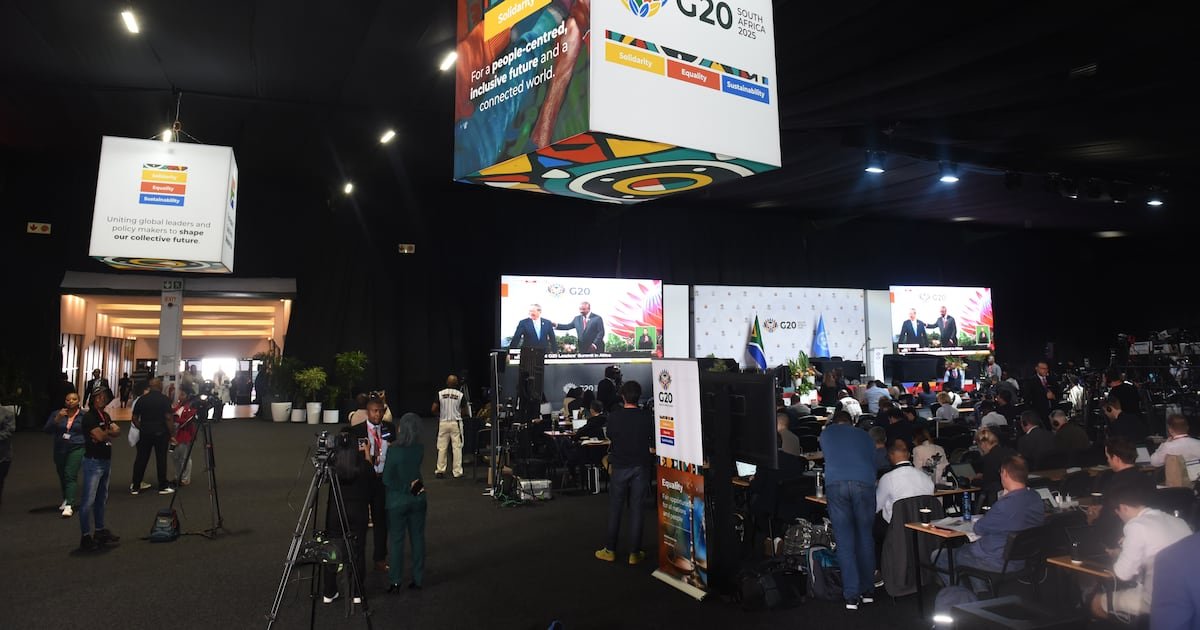
Thursday, November 20th was an important day in the history of the investment industry. More than 100 people representing some of the most influential local and international institutional investors, sovereign wealth funds and development finance institutions gathered at Melrose Arch in Johannesburg to sign what will become known as the Melrose Resolution.
In attendance were the CEOs of Ninety One, M&G Investments, Africa50 and Enco Capital, the President of the IMF of South Africa, the President of the New Development Bank, and the Chair of the African Government Investors Forum.
We expected that the Melrose Declaration would receive some support from business leaders attending the Public Investment Corporation (PIC) G20 Investment Conference. But we didn’t expect nearly everyone there to adopt it. That was the moment I witnessed it. An industry built on economic interests has committed to a series of actions rooted in the desire to make the world a better and more just place.
The occasion was the final session of PIC Perspective’s G20 Dialogue, which was held under the theme “Mobilizing Global Capital for Inclusive Growth.” It was the culmination of a year’s work.
As part of my commitment to creating a new culture of transparency at PIC, we have agreed to a series of public engagements with investment professionals. The aim was to share the work we are doing while advocating for Africa to receive a greater allocation of much-needed capital for industrialization and critical public infrastructure development.
In partnership with the University of Oxford, our economists and research and development team have published a series of papers making a compelling case for infrastructure investment in Africa as a catalyst for growth. A study on the theme ‘Accelerating infrastructure development in Africa: Strategies to reduce lead times’ showed that this is not only necessary, but urgent.
The Melrose Resolution sparked a commitment to co-finance cross-border projects for integrated markets, expand project preparation facilities for shovel-ready initiatives, build local capacity, and mobilize green investment.
The continent’s current economic trajectory, rapid population growth, and persistent disparities in access and quality of services all point to the same conclusion. Without a gradual change in the pace and scale of infrastructure development, Africa risks falling further behind in its pursuit of inclusive growth and structural transformation.
According to the African Financial and Development Bank, Africa needs between $130 billion and $170 billion of annual investment to close this infrastructure gap. Until this happens, energy systems will remain underpowered, transport networks fragmented, water infrastructure inadequate and digital connectivity far from universal. These gaps harm productivity, limit regional integration, and constrain the emergence of globally competitive industries. Our research shows that the global demand for sustainable energy presents a unique opportunity to accelerate development in South Africa and the African continent.
As Africa’s first G20 president, South Africa has sought to tackle inequalities in trade, finance and climate action, and amplify the voice of developing countries. The result has been concrete commitments by world leaders to address these issues. The Melrose Resolution sparked a commitment to co-finance cross-border projects for integrated markets, expand project preparation facilities for shovel-ready initiatives, build local capacity, and mobilize green investment.
Participants were committed to exploring strategic partnerships and cooperation to unlock capital for investment in the continent’s infrastructure, industrialization, green economy and emerging industries. PIC intends to actively seek opportunities to co-invest in mixed financing structures with development financial institutions and public bodies to de-risk projects for potential investors.
Our research in 2025 further shows that at appropriate investment levels, green investments can create 250,000 new jobs over five years. It’s a well-known adage in our industry that capital requires confidence. It is noteworthy that South Africa is in an adjustment phase. We have solved many of our economy’s structural problems by working closely with the private sector. It delivered concrete results, such as ending load shedding, and inspired new confidence in the economy.
The rest of the world has noticed. The company was removed from the Financial Action Task Force’s gray list and received its first upward credit rating upgrade from Standard & Poor’s following the Medium Term Budget Policy Statement. Both reduce the cost of capital needed to finance long-term development projects. South Africa also has a well-developed financial system and extensive experience in delivering large-scale cross-border infrastructure projects. Both underpin confidence in our economy.
Thinking back to that moment of solidarity at Melrose Arch, where normally profit-motivated business leaders embraced equity for a better world, South Africa’s G20 leadership could position us as the gateway to global capital.
• Dlamini is CEO of PIC
