


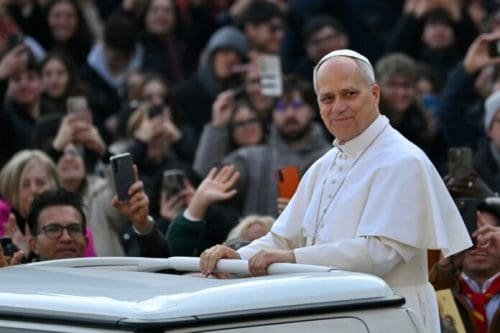
Pope Leo XIV on Thursday condemned the growing use of artificial intelligence in military operations, saying that delegating life and death decisions to machines is a devastating betrayal of the principles that sustain civilization.
The Pope made the remarks in his first message for World Day of Peace, published on December 18, in which he expressed concern about the growing role of artificial intelligence in modern warfare. The Catholic Church has designated January 1 as World Day of Peace, and the pope’s messages traditionally refer to pressing global issues affecting peace and human dignity.
Further technological advances and the military introduction of artificial intelligence are exacerbating the tragedy of armed conflict, he said in his message. According to the Pope, there is a growing trend among political and military leaders to avoid responsibility as decisions about life and death are increasingly delegated to machines.
Leo, who was elected as the Catholic Church’s first pope from the United States in May 2025, has repeatedly called for the ethical use of artificial intelligence since taking office. His comments come as several countries increasingly deploy AI-driven technologies for military purposes, including automated surveillance systems, cyber defense tools, and weapons such as autonomous drones and missile defense systems that rely on predictive algorithms.
These developments have raised growing ethical and legal concerns among international organizations, human rights organizations, and religious leaders around the world. The Vatican has positioned itself as a leader in advocating for international regulation of artificial intelligence technologies, particularly in military applications where human responsibility could be reduced or eliminated.
The 70-year-old pope warned that delegating military decisions to machines represents an unprecedented and devastating betrayal of the legal and philosophical principles of humanism that underlie and protect every civilization. His statement reflects the Vatican’s broader concerns about technology replacing human judgment in matters of life and death.
In the same message released ahead of World Peace Day, Leo also criticized the use of religion for political purposes. He said it was becoming increasingly common to drag words of faith into political struggles, celebrate nationalism and justify violence and armed struggle in the name of religion.
The Pope also criticized military force, particularly the concept of nuclear deterrence, saying it is irrational and rooted in fear rather than justice. His message is that this approach to international relations is built not on law, justice and trust, but on fear and control through force.
Leo’s election on May 8, 2025 was a historic moment for the Catholic Church. Born Robert Francis Prevost in Chicago in 1955, he became the first American to lead the world’s 1.4 billion Catholics. He was also the first pope from the Order of St. Augustine, had dual citizenship in the United States and Peru, and served as a missionary for nearly 20 years.
While in Peru, Prevost was appointed Bishop of Chiclayo in 2014, elevated to archbishop in 2023, and elevated to cardinal in 2024 by his predecessor, Pope Francis. His experience working with poor communities in Latin America shaped his views on social justice, human dignity, and the ethical dimensions of technological development.
The new pope has positioned himself as the voice of moderates within the church, seeking to continue many of Francis’ reforms while maintaining a cautious approach to controversial issues. His statement on artificial intelligence is consistent with the broader Vatican position, which advocates human-centered technology development that respects fundamental human rights and dignity.
Vatican officials have previously called for an international treaty to regulate the development and deployment of artificial intelligence. The Holy See participates in global forums on AI governance and consistently emphasizes that technological advances must serve humanity, not undermine human agency and moral responsibility.
Military applications of artificial intelligence present particularly complex ethical challenges. Autonomous weapons systems that can identify and attack targets without direct human control raise questions about liability in the event of civilian casualties or errors during combat operations.
Several countries, including the United States, China, Russia, and Israel, are investing heavily in military AI technology. These systems range from surveillance tools that process vast amounts of data to identify potential threats, to missile defense platforms that make instant decisions about intercepting incoming projectiles, to fully autonomous drones that can perform their missions with minimal human oversight.
Supporters of military AI argue that these technologies can reduce human casualties by removing soldiers from dangerous situations, improve accuracy to minimize civilian deaths, and provide defensive capabilities against adversaries deploying similar systems. Critics counter that machines lack the moral reasoning needed to make life-or-death decisions and that automated warfare could lower the barrier to military conflict.
International humanitarian law requires that weapons systems maintain meaningful human control over the decision to use force. However, as AI systems become more sophisticated and operate at speeds that exceed human reaction times, it becomes increasingly difficult to define meaningful human control.
The United Nations has convened multiple rounds of discussions on lethal autonomous weapons systems, but member states have not reached agreement on binding regulations. Some countries advocate pre-emptive bans on fully autonomous weapons, while others resist restrictions, seeing them as hindering defense capabilities and technological innovation.
Pope Leo’s message was delivered during the 59th World Day of Peace celebrations. This day was established by Pope Paul VI in 1968 to promote peace and address global challenges that threaten human well-being. Each year, the Pope issues a message that examines contemporary issues through Catholic social teaching and universal human values.
The topic of technological ethics has featured prominently in recent papal messages. Pope Francis dedicated his 2024 World Day of Peace message to artificial intelligence and peace, warning of the risks of misinformation, social control and exacerbation of inequality caused by AI technologies. Leo’s message builds on these concerns, with a particular focus on military applications.
The Vatican’s approach to technology issues reflects the Church’s tradition of addressing the moral aspects of scientific and technological progress. From nuclear weapons to genetic engineering to digital technology, successive popes have sought to articulate ethical principles that guide the responsible development and use of powerful new capabilities.
Leo appealed to people to follow the example of St. Francis of Assisi, who sought peace through humility and poverty, striving for all people to live in peace. The reference to Leo’s predecessor, namesake Francis, underscores the continuity of the Vatican’s peace advocacy and emphasizes the new pope’s commitment to dialogue and reconciliation.
The Pope’s message resonates beyond the Catholic community. Religious leaders from multiple traditions have expressed similar concerns about artificial intelligence in warfare, arguing that the ethical constraints on violence rooted in religious teachings cannot be encoded into algorithms or delegated to machines lacking moral consciousness.
As the capabilities of artificial intelligence rapidly advance, the debate over appropriate limits and regulations will intensify. Pope Leo’s intervention adds moral authority to calls for international cooperation to establish a framework that ensures that AI technologies serve human flourishing, rather than threatening fundamental values of human dignity, responsibility, and peace.
