


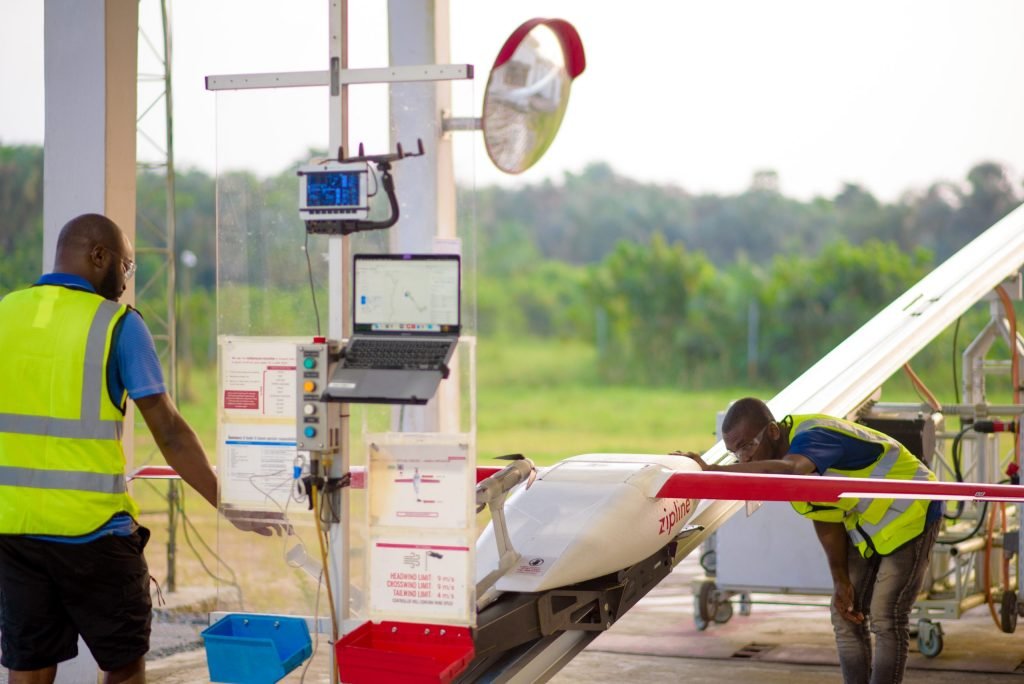
The U.S. Department of State will award $150 million to Zipline, the world’s largest autonomous logistics system, to help expand lifesaving artificial intelligence and robotics infrastructure across Africa.
Under this pay-for-performance model (a first for the State Department), funds would be released only if African governments sign expansion agreements, commit to ongoing operating costs, and ensure the long-term sustainability of services in their public health systems. Participating African governments are already using Zipline regionally, and this award will enable them to expand their centralized, on-demand logistics infrastructure across the country.
Zipline’s expanded services will reach more than 130 million Africans at scale through on-demand delivery that reduces waste, equalizes access to care, increases treatment rates and improves health outcomes. This will triple the number of health facilities served by Zipline to 15,000 and help create more than 800 high-skilled, high-paying jobs in Africa in logistics, health systems, and advanced engineering in robotics and artificial intelligence. It would also generate economic benefits of up to $1 billion a year across Africa by solving the logistics and credit bottlenecks that hold back commerce in so many regions.
This landmark agreement will usher in a new results-driven foreign aid model that prioritizes innovation, scales up what works, and emphasizes long-term sustainability and mutual economic growth.
Zipline has been operating across Africa since 2016, partnering with governments to deliver blood and medicine to more than 5,000 hospitals and medical facilities. Its efforts have been credited with contributing to reducing maternal deaths by up to 56%, zero-dose prevalence by 42% in a single year, and missed opportunities for severe malaria treatment by 66%. Since its first delivery in Rwanda in 2016, Zipline’s autonomous logistics system has flown more than 120 million commercial autonomous miles and completed more than 1.7 million autonomous deliveries with zero safety incidents, proving that life-saving technology can be rapidly deployed to expand access and improve health outcomes across Africa.
Rwanda is expected to be the first country to expand under this new award, building a third distribution center to double daily delivery volumes, expanding into urban communities with Zipline’s new short-range precision delivery drones, and building its first flagship test facility to host Zipline’s global hardware and software product testing. Zipline expansion is planned for additional countries including Ivory Coast, Kenya, and Nigeria.
“We started Zipline to build a logistics system that serves everyone equally. Now, the U.S. government is stepping up our efforts and leveraging AI, robotics, and autonomous logistics systems to improve health outcomes,” said Keller Rinaudo Clifton, CEO and co-founder of Zipline. “For years, presidents and prime ministers have told me they want the best of what America has to offer: innovation, jobs, and 21st century technology to leapfrog into the future. That has always been a uniquely American value proposition, and today the U.S. State Department is making that a reality.”

“This partnership is an example of the innovative, results-driven partnerships that are at the heart of the America First foreign aid agenda,” said Jeremy Lewin, Under Secretary of State for Foreign Assistance, Humanitarian Affairs, and Religious Freedom. “With modest U.S. capital investment support, these five countries will be responsible for maintaining and continuing to invest in the supply chain network of innovative health products that the United States is building.” “By activating private capital, fostering local buy-in, and strategically deploying aid resources to champion American businesses, President Trump’s foreign aid policies are leading developing economies into the 21st century, while helping the United States win tomorrow’s technological races.”
“African governments are choosing to invest their own resources in ziplines because they are effective and incredibly cost-effective. They can solve intractable global health challenges such as maternal mortality, malnutrition and under-five mortality,” said Caitlin Barton, CEO of Zipline Africa. “This award marks a pivotal moment in foreign aid. The U.S. government is supporting Africa’s vision, building the infrastructure Africa wants, and accelerating the implementation of American innovations that are proven to be effective and recognized as some of the most cost-effective public health interventions ever studied. This will forever change the trajectory of human health and development in Africa.”
“Rwanda and Zipline have been working together for many years to leverage technology for the benefit of our people. We have seen the incredible impact of drone delivery in saving time, saving money and saving lives,” said Paula Ingabire, Rwanda’s Minister of ICT and Innovation. “With this partnership, we will expand our delivery to urban areas and bring these benefits to even more communities. We thank the U.S. government for supporting Zipline’s expansion and joining us in building the foundation for Africa’s future in healthcare and innovation.”
“Nigeria, with a population of over 200 million people, faces unique challenges and opportunities in delivering healthcare equitably and efficiently. Existing zipline operations in three Nigerian states demonstrate how drone delivery can transform access to healthcare. It will eliminate stockouts, create new service points where there are no health facilities, facilitate increased visitation and treatment rates, and improve treatment success and health outcomes,” said Muhammad Ali Pate, Nigeria’s Minister of Health and Human Services. “We applaud the U.S. government’s support for innovations like ziplines that have the potential to advance our vision for a healthier and more just future for our people, and we are in talks to work together to find a sustainable path forward.”
Pierre Dimba, Ivorian Minister of Health, Public Health and Universal Health Care, said: “Our priority in Ivory Coast is to ensure that all citizens have prompt, reliable and equitable access to essential health products.” “Since we began operating Zipline in our country, we have seen the tangible effects of medical drone delivery: reducing supply times, increasing the availability of critical products, strengthening the capacity of medical facilities, and improving the services provided to our citizens, including in rural and remote areas.With this expanded partnership, we are able to extend these achievements and extend the benefits to the entire territory. “This approach is fully aligned with our vision of a modern, resilient health system.” ”
About zip lines
Zipline is the world’s largest and most experienced autonomous delivery service. Today, Zipline operates on four continents, makes a delivery somewhere in the world every 30 seconds, and serves more than 5,000 hospitals and medical facilities. Zipline’s customers include federal and state health systems, healthcare providers, restaurants, and retail stores. With more than 120 million commercial autonomous miles flown safely to date, Zipline is transforming access to healthcare, consumer products, and food. Our customers rely on Zipline to save lives, reduce emissions, increase economic opportunity and deliver new logistics services at scale.
For years, Zipline has worked with governments and charities willing to take bold action to improve the health outcomes of tens of millions of people. Partners include the Elton John AIDS Foundation, the Gates Foundation, Gavi, Pfizer, and the UPS Foundation, who have helped Zipline and its partner governments develop a wealth of empirical evidence that advances our understanding of how improved supply chain performance increases timely treatment and ultimately saves lives.
