


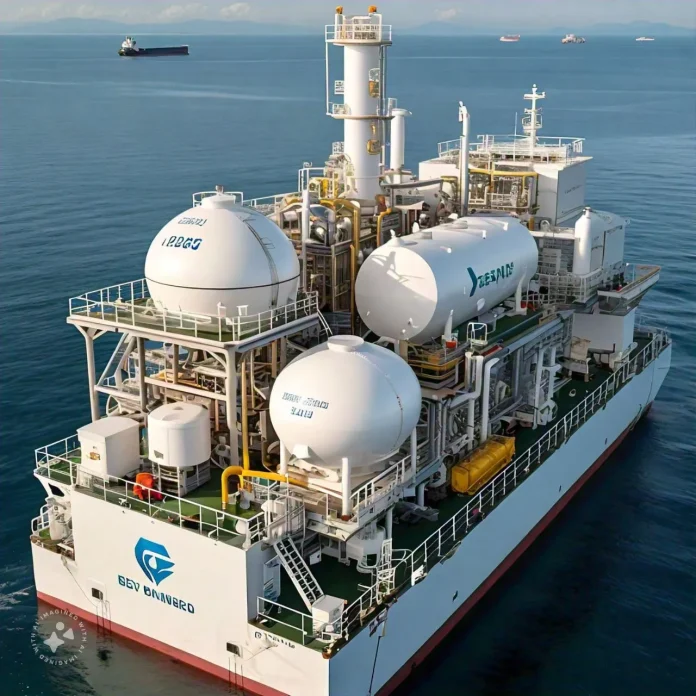
According to Bloomberg’s “Global LNG Market Outlook 2030,” global liquefied natural gas (LNG) supply is expected to surge from 2027 due to new projects and production expansion in the United States and Qatar. The forecast predicts that by 2030, global supply will reach 594 million tons, an increase of 42% compared to 2024, resulting in an oversupply of 15 million tons in the international market.
The global LNG market is expected to enter an oversupply phase from 2027 onwards due to the commissioning of new liquefaction projects. More than 174 million tonnes per year of gas liquefaction capacity is currently under construction. The market is expected to become increasingly oversupplied by the end of the century, although geopolitical risks and potential project delays could change this balance.
While geopolitical risks and potential project delays could shift this balance, the prospect of sustained LNG surpluses raises important questions for Africa. The question is how the continent can strengthen its domestic gas value chain to protect itself from fluctuations in global markets. The impending oversupply highlights strategic challenges for African countries seeking to balance export revenues with domestic energy security.
Natural gas production in Africa is increasing, with several new LNG projects coming online across Africa. North Africa currently produces two-thirds of the continent’s gas, but the African Energy Chamber’s (AEC) Africa Energy Status 2026 Outlook predicts this share will fall to 40% by 2035 as sub-Saharan gas production accelerates.
The chamber noted that sub-Saharan LNG supplies could quadruple current levels by 2050, while African gas demand is expected to increase by 60% from 55 billion cubic meters in 2020 to about 90 billion cubic meters. Despite this increased demand, most of Africa’s gas continues to flow overseas due to limited infrastructure.
The chamber explained that the domestic market remains underserved due to limited pipeline networks, weak transmission systems, and inadequate processing and storage capacity, making LNG exports the most profitable option. While export projects benefit from long-term offtake agreements and easy access to international financing, domestic infrastructure requires patient capital, government guarantees and regulatory support, which are often difficult to secure.
Recent developments suggest positive momentum towards a more integrated African gas economy, with countries building terminals to support domestic and regional access, including projects at Richards Bay in South Africa and the port of Nador in Morocco. Ethiopia has signed a landmark agreement to advance its Gas-by-Rail Economic Corridor initiative, a 73,500-kilometre freight rail system designed to transport LNG to more than 40 sub-Saharan countries.
The network is designed to transport liquefied natural gas to 40 sub-Saharan countries, serving more than 1.2 billion people on its freight rail system. Supporters describe the rail corridor as a virtual pipeline that can avoid the complex geopolitical and engineering challenges that have long hampered traditional pipeline projects.
Several major pipeline projects are underway, including the $25 billion Nigeria-Morocco Gas Pipeline across 13 West African states, the Trans-Saharan Gas Pipeline linking Nigeria and Algeria, and the $1.5 billion Mozambique-Zambia Pipeline announced for 2025. Senegal is developing a multiphase gas network linking offshore production with power plants, industrial areas and urban areas.
Ghana is planning five multipurpose petrochemical plants, each producing 90,000 barrels per day of chemicals, including fertilizers and lubricants, to support industrial and agricultural development. The expansion of domestic processing capacity represents a shift towards recovering more value from gas resources in producing countries.
Gas power generation has emerged as a central pillar of national energy strategies, with the African Energy Chamber predicting that natural gas will provide 45 percent of the continent’s electricity by 2050. Countries including Nigeria, South Africa, Angola, Senegal, Ghana and Mozambique are positioning gas as a bridge fuel to expand electricity access, support industry and reduce dependence on dirty fuels.
NJ Ayuk, Executive Chairman of the African Energy Chamber, stressed that export projects alone cannot secure Africa’s energy future. He said strategic investments in gas infrastructure will determine whether increased production translates into access to electricity, industrial capacity and economic resilience.
Demand growth is expected to be led by Asia, particularly mainland China and India, as countries in the region aim to reduce emissions and expand gas supply networks. By the fourth quarter of 2026, gas prices in Europe and Asia are expected to fall below $10 per million British thermal units.
As global LNG markets become increasingly crowded, Africa’s ability to direct gas to domestic power, industry and regional trade is increasingly seen as key to protecting the energy sector from external shocks. The continent faces a crucial choice between continuing to prioritize exports or strategically investing in infrastructure that can turn increased resources into long-term economic benefits and expanded energy access for millions.
