


President Donald Trump’s Venezuela operation rightly captured the world’s attention and sent a clear message to America’s adversaries: Peace through strength is once again not just a slogan but a governing principle.
But Venezuela needs to be treated as a lesson, not just a powerful and useful message to the world. Africa will be a test of whether we have learned that lesson, and President Trump’s America First global health strategy is an important and positive step to ensure that the problem does not spill over into an emergency again.
President Trump has succeeded in restoring a form of deterrence that too many of his adversaries have begun to treat as a relic. When the White House says it enforces red lines, it now has a record of its actions. It’s not a desire for war, but an argument that bad guys should expect results, not press releases.
But Venezuela is not only a cautionary tale against those who work against U.S. interests, but also a cautionary tale about what happens when the U.S. government accepts a manageable challenge and escalates it into a full-blown crisis.
A common mistake in conservative foreign policy discussions is to treat strength and “soft power” as substitutes. So, choose strength or choose engagement. That’s the wrong choice. The wisdom that the Trump administration is demonstrating through its Global Health Strategy is that strength is most effective when combined with proactive, targeted influence that prevents crises from escalating in the first place.
Consider the broader strategic landscape. The Chinese government does not just export goods to other countries; it also exports leverage through its dependence on infrastructure, digital networks, port access, and supply chains. The Chinese Communist Party has combined industrial overcapacity with a global influence campaign that reaches deep into regions where governance is weakest and capital is scarce.
This strategy was on full display in Venezuela. The same is true in Africa, a trend that is accelerating as China’s manufacturing machinery continues to roar. If the United States withdraws from the scene, we should not be surprised if tomorrow’s Venezuela emerges somewhere else—another fragile state occupied by bad actors, another corridor of illicit finance and trafficking, another destabilizing population boom, another strategic mineral supply chain blocked by China, another port repurposed for military access.
The answer is not a return to global over-policing or endless nation-building. “America First” voters rightly demand that U.S. engagement delivers clear benefits to the American people, advances U.S. security, and leaves no strategic opening for adversaries. That’s exactly the logic behind President Trump’s America First Global Health Strategy. That means developing targeted, results-driven engagement that protects Americans at home, stabilizes our partners abroad, and wins against China without fostering corruption and dependence.
This strategy turns global health into a tool of national power by partnering with U.S. private companies and related agencies to strengthen disease surveillance, medical supply chains, and workforce capacity. Done right, it reduces the chance of fragile states collapsing into centers of crime or hostile forces, and can do so at a fraction of the cost of ex-post military intervention.
Programs and authorities such as the African Growth and Opportunity Act, the United States International Development Finance Corporation, and the Millennium Challenge Corporation exist precisely to transform American power into lasting alliances by bringing in private capital, rewarding reform, and deepening market linkages that create jobs and reduce opportunities to China.
This is a way to avoid a future in which U.S. policymakers face only two options: tolerate the criminal acts of a hostile regime or launch an operation to end the hostile regime.
We can and should start influencing our positioning in advance where our competitors are laying tracks.
Waiting until a problem the United States can address becomes an emergency will increase costs and limit options. The more durable path that President Trump has embarked on is one that combines credible military forces with early, results-driven engagement. The America First Global Health Strategy is an opportunity to leverage trade, investment, and strategic partnerships to shape outcomes before our adversaries do.
Getting this balance right in Africa will determine whether future headlines look like Caracas or don’t need to be written at all.
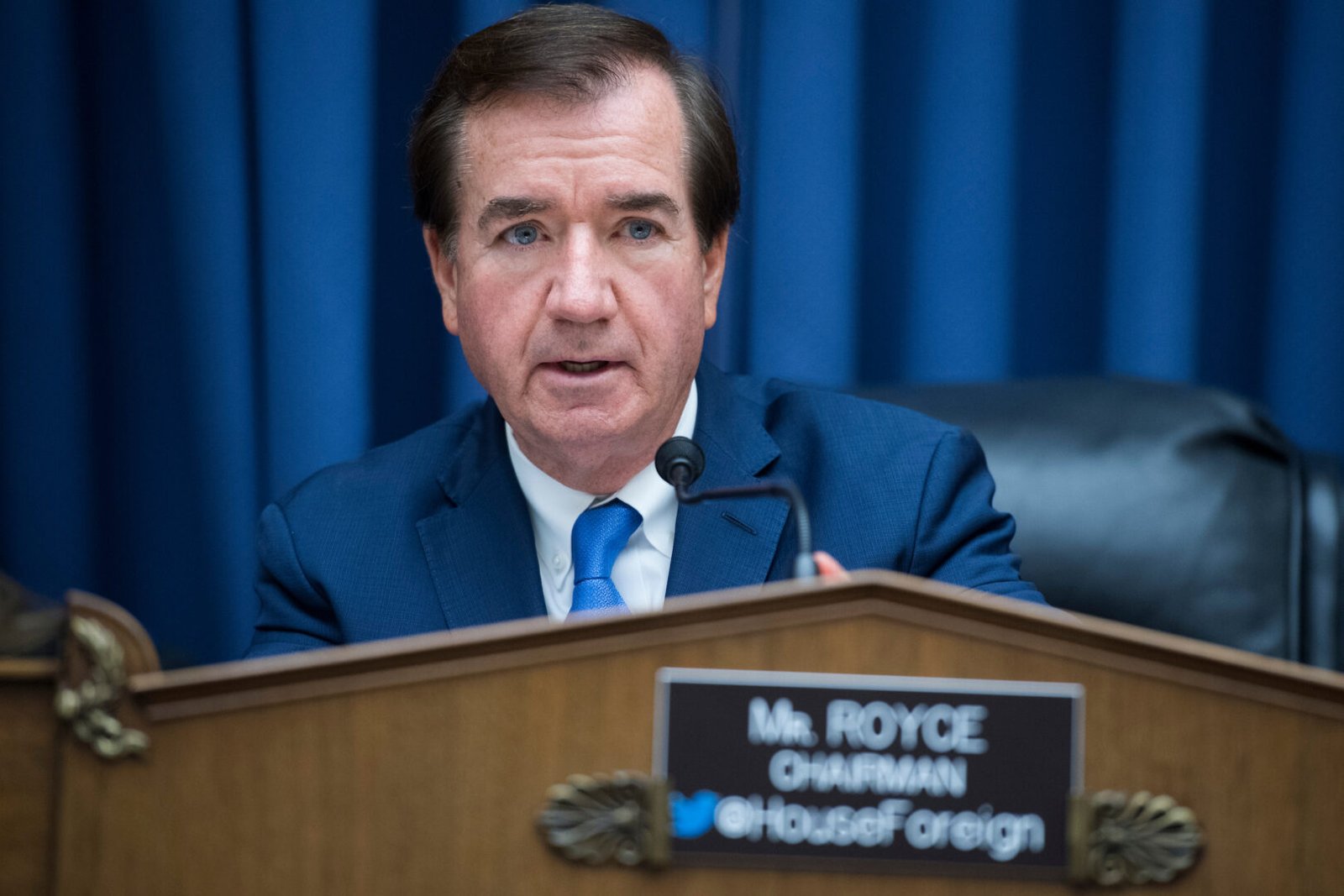
Former Representative Ed Royce, Republican of California, served as chairman of the House Foreign Affairs Committee from 1993 to 2019 and as chairman of the House Foreign Affairs Committee from 2013 to 2019. He currently co-chairs the Development Reform Consensus and serves as policy director at Brownstein, Hyatt, Farber, and Schreck.
Former Utah Republican Rep. Chris Stewart served in Congress from 2013 to 2023 and served on the House Intelligence Committee, the House Defense Appropriations Subcommittee, and the House China Task Force. He currently serves as president of Skyline Capitol, a government relations company in Washington, DC.
