


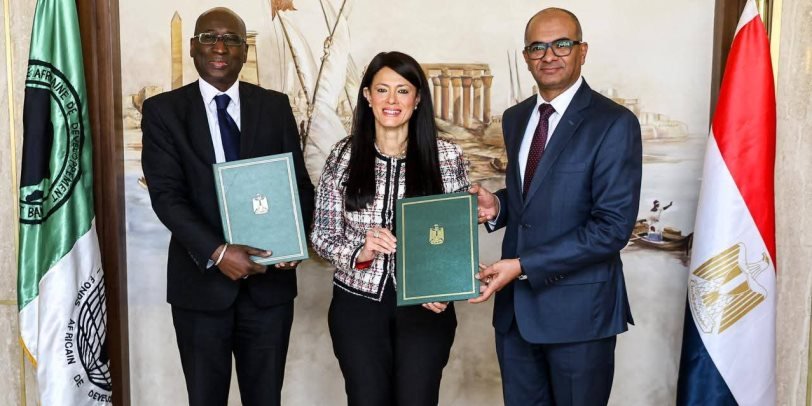
The Egyptian government has signed an agreement with the African Development Bank (AFDB) on the second phase of a private sector development and economic diversification support program worth $170 million, aimed at supporting the national budget and accelerating the implementation of structural reforms.
The two parties also signed a $400,000 grant, equivalent to approximately 19 million Egyptian pounds, to improve the sustainability of the Abu Rawash wastewater treatment plant.
Minister of Planning, Economic Development and International Cooperation Rania Almashat highlighted the depth and long-term nature of the strategic partnership between Egypt and the African Development Bank, noting the bank’s pivotal role in supporting Egypt’s inclusive and sustainable development efforts.
He highlighted the Bank’s contribution to progress across priority areas such as water and sanitation, structural reform and transport.
Mr. Almashat explained that the agreement is part of a broader government effort to work with various development partners, mobilize concessional funds to support the budget, increase fiscal space for spending on human development programs, and advance structural reforms.
He also pointed to the African Development Bank’s strong role in supporting the private sector, noting that private sector lending operations in 2025 will be three times larger than government lending operations, reflecting strong confidence in Egypt’s growing economy.
The minister added that this trend highlights Egypt’s openness and readiness for new partnerships and foreign investments that can drive innovation, sustainable growth and long-term development.
The second phase of the Private Sector Development and Economic Diversification Financing Program builds on the first phase, which was approved by the Egyptian Parliament in December 2024 with a loan amount of $131 million.
In this context, Mr. Almashat emphasized the importance of the subsidy allocated to the Abu Lawash wastewater treatment plant, one of the largest wastewater treatment facilities in the world.
The collaboration with the African Development Bank aims to increase the environmental sustainability and operational efficiency of the factory.
In May, the Egyptian government signed an agreement with the African Development Bank to finance the fourth phase of the Abu Rawash wastewater treatment project.
This phase aims to increase the plant’s capacity from 1.6 million cubic meters per day to 2 million cubic meters per day.
The project is expected to benefit approximately 8.6 million people in Giza Governorate, while maximizing water resource use, improving public health, increasing environmental sustainability, providing suitable water for agriculture, and protecting ecosystems.
It is noteworthy that the Ministry of Planning, Economic Development and International Cooperation previously announced that the amount of concessional financing for three years (2023-2026) budgetary support will amount to approximately $9.5 billion, aimed at strengthening structural economic reforms, supporting macroeconomic stability, improving the business and investment environment, and accelerating the transition to a green economy.
